
Daylight Saving Time Ends This Weekend: Exact Clock Change Rules, Who Gets to Skip It, and Why the Push to End the Switch Is Stalled


Millions of Americans will gain an extra hour of sleep when daylight saving time officially ends at 2 a.m. local time on Sunday, Nov. 1. At that exact moment, clocks across most of the nation turn backward one hour to 1 a.m., delivering brighter morning commutes alongside noticeably earlier evening darkness.
While the biannual ritual promises an extra hour of rest, it also resurrects a familiar household scramble across kitchens, bedrooms, and vehicle dashboards. The seasonal reset marks the end of an eight-month stretch that began when clocks moved forward on Sunday, March 8.
The transition back to standard time affects the vast majority of the country, yet a stalled federal effort to stop the clock-switching routine entirely leaves millions asking why the debate never seems to cross the finish line.
What You Need to Reset Before Sunday Morning
Most modern tech handles the disruption seamlessly without any manual setup.
Smartphones, laptops, smartwatches, and connected home gadgets update automatically overnight, provided their network time settings remain enabled. Traditional analog clocks, microwave displays, ovens, and older vehicle dashboards, however, still require a manual turn of the dial.
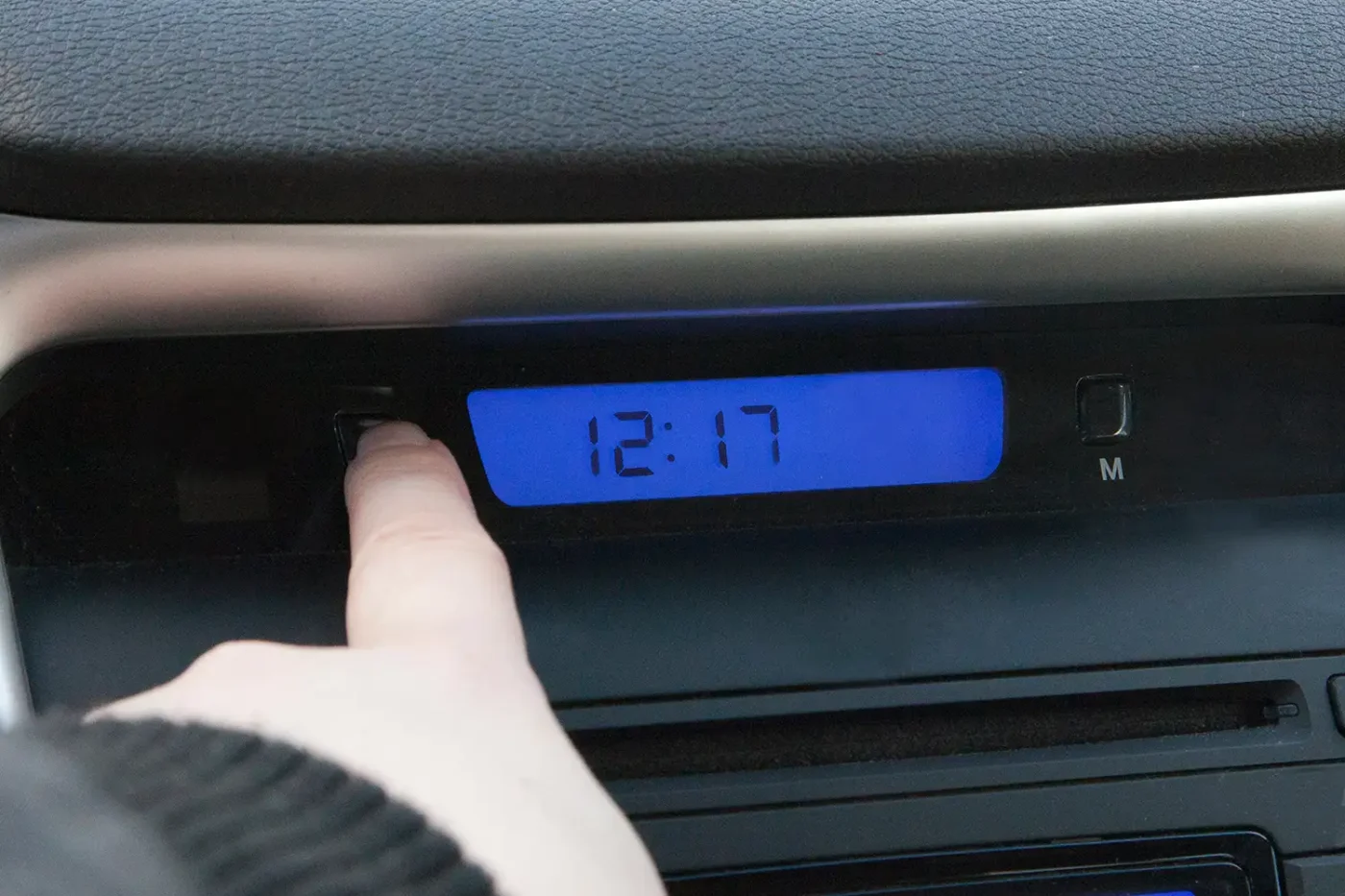
A driver manually adjusts the dashboard clock ahead of the seasonal time switch.
To avoid waking up disoriented on Sunday morning, the simplest workaround is adjusting manual appliances before going to sleep on Saturday, Oct. 31.
When double-checking which way the hands turn, remember the classic rule: spring forward, fall back.
Who Skips the Time Change Entirely?
A widespread misconception is that every single person living on American soil participates in the autumn reset. Under guidelines enforced by the U.S. Department of Transportation, several states and territories opt out completely.
Hawaii and the vast majority of Arizona remain on standard time year-round, completely ignoring the seasonal shift. The major geographic exception within Arizona is the Navajo Nation, which spans the state’s northeastern corner and actively observes daylight saving time to maintain synchronization with its territory across neighboring states.
| Jurisdiction | Time Change Status |
|---|---|
| Most U.S. States | Observes DST (Clocks fall back 1 hour) |
| Hawaii | Exempt (Maintains standard time year-round) |
| Most of Arizona | Exempt (Maintains standard time year-round) |
| Navajo Nation (AZ) | Observes DST (Follows seasonal shift) |
| Puerto Rico & U.S. Virgin Islands | Exempt (No clock changes observed) |
| Guam, American Samoa & CNMI | Exempt (No clock changes observed) |
Residents in overseas U.S. territories do not alter their devices either. Puerto Rico, the U.S. Virgin Islands, Guam, American Samoa, and the Northern Mariana Islands bypass the change entirely, staying on uniform time all twelve months.
Why Does Daylight Saving Time Exist in the First Place?
Daylight saving time was originally introduced to align working hours with natural daylight during extended summer evenings, theoretical savings on residential lighting and fuel consumption driving the early policies.
The federal government first enacted national daylight saving rules in 1918 during World War I to conserve wartime energy reserves. Decades of patchwork local time rules followed until the Uniform Time Act of 1966 established consistent start and end dates nationwide.
The modern schedule in place today stems from the Energy Policy Act of 2005, which took effect in 2007 according to the National Institute of Standards and Technology (NIST). That legislation lengthened daylight saving time by roughly a month, locking the operational window between the second Sunday in March and the first Sunday in November.
Why Federal Action to Lock the Clocks Remains Stalled
Every season, the pending transition renews public frustration, and Capitol Hill has repeatedly weighed steps to end the practice forever.
In July, the U.S. House of Representatives passed the bipartisan Sunshine Protection Act in a decisive 308–117 roll call, aiming to make daylight saving time permanent across the United States. If signed into law, it would permanently end the twice-a-year disruption, eliminating the need to adjust clocks ever again.
The Senate Roadblock
Despite heavy House support, the legislation has ground to a halt after being referred to the Senate Committee on Commerce, Science, and Transportation.
“It’s something we’re having conversations about, but there’s no clear path forward or consensus on it yet,” said Senate Majority Leader John Thune.
Opponents of permanent daylight time point out major lifestyle drawbacks during the winter months. Under permanent daylight saving, specific regions of the northern and western United States would not see the sun rise until nearly 9 a.m. in the depths of winter, creating dark, frosty morning routines for children and commuters.

A bedside table alarm clock ready for an extra hour of rest before standard time resumes.
When Will the Clocks Spring Forward Again?
Because federal legislation remains in limbo, the established biannual schedule stays fully intact for the foreseeable future.
Daylight saving time will return on Sunday, March 14, 2027, when clocks spring forward one hour at 2 a.m. local time, stripping away that extra hour of rest in exchange for long summer twilights.
Until then, make the most of the bonus 60 minutes this weekend as earlier evenings officially arrive.
📱 Don’t forget to set your oven and microwave displays back before going to bed on Saturday night.
✨ That extra hour of morning daylight will be a welcome sight, even if early dusk settles in fast.
💬 Are you ready to see seasonal clock shifts permanently eliminated, or do you prefer the extra winter morning light? Drop your thoughts in the comments below!
 1
 2
 3
 4
