
Miami Cargo Plane Runway Overrun: How Amazon Flight 7598 Left 5 Dead and Sparked a Federal Safety Investigation

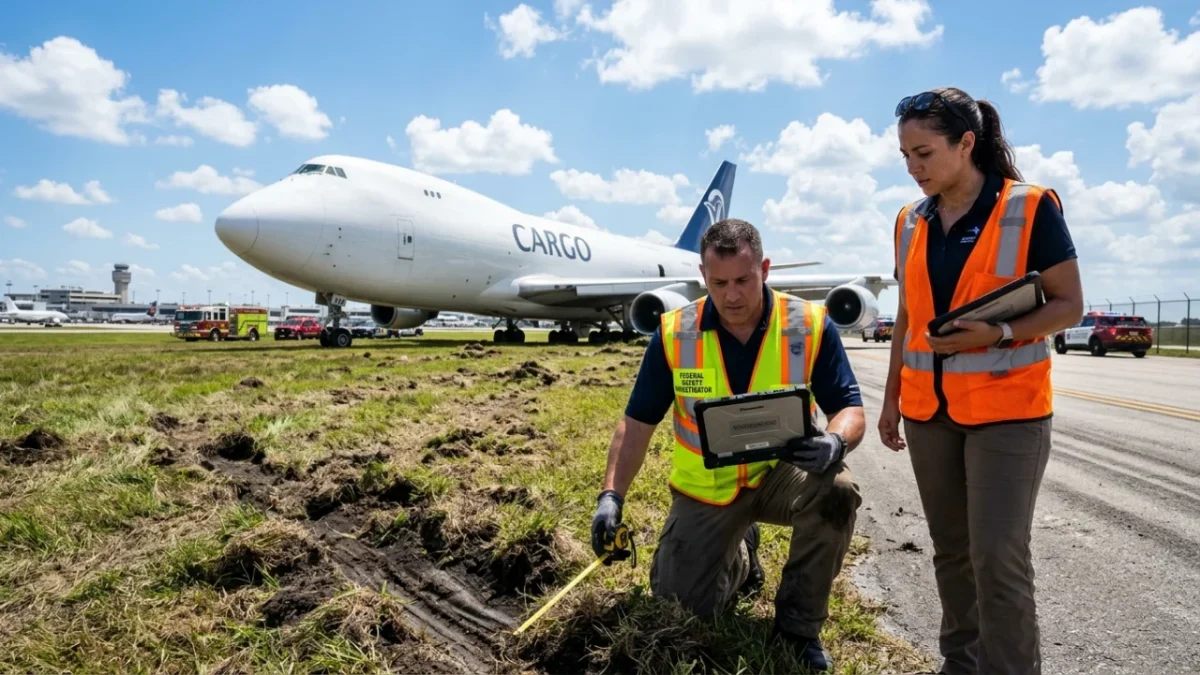
A Boeing 767 cargo aircraft operating as Amazon Air Flight 7598 overran runway 30 at Miami International Airport at roughly 128 mph, traveling 1,300 feet past the paved strip and leaving five airport ground workers dead.
The wide-body jet tore through an airport perimeter fence before slamming into two ground vehicles, including a transport van carrying maintenance workers and an SUV on a nearby roadway. The catastrophic impact instantly ignited a massive multi-agency response and triggered an extensive federal probe.
While the aircraft’s two flight crew members survived with minor injuries and were promptly discharged from medical care, the tragedy inflicted devastating losses on the ground, raising pressing questions about runway overrun margins and ramp safety protocols across major American transport hubs.
The Collision Path: 1,300 Feet Past the Pavement
Operated by 21 Air LLC, the Boeing 767-300 was completing its third scheduled leg of the day, having flown an interstate triangle from Cincinnati to Miami, onward to San Juan, Puerto Rico, and back to South Florida. Landing just before 2:00 p.m., the wide-body transport failed to decelerate within the available paved surface of runway 30.
Tire friction marks tracked straight off the tarmac, tearing deep gouges through airfield sod before the airframe breached the boundary security perimeter. The primary impact decimated a 2012 white Ford Econoline passenger van owned by Professional Ocean Service Corp., a contracted aircraft cabin cleaning company.
All seven occupants of the commercial cleaning van suffered critical trauma. Five workers inside that van lost their lives at the scene: Rolando Aleman Leon, Yoel Rodriguez Narajo, Julio C. Pineda, Carlos Acosta Fajardo, and Javierkys Reyes Quevedo. Two surviving passengers sustained critical injuries, while the jet also struck an exterior Toyota Corolla Cross LE SUV, leaving additional victims injured outside airport grounds.
“I would describe it in one word of devastating, utter devastation. I mean, you can see, on the paved surface, tire marks that continue through the grass. There’s debris everywhere. The Econoline van is torn apart.”
The sheer physical displacement of aviation fuel across the crash zone created an immediate environmental hazard, requiring hazardous materials crews to drain remaining reserves directly from the punctured airframe while skimming soil along the impact trench.
Key Metrics Behind Amazon Flight 7598
Data recorded at the scene underscores the extreme force of the overrun and the narrow margins separating runway operations from public perimeter zones.
| Investigation Parameter | Documented Details |
|---|---|
| Aircraft Type | Boeing 767-33 Alpha operated by 21 Air LLC |
| Flight Origin & Destination | Luis Muñoz Marín Airport (SJU) to Miami International (MIA) |
| Overrun Distance | Approximately 1,300 feet beyond paved runway |
| Exiting Speed | Approximately 128 mph (preliminary tracking) |
| Total Casualties | 5 fatalities, 5 individuals injured |
| Flight Recorders | Both CVR and FDR recovered for lab analysis |
What Federal Safety Investigators Are Examining
The National Transportation Safety Board deployed a specialized 32-member go-team to catalog volatile physical evidence before weather conditions and recovery operations altered the site. The agency secured both the Cockpit Voice Recorder (CVR) and the Flight Data Recorder (FDR) within hours of the crash.
Critical Inquiry Vectors
Federal officials confirmed that field investigators will isolate several technical and operational variables rather than issuing premature conclusions at the scene:
- Crew Duty and Fatigue: Auditing flight logs across the crew’s three-leg schedule between Ohio, Florida, and Puerto Rico.
- Mechanical Systems: Checking brake pressure, thrust reverser deployment, spoiler actuation, and hydraulic integrity on the Boeing 767.
- Ground and Approach Control: Reviewing radio transmissions between the cockpit and Miami air traffic controllers.
- Environmental Factors: Analyzing surface winds, runway surface friction levels, and ambient runway temperature during rollout.
“We can only work to prevent the next accident or tragedy if our recommendations at the end of an investigation are implemented. If we are in the business of repeatedly investigating an accident or tragedy, and our recommendations are not implemented, then we’re here again and again and again.”
Myth vs. Reality: Ground Vulnerability in Modern Aviation
Public perceptions often treat runway overruns as low-energy fender benders that rarely threaten life, assuming modern aircraft arrestor beds and buffer zones eliminate ground hazards entirely.
The physical reality documented at Miami International Airport reveals a stark contrast. While modern commercial air travel maintains remarkable structural survival rates for seated passengers during rollouts, support personnel stationed inside perimeter service roads remain exposed to catastrophic kinetic hazards.
A fully laden Boeing 767 exiting a runway at over 100 mph carries immense kinetic force. When buffer corridors fail to scrub that velocity before perimeter fences, service vehicles and perimeter roads become sudden impact zones.
The tragedy surrounding this Miami plane crash demonstrates that airport perimeter architecture and vehicle service roadways face renewed federal scrutiny as the NTSB works toward formal recommendations.
💬 How should major international airports rethink perimeter service roads and vehicle safety zones near active runways?
📱 Drop your thoughts in the comments below and share this breakdown with aviation safety observers.
👇 We want to hear your perspective on airfield infrastructure reforms.
 1
 2
 3
 4
