
Why SOS Never Stood for ‘Save Our Souls’: The Secret Morse Code Shortcuts That Pioneered Modern Texting

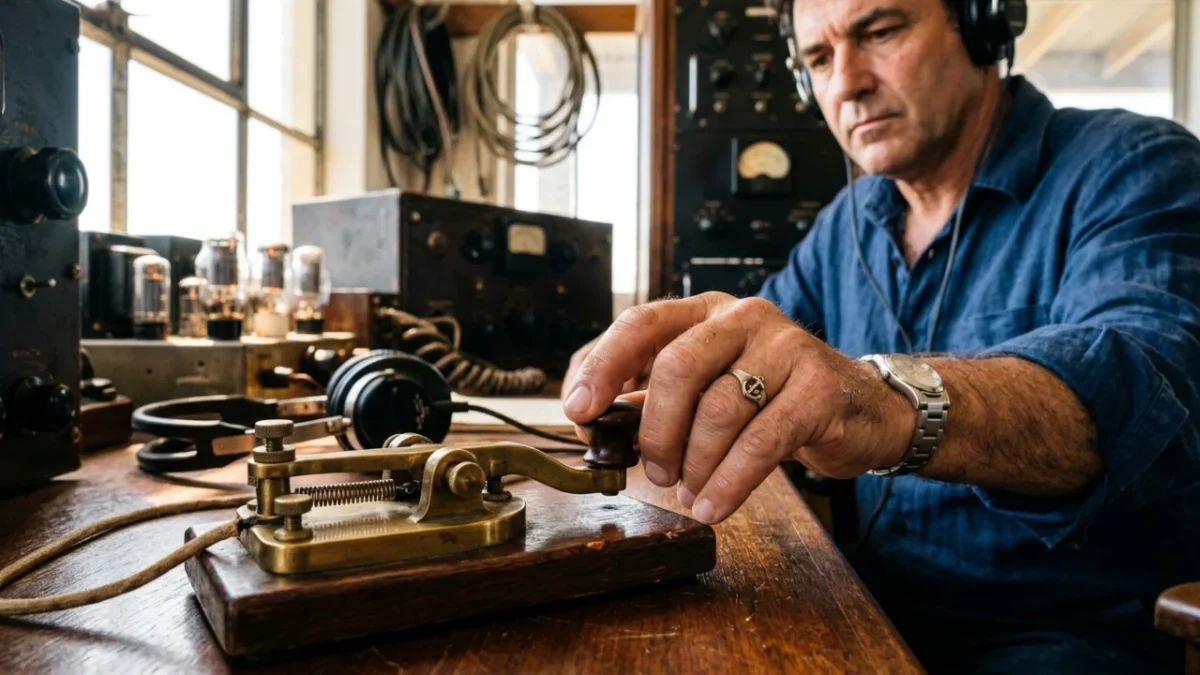
Long before modern smartphone users shortened phrases into rapid-fire acronyms like “BRB” or “IDK,” telegraph operators relied on vital Morse code abbreviations to transmit critical messages under extreme bandwidth limits. The most famous emergency call in history, SOS, never actually stood for “Save Our Souls,” “Save Our Ship,” or “Sink or Swim.” It was chosen purely because its symmetrical pattern of three dots, three dashes, and three dots created an unmistakable, impossible-to-miss rhythm across wireless airwaves.
In the high-pressure world of early maritime communication, every fraction of a second mattered. Sending full words character by character across weak radio signals wasted precious time, drained equipment batteries, and increased the risk of catastrophic static interference.
To cut transmission down to the bone, operators established standardized procedural shorthand that laid the groundwork for today’s digital communication culture.
The Great Misconception: Why SOS Isn’t an Acronym
Popular culture spent decades insisting that maritime disaster signals hid desperate phrases beneath their letters. Yet historical reality tells a completely practical engineering story.
The International Radio Telegraphic Convention officially selected the signal in 1906 strictly for its acoustic simplicity. In dot-and-dash notation, the sequence translates to three short taps, three long presses, and three short taps (··· — — — ···).
The sequence formed a distinct, unbroken rhythm that cut through static without requiring the listener to decode complex phrasing. It was so visually and audibly memorable that any radio operator could identify it instantly through the roar of ocean storms.
Unlike modern texting initialisms, early distress prosigns were selected entirely for operational clarity and acoustic rhythm rather than linguistic meaning.
Furthermore, technical standards define the distress call as a “prosign” or procedural sign. Rather than pausing between individual letters as standard Morse transmission requires, operators keyed the entire sequence together as a single continuous character.
Before the Standard: The Fragmented Era of Distress Calls
Standardizing international emergency signals took catastrophic trial and error. Before global conventions unified maritime radio, competing nations and telegraph monopolies deployed their own proprietary codes.
- British Marconi Operators: Relied heavily on CQD, combining “CQ” (the traditional signal for “seeking you” or “all stations”) with “D” for distress.
- German Maritime Stations: Initially used SOE as their standard distress call before transitioning toward international formats.
- American Vessels: Regularly utilized NC, derived from traditional maritime visual flag signaling codes.
This fragmentation created dangerous confusion when ships of different nationalities crossed paths. The most famous example occurred in April 1912 when the Titanic struck an iceberg in the North Atlantic.
The ship’s wireless operators began transmitting CQD to alert nearby British vessels. Partway through the frantic operation, the crew switched to the newer international standard, tapping out SOS to ensure any listening station across the freezing waters would register the crisis.
How Early Wireless Protocols Compared
Each early telegraph standard attempted to balance speed, radio frequency interference, and operator fatigue in distinct ways.
| Distress Code / Prosign | Historical Origin & Meaning |
|---|---|
| SOS | Adopted at the 1906 International Radio Telegraphic Convention; pure rhythm, no linguistic meaning |
| CQD | British Marconi standard; combined “CQ” (all stations) with “D” (distress) |
| SOE | Early German maritime radio distress indicator |
| NC | Traditional American maritime distress call originating from signal flags |
The Mechanics of Sending Code Under Pressure
Mastering early electronic shorthand required strict physical discipline and precise timing. A single misplaced interval could invert the meaning of an entire sentence or render an urgent report completely illegible.
- Master the Basic Units: A single short tap registers as a dot, while a deliberate long press forms a dash.
- Maintain Interval Gaps: Standard transmission requires short pauses between individual letters and longer intervals between distinct words.
- Eliminate Prosign Pauses: Emergency prosigns require omitting inter-letter pauses to broadcast the message as one unified acoustic unit.
- Verify Before Responding: Early operators monitored incoming rhythms continuously to separate real distress signals from background atmospheric noise.
How the Digital Era Closed the Telegraph Chapter
While dot-and-dash shorthand dominated naval communication and transcontinental dispatching for nearly a century, technology eventually outpaced manual telegraph keys. A landmark 1999 United Nations agreement formally retired Morse code as the official international distress communication method for maritime vessels.
Global fleets shifted permanently to the satellite-driven Global Maritime Distress and Safety System. This automated framework delivers instant positioning, real-time telemetry, and automated rescue alerts without relying on a human ear deciphering audio pulses.
Yet the legacy of early operator shorthand never vanished. The instinct to strip unnecessary characters from language to achieve maximum transmission speed remains alive in every text, instant message, and digital notification sent today.
📱 Early telegraphers essentially prototyped the rapid-fire texting language we use every single day.
✨ Understanding the real origins of signals like SOS proves how practical engineering often beats popular folklore.
💬 Did you grow up believing that SOS stood for “Save Our Souls”? Drop your thoughts in the comments below!
 1
 2
 3
 4
