
Prospector 5 Rig Sinks Offshore Gabon After Catastrophic Seabed Failure: 110 Rescued and Emergency Search Underway for Missing Crew

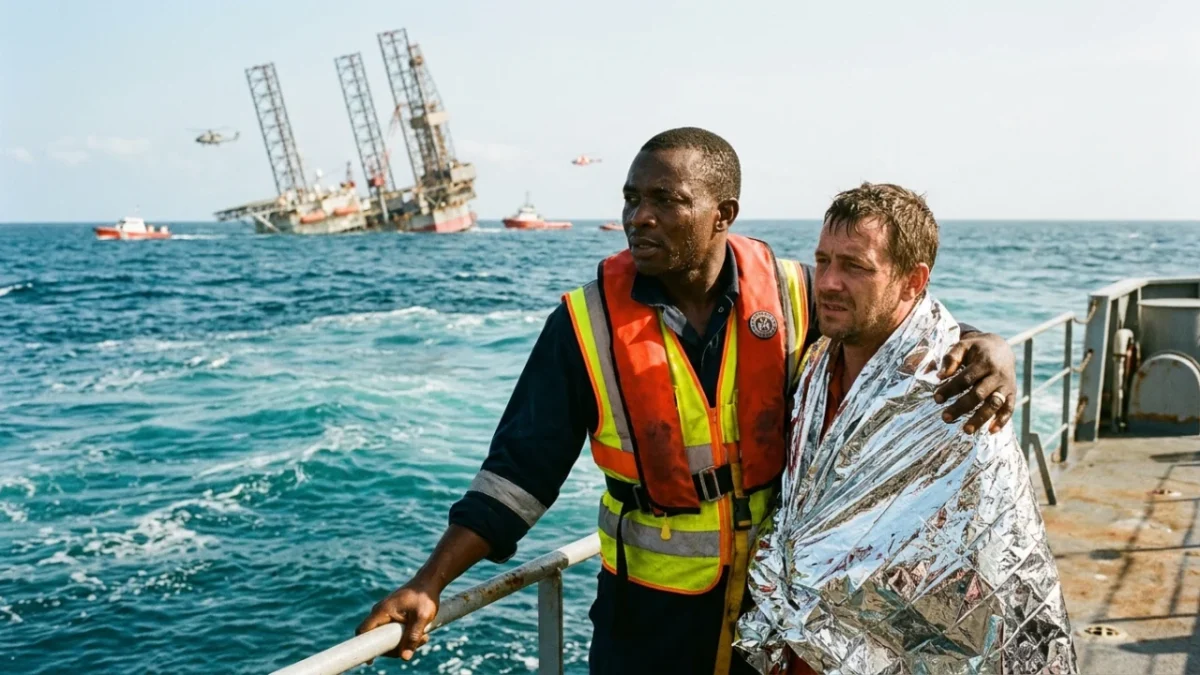
A catastrophic seabed “punch-through” during delicate jacking operations has caused the Prospector 5 offshore drilling rig to capsize and sink off the coast of Gabon, triggering an urgent multi-agency maritime rescue operation. While 110 crew members from the 115 on board were successfully evacuated and brought safely ashore, emergency teams continue an intensive air and sea search for the remaining missing workers.
The sudden disaster struck at approximately 20:37 local time near Mayumba, before planned drilling activities at the offshore Dussafu Marin permit had even begun. Within moments, the towering jack-up platform suffered an irrecoverable loss of balance during structural preloading, plunging into the Atlantic waters.
The scale of the Prospector 5 sinking has sent shockwaves through the international energy sector, prompting immediate comparisons to historical seabed foundation failures monitored by marine safety regulators worldwide.
Catastrophe at Mayumba: How the Jack-Up Platform Overturned
The rig, owned by international contractor Borr Drilling, was positioning itself to execute a planned drilling campaign for customer BW Energy, which holds a 73.5 per cent working interest in the Dussafu Marin licence. Panoro Energy, an operating partner holding a 17.5 per cent stake, confirmed that all local production in the permit area has been suspended immediately as a precautionary measure.
According to preliminary operational findings, the accident occurred while the crew was conducting essential preload activities. During this manoeuvre, water ballast is pumped into the hull to drive the spudcans—the heavy steel footings at the base of the rig’s legs—firmly into the ocean floor to guarantee stability against ocean currents.
Disaster struck when the seabed beneath one of the massive legs unexpectedly gave way. Known in offshore engineering as a “punch-through”, this sudden structural collapse happens when a firm upper layer of marine sediment breaks into a softer subterranean pocket, causing the rig to tilt precipitously under enormous structural torque.
The resulting instability proved impossible to arrest, forcing the entire offshore installation to capsize and sink beneath the surface.
Mass Evacuation and the Critical Search Operation
Borr Drilling immediately activated its onshore emergency response protocols, collaborating with the Gabonese navy, local port authorities, and BW Energy to pull survivors from the sea. Of the 115 workers on board at the time of the collapse, 110 were accounted for and ferried to shore facilities in Gabon to receive medical examinations and trauma support.
Local authorities reported that one worker, an Indian national, was subsequently confirmed dead, while four workers—comprising three Gabonese nationals and an expatriate specialist—remained unaccounted for as aerial and naval sweeps expanded across the sector.
“We are deeply concerned for those who remain unaccounted for and everyone affected by this incident,” said Borr Drilling Chief Executive Officer Bruno Morand. “Our immediate priority is supporting the ongoing search and rescue efforts and the welfare of all personnel involved.”
Crisis Mobilisation and Environmental Safeguards
Gabon’s Ministry of Petroleum and Gas responded by establishing an inter-agency crisis task force comprising senior representatives from the ministry, the national navy, state-backed Gabon Oil, BW Energy, and Borr Drilling. Petroleum and Gas Minister Clotaire Kondja formally launched a technical inquiry while instructing naval commanders to deploy maximum search capacity.
Because the disaster occurred close to sensitive ecological zones, maritime environmental protection units have been dispatched to contain any potential fuel spills:
- Coastline Protection: Specialised barrier craft and skimming equipment have deployed to safeguard the nearby Mayumba National Park, internationally recognised for its fragile marine wildlife habitats.
- Pollution Monitoring: Continuous aerial surveillance has reported no immediate release of harmful hydrocarbons or drilling chemicals into open waters.
- Production Standstill: Commercial extraction across adjacent licence infrastructure remains shut in until seabed stability and perimeter risks can be thoroughly evaluated.
- Technical Reconstruction: Marine accident investigators are reviewing seabed core samples and jacking logs to ascertain why geotechnical surveys failed to flag the subsea void.
The Perils of Offshore Preloading Operations
While deepwater drilling has increasingly moved towards semi-submersible rigs and dynamically positioned drillships, jack-up platforms remain the workhorses of shallow-shelf exploration due to their rigid operational efficiency. However, the jacking and preloading phase represents the most vulnerable window in a platform’s deployment cycle.
Marine engineering guidelines—such as those upheld across the UK Continental Shelf by the Health and Safety Executive (HSE) and maritime classification bodies—require extensive geophysical profiling before any heavy footing is weighted down. If underlying strata contain hidden layers of gas, loose silt, or uneven limestone, the enormous downward force applied during ballasting can trigger structural shearing in fractions of a second.
Once a single leg sinks deeper than the others beyond hydraulic levelling thresholds, gravity exerts extreme lateral leverage against the entire framework, making an inversion nearly unavoidable for personnel stationed above deck.
The technical investigation led by Gabonese authorities will closely scrutinise the site surveys carried out prior to the arrival of the Prospector 5, assessing whether changing seabed contours or localised sediment fatigue contributed to the sudden platform loss.
As recovery assets scan the waters off Mayumba, the maritime energy industry awaits urgent clarity on structural safeguards to prevent similar seabed collapses across operational basins.
💡 What safety improvements should global offshore operators prioritise during high-risk seabed positioning? Have you worked on offshore platforms or followed industrial safety standards? Share your perspective in the comments below.
👇 Join the discussion below and tell us your thoughts on the evolving protocols surrounding jack-up rig security.
 1
 2
 3
 4