
Scientists Revisit a Pacific Deep-Sea Mining Site After 44 Years—and Find Industrial Scars Frozen in Time 3 Miles Beneath the Surface


An experimental deep-sea mining trial conducted in 1979 has left unmistakable physical tracks on the Pacific Ocean floor that remain sharply defined more than four decades later. When marine scientists returned to survey the site, they discovered that while some microscopic organisms managed to repopulate the area, larger species reliant on mineral deposits have largely failed to recover.
The findings, published in the journal Nature and detailed by researchers at the Natural History Museum, provide a rare, real-world benchmark for understanding how slowly deep-ocean environments heal from heavy industrial operations.
Targeting the mineral-rich Clarion-Clipperton Zone—a vast expanse stretching across the Pacific between Mexico and Hawaii—the study reassessed an area where heavy machinery scooped up polymetallic nodules 44 years earlier. These potato-sized seafloor rocks contain concentrated reserves of nickel, cobalt, and copper, making them prime targets for modern commercial ventures.
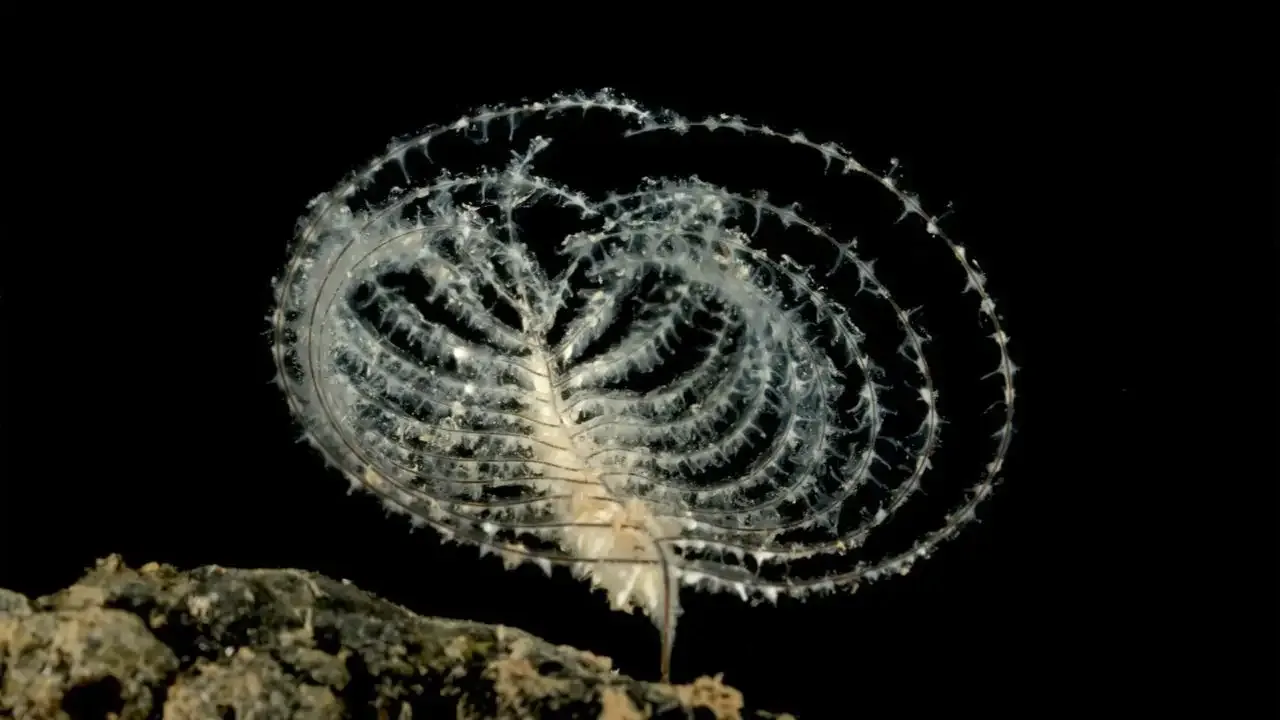
Pacific seabed area examined for long-term ecological disturbance from experimental mining.
A 100-Ton Machine Footprint Frozen in Time
During a research cruise aboard the Royal Research Ship James Cook, an international team led by Professor Daniel Jones of the National Oceanography Centre and Dr. Adrian Glover from the Natural History Museum deployed the robotic submersible Isis to investigate the 1979 test site.
It took the team just seven to eight hours during their initial dive to locate the historical operation zone. What they found on the ocean floor, roughly 5,000 meters down, looked shockingly fresh.
An 8-meter-wide path cleared of nodules remained completely distinct, flanked by two sharp, deep furrows carved by the 100-tonne vehicle. In the near-freezing, low-energy waters of the abyssal plain, natural sedimentation is so slow that four decades of ocean currents barely softened the industrial tracks.
“The results help researchers understand how different parts of an ecosystem respond at different rates,” noted Natural History Museum scientist Dr. Adrian Glover.
The Biological Divide: Who Returned and Who Vanished
The biological response to the machinery tracks revealed an unexpected contrast across different marine groups. Life on the deep seabed did not vanish entirely, but the recovery has been sharply fragmented.
Small, mobile animals living directly on or inside the soft mud recolonized the tracks, reaching densities comparable to nearby untouched zones. Researchers also documented the return of xenophyophores, large single-celled amoeba-like organisms native to the Clarion-Clipperton Zone.
The furrows actually acted as collection troughs for drifting organic debris, creating artificial feeding hotspots for detritus feeders.
Yet for sessile creatures—organisms that physically attach to hard substrates—the outcome was far grimmer. Sponges, corals, and associated fauna require hard nodule surfaces to anchor themselves. Because those rocks were stripped away in 1979 and take millions of years to reform, those complex habitat structures remain virtually empty.
| Seabed Feature or Group | 44-Year Ecosystem Observation |
|---|---|
| Machinery Furrows | Distinctly visible; collected organic matter and sustained sediment-dwelling fauna |
| Polymetallic Nodules | Permanently absent from cleared tracks; recovery not observed |
| Mobile Invertebrates | Recolonized disturbed zones to levels comparable to pristine seabed |
| Corals and Sponges | Severely depleted due to the total loss of hard attachment surfaces |
| Sediment Plumes | Showed limited long-term physical or biological impact at the test site |
The Surprising Reality of Sediment Plumes
Environmental debates surrounding deep-sea mining often treat heavy sediment clouds as an all-encompassing ecological hazard. Underwater excavation kicks up vast underwater plumes that critics warn could blanket surrounding marine life for miles.
However, the researchers made an important discovery: the historical plumes produced during the 1979 test caused limited measurable long-term physical damage to surrounding areas. Furthermore, the survey detected no lasting negative effect on animal populations outside the primary tracks that could be tied directly to settling silt.
While scientists stress that this does not clear industrial plumes as harmless under every ocean condition, it confirms that the permanent loss of rock habitat—not the drifting sediment—presents the most severe multi-decade barrier to recovery.
💬 As global demand for clean-energy battery metals surges, the debate over opening international seabed claims to commercial extraction is accelerating rapidly.
✨ These four-decade-old tracks prove that deep-water disruption leaves physical evidence across human lifespans, turning regional marine zoning into a critical environmental battleground.
👇 Should nations allow commercial deep-sea mining, or are these multi-decade scars too high a price? Drop your thoughts in the comments below.
 1
 2
 3
 4
