
Scientists Scan a 1920s Fossil and Uncover an Unknown 45-Million-Year-Old Crocodile Species Tied to the Great Sphinx of Giza

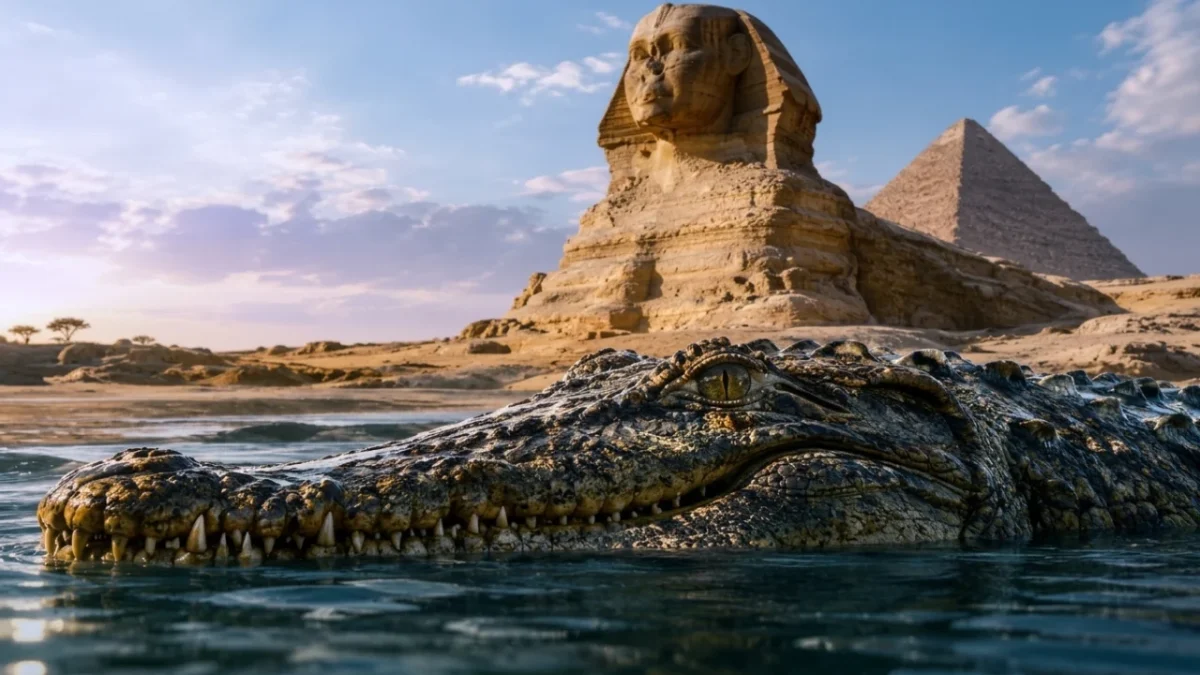
A fossil skull sitting in museum storage for nearly a century actually belongs to a completely unknown new crocodile species that swam the waters of ancient Egypt roughly 45 million years ago. Researchers conducting high-resolution CT scans on the specimen uncovered distinct internal cranial features, proving the prehistoric reptile was not what paleontologists had claimed since the 1920s.
Named Herugavialis cairensis, the creature is a long-extinct gavial—a unique lineage of crocodilians recognized by their elongated, slender snouts.
The findings, published in the journal Royal Society Open Science, unravel a century-old case of mistaken scientific identity while revealing an uncanny connection between the ancient predator and the iconic limestone monuments of Ancient Egypt.
How a Century-Old Fossil Revealed a Prehistoric Secret
The fossilized skull was originally excavated during the 1920s from Egypt’s famous Mokattam Formation. For decades, it was labeled as Tomistoma schlegelii, a known crocodilian relative.
That classification held up until modern technology intervened.
A research team led by scientists including co-author Philip Mannion from University College London (UCL) decided to run the ancient specimen through a computerized tomography (CT) scan. Peering inside the calcified bone, they spotted multiple anatomical structures that sharply contradicted the original tag.
“Given this coincidence, we decided to name the new crocodile after the Egyptian god Heru, who may have been the inspiration for this monument,” Mannion said.
The internal bone architecture verified that the specimen represented an entirely distinct genus and species within the gavial group.
The Gavial Family Tree and Modern Survivors
Gavials are ancient aquatic specialists engineered for capturing fish with their narrow jaws. While ancient oceans and riverways once teemed with diverse gavial relatives, their lineage has dramatically dwindled over geological time.
- Fossil lineage: Herugavialis cairensis thrived in the Mediterranean basin around 45 million years ago.
- Survival status: Extinct for millions of years.
- Living relatives: Only two species of gavials exist on Earth today, and both face severe extinction threats.
The CT data finally secures this ancient reptile’s true spot on the crocodilian evolutionary tree.
| Feature | Scientific Details |
|---|---|
| Species Name | Herugavialis cairensis |
| Geological Age | Roughly 45 million years old |
| Discovery Site | Mokattam Formation, Egypt |
| Initial Misclassification | Tomistoma schlegelii |
| Key Identification Method | High-resolution CT scanning |
The Strange Link to the Great Sphinx of Giza
The connection between Herugavialis cairensis and Egyptian antiquity goes far beyond geography. The fossil itself emerged from the very same geological layer of rock that ancient builders quarried to carve the Great Sphinx of Giza.
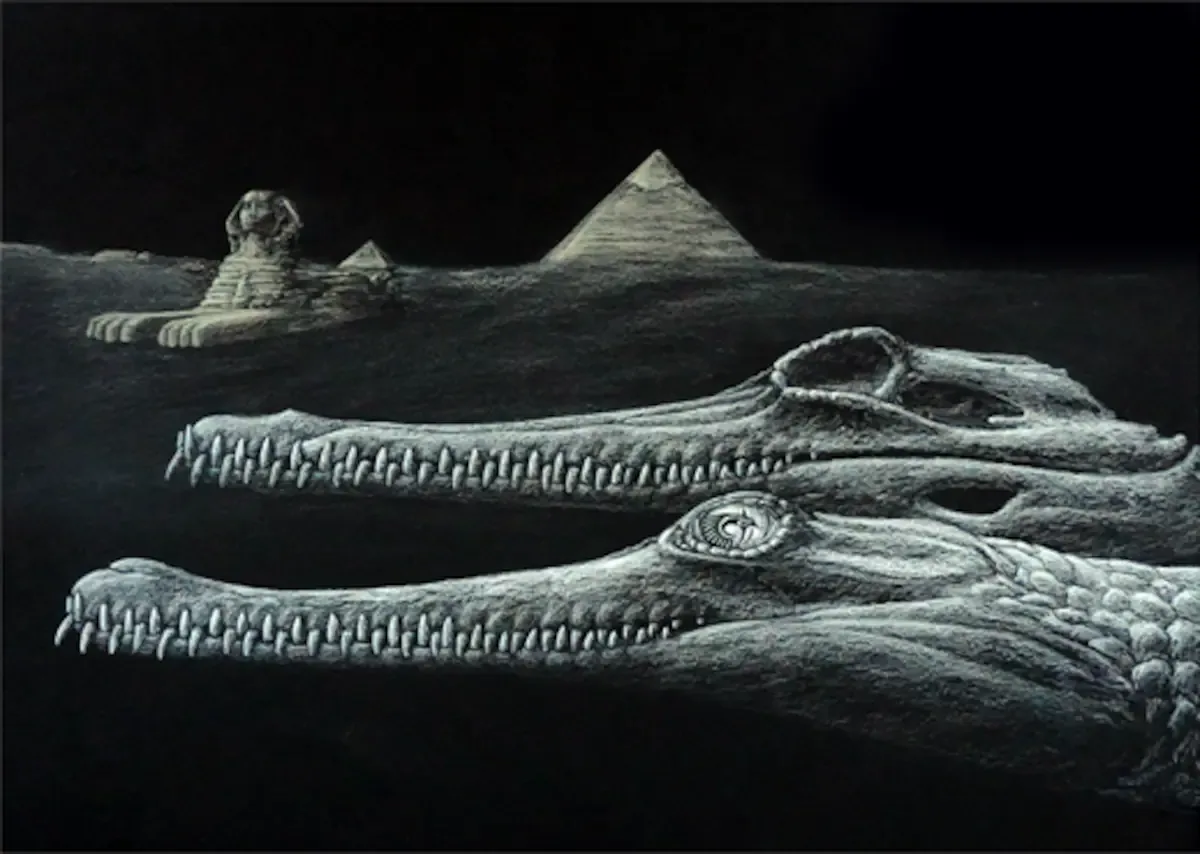
This crocodile’s link to the mysteries of Ancient Egypt.
Yet, the physical parallel is what sealed its name. When paleontologists examined the fossil skull, they noted that the very tip of its snout had broken away in deep antiquity—mirroring the famous missing nose on the face of the Great Sphinx.
Because the monument may have drawn artistic inspiration from the ancient Egyptian deity Heru, researchers chose the name Herugavialis to immortalize both the geological bedrock and the mythology of the region.
The study proves that museum archives across the globe still harbor massive prehistoric discoveries waiting for the right imaging tools to unlock them.
💬 Modern imaging techniques continue to rewrite what we thought we knew about life millions of years ago.
✨ From deep limestone strata to ancient Egyptian lore, this 45-million-year-old predator finally has its real story told.
📱 Drop your thoughts in the comments below: Did you expect museum fossils from the 1920s to hide entirely new species?
 1
 2
 3
 4
