
Why Tech Giants Are Chasing Power Beyond U.S. Borders as AI Energy Grid Bottlenecks Collide With Surging Equipment Backlogs

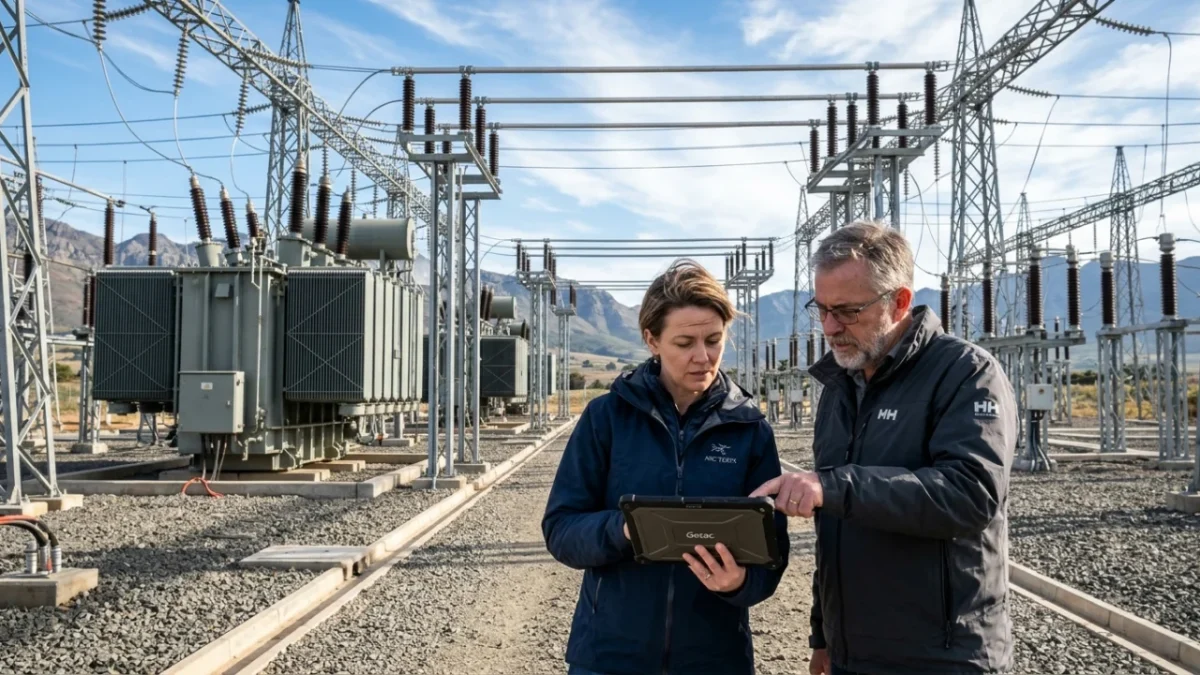
Surging data center power demand is running headfirst into hard electrical limits across the United States. As local communities resist new substation connections and domestic utilities struggle with capacity constraints, hyperscale operators are confronting a stark reality: computing power cannot expand faster than the physical grid can deliver electricity.
The race to secure high-density megawatts has ignited a dual scramble. On one side, equipment manufacturers face multibillion-dollar backlogs for specialized cooling, uninterruptible power supplies, and distribution bus ducts. On the other, tech giants are actively scouting international power markets to escape domestic bottlenecks.
This structural grid squeeze is redefining where compute clusters get built and how much capital hardware suppliers can capture.
The Real Bottleneck: Why AI Compute Racks Are Overheating the Grid
High-performance computing clusters run hotter and draw vastly more electricity per square foot than legacy enterprise server farms. That concentration of load requires direct access to high-voltage transmission lines, triggering severe friction with public utilities and municipal planners.
Across multiple American regions, local resistance to utility buildouts has surged. Communities are increasingly rebuffing facility proposals over land use, aesthetic disruptions, and concerns about rising utility rates for residential ratepayers. Simultaneously, domestic lawmakers have debated new tax policies targeting the massive electricity use and output of major server campuses.
When physical grid access stalls, construction timelines stretch from months into years. The resulting supply-demand mismatch has turned basic electrical delivery into the single most decisive factor in artificial intelligence deployment.
Equipment Suppliers Ride Multibillion-Dollar Backlogs
While tech giants navigate grid queues, the companies engineering the electrical guts of these facilities are experiencing historic demand. The hardware required to step down transmission voltages, prevent power drops, and extract heat from dense silicon has created massive order books.
Electrical connection and protection specialist nVent Electric, valued at roughly $20.4 billion, holds a project backlog of approximately $2.5 billion. The firm projects total data center sales to surpass the $2 billion mark in 2026 as utilities and private developers race to convert engineering plans into energized sites.
Overseas, critical power providers such as Shenzhen KSTAR Science and Technology—valued at around CN¥14.9 billion—are seeing similar momentum. Their push into uninterruptible power systems (UPS), modular server rooms, and combined photovoltaic-plus-storage solutions underscores the global urgency to keep compute loads online without crashing municipal grids.
Cooling Hardware and High-Density Protection Under Pressure
Power delivery is only half the equation; thermal management is the other. Denser chips require liquid-to-air heat exchangers and complex manifold plumbing to avoid thermal throttling under maximum training loads.
Thermal management provider Modine Manufacturing has pivoted aggressively toward these high-density requirements. The company’s Performance Technologies segment already accounts for about $1.1 billion of its $2.3 billion adjusted revenue base. After logging $1.1 billion in data center revenue in fiscal 2026, management is guiding for 60% to 80% sales growth in fiscal 2027, with an ultimate target of $2 billion in dedicated data center revenue by fiscal 2028.
These massive growth trajectories highlight how heavily compute operators rely on third-party engineering to keep high-voltage facilities from overheating.
| Infrastructure Segment | Market Impact & Backlog Profile |
|---|---|
| Thermal & Liquid Cooling Systems | High-density rack designs driving 60% to 80% annual supplier segment growth targets. |
| Electrical Protection & Connection | Suppliers conversion pipelines supported by multi-billion-dollar backlogs exceeding $2.5 billion. |
| Uninterruptible Power Systems (UPS) | Rising deployment of battery storage and modular systems to insulate grids from load spikes. |
| Cross-Border Renewable Interconnects | Hyperscalers securing international hydro, solar, and wind surplus to bypass domestic queues. |
The Global Release Valve: Seeking Megawatts Abroad
Domestic delays have forced developers to look across borders where surplus power is cheap, green, and immediately available. Brazil has emerged as an unexpected epicenter for this structural overflow.
The Latin American nation operates on an electrical grid powered by nearly 87% renewable energy, driven largely by rapid expansions in wind, hydro, and solar capacity. Crucially for data operators, power costs there sit at less than half the going rate seen across the United States.
U.S. backlash isn’t pushing hyperscalers out of the country so much as pushing them toward wherever power shows up first.
Capital commitments highlight this shift. Amazon Web Services invested over $3.8 billion in Brazilian infrastructure between 2011 and late 2026, pledging an additional $1.8 billion through 2034. Microsoft has committed $2.7 billion over a three-year span, while Google plans to double its cloud infrastructure footprint in the country by 2030.
To accelerate development, Brazilian President Luiz Inácio Lula da Silva enacted the REDATA law on September 15. The legislation slashes import taxes on qualifying data center hardware, provided operators dedicate at least 10% of their compute capacity to domestic clients and allocate 2% of the equipment value into local research and development.
Fact Check: Will Domestic Utilities Simply Expand to Meet Demand?
A widespread assumption is that U.S. power providers can easily scale up output by constructing more substations and transmission lines wherever Big Tech wants to build. Documented grid logistics show that this is physically and legally inaccurate.
- Transmission Lead Times: Approving and stringing regional high-voltage transmission lines typically takes several years due to multi-state regulatory reviews and environmental permitting.
- Substation Equipment Scarcity: High-voltage step-down transformers and specialized switchgear face multi-year manufacturing lead times that rival the construction schedules of the data centers themselves.
- Ratepayer Friction: State regulators frequently scrutinize industrial power contracts to prevent residential utility customers from footing the bill for heavy infrastructure upgrades.
Far from being an infinite tap that operators can turn on at will, electrical infrastructure is a rigid, regulated physical asset with strict capacity ceilings.
How Developers Navigate the Gridlock
Navigating the ongoing power crunch requires a fundamental shift in how compute capacity is planned and deployed:
- Auditing Substation Availability: Developers prioritize site selection based strictly on verified substation capacity and existing transmission access rather than proximity to corporate hubs.
- Pre-Ordering Heavy Electrical Gear: Hyperscalers lock down orders for bus ducts, breakers, and backup systems years ahead of groundbreaking to beat manufacturing lead times.
- Leveraging Hybrid Renewable Microgrids: Campus operators increasingly deploy dedicated on-site solar, battery storage, and modular gas backups to reduce direct strain on the public grid.
- Diversifying Geographies: Cloud architects split workloads, keeping latency-sensitive tasks domestic while shifting massive batch training to international regions with abundant, cheap power.
The race for computing dominance is no longer decided strictly by chip performance or software architecture. The true competitive edge belongs to whoever secures the physical electricity to power it.
💬 As data center power demand reshapes local energy policies, communities and tech giants must navigate the trade-offs of industrial-scale energy consumption.
✨ Have you noticed local grid debates or new data center projects in your area? Drop your thoughts in the comments below.
📱 Share this breakdown with anyone tracking how energy infrastructure is shaping the modern tech landscape. 👇
 1
 2
 3
 4
