
Panic at Mykolaiv Zoo as Four-Month-Old Amur Tiger Cub Slips Out of Enclosure: Urgent Search Ends in Safe Recapture

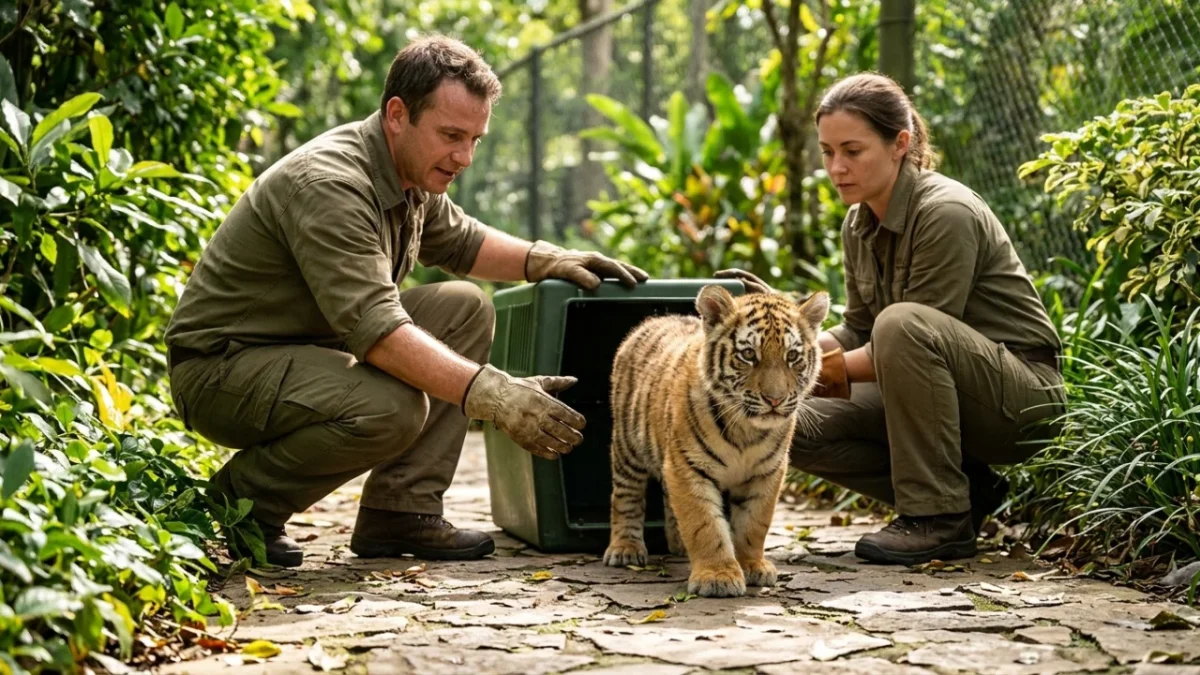
An urgent perimeter alert at Mykolaiv Zoo has ended safely after specialists tracked down and recaptured a four-and-a-half-month-old Amur tiger cub escape artist that managed to slip past its enclosure boundaries. Keepers quickly cornered the young female predator within the facility grounds, averting potential danger to visitors and staff.
The swift operation brought an immediate halt to what could have escalated into a serious emergency. Amur tigers, even in their juvenile stages, possess formidable strength, sharp claws, and rapid acceleration that can pose distinct containment hazards.
Keepers initiated lockdown protocols the moment staff detected an empty den space, mobilising dedicated teams to secure the perimeter before the runaway cub could breach the wider municipal area.
Behind the Enclosure Breach: How the Alert Unfolded
Specialists tracking the four-month-old cub located the animal hiding within the complex after it managed to wriggle through a vulnerability in the enclosure perimeter. Because big cats rely heavily on instinct when startled, handlers had to approach with extreme caution to prevent the youngster from bolting into harder-to-reach terrain.
Zoo staff utilised non-injurious containment techniques to secure the young tigress, guiding her into a secure transport crate without the need for high-risk tranquilisation measures. Physical evaluations conducted immediately following the incident confirmed that the cub suffered no injuries during her brief taste of freedom.
Veterinary staff placed the young Amur tiger under observation in an internal isolation enclosure to monitor her stress levels and assess her general welfare.
The Fragile Nature of Captive Big Cats
Amur tigers are among the most heavily protected big cat species on the planet, making every individual specimen extraordinarily valuable to international conservation efforts. At roughly four to five months of age, cubs begin exploring their surroundings aggressively, testing boundary fences, mesh wiring, and subterranean barriers with unexpected agility.
In standard modern zoological collections, juvenile big cats require specialised habitat adaptations to ensure their adventurous behaviour does not outpace physical barriers. Keepers must routinely inspect mesh tensions, latch tolerances, and natural foliage that agile cubs can utilise as escape ramps.
Emergency Protocols and Public Safety Containment
When predatory animals breach containment, licensed zoological institutions operate under strict safety guidelines comparable to those enforced across the UK by local authority inspectors under the Zoo Licensing Act. Facility operators must ensure multi-layered perimeter walls prevent any animal from reaching residential zones even if an inner enclosure fails.
Routine emergency containment frameworks deployed during predatory escapes typically prioritise three critical phases:
- Immediate Sector Isolation: Sealing off adjacent pathways, visitor concourses, and secondary perimeter gates to constrain the animal’s movement corridor.
- Specialist Tracking and Decoy Deployment: Using familiar scent trails, familiar handler voices, or food incentives to draw the animal toward enclosed capture traps without triggering fight-or-flight panic.
- Perimeter Reinforcement Audits: Conducting immediate structural reviews of the failure point to eliminate recurring vulnerabilities before returning the animal to display.
Technical inspectors at Mykolaiv Zoo have initiated a thorough audit of the enclosure fencing to pinpoint precisely how the cub found a route past the initial perimeter. Structural enhancements are underway to reinforce the enclosure edges, ensuring the young predator remains safely inside as her climbing strength and curiosity continue to develop.
Ensuring absolute perimeter integrity remains an ongoing operational challenge for public wildlife facilities worldwide, where animal enrichment must always balance against uncompromising public security.
🔍 Modern zoo architecture continues to evolve, balancing humane, naturalistic habitats with impenetrable secondary containment barriers.
💡 Close monitoring and rapid response training among animal handlers remain the single most effective defence against accidental breaches.
👇 How do you feel about zoo safety standards and enclosure designs when curious young predators manage to outsmart them? Share your thoughts in the comments below.
 1
 2
 3
 4