
Scientists Built a Moth-Shaped Robot That Grows Its Own Working Sensors on Demand Using Artificial Blood

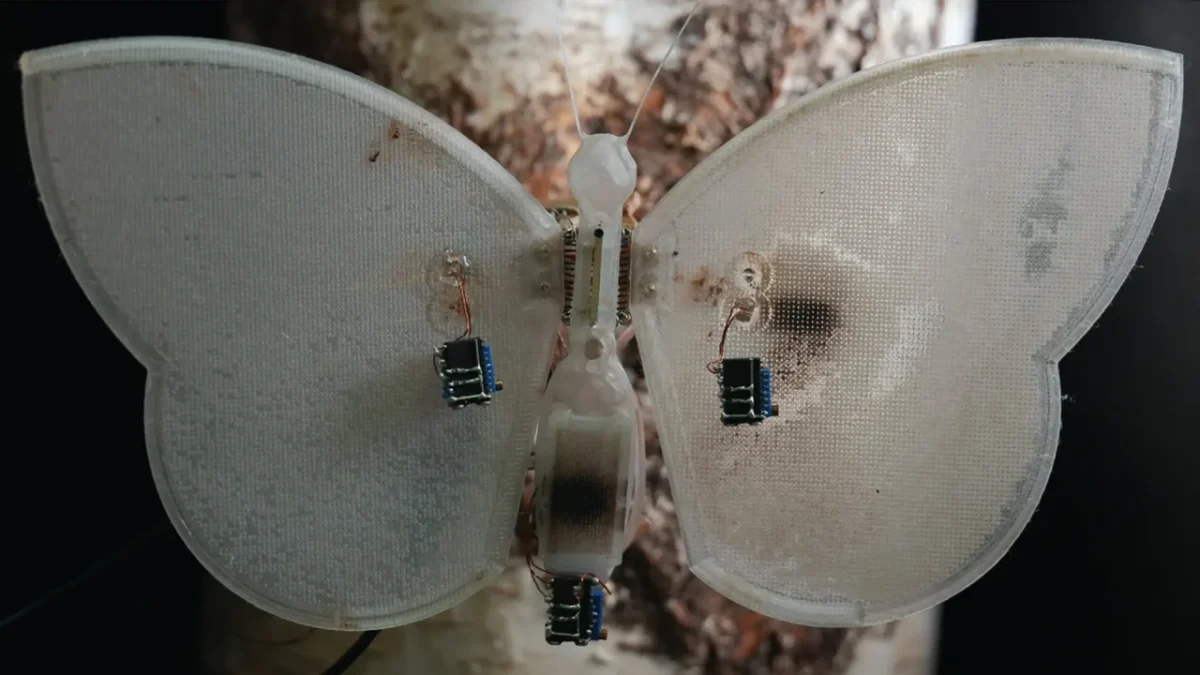
Roboticists have developed an autonomous moth-shaped robot capable of physically growing its own working light sensors on demand. Instead of returning to a workshop when its original hardware falls short, this bio-inspired machine circulates chemical building blocks through synthetic veins to manufacture new electronics directly on its body.
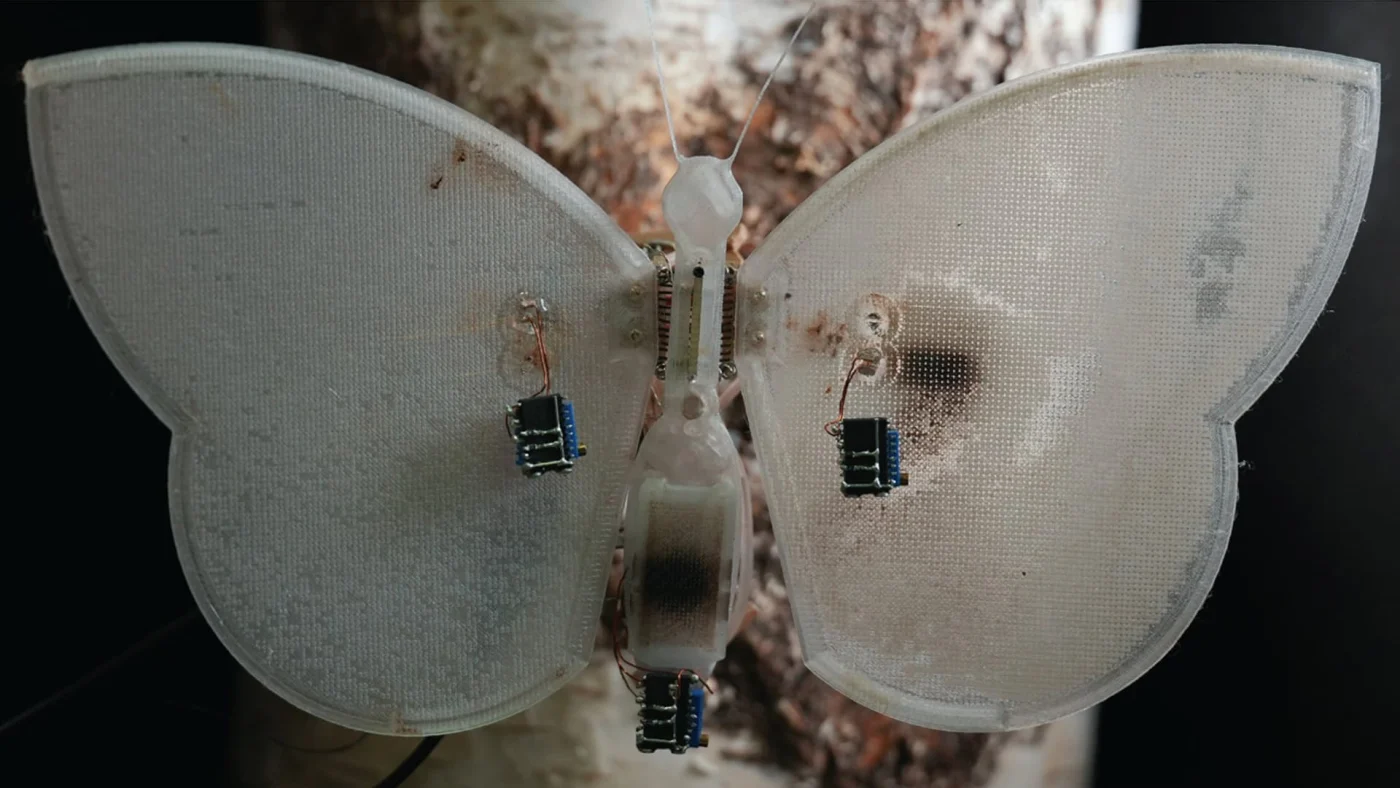
The moth-shaped robot.
Developed jointly by researchers at the University of Tartu in Estonia and the Italian Institute of Technology, the device challenges one of the oldest rules in mechanical engineering: hardware is permanent once it leaves the bench.
By mimicking the open circulatory systems of insects, the machine transforms unpredictable environmental exposure from a physical hazard into a manufacturing trigger.
Why Factory-Built Hardware Limits Field Robots
Most industrial and exploratory robots leave assembly lines with fixed capabilities. If an exploration drone enters a collapsed building, a dense forest, or an alien surface and lacks the specific hardware to register ambient radiation or light, it remains blind.
The widespread myth: Many assume that modern adaptive software and artificial intelligence can compensate for any environmental surprise. In reality, algorithms cannot synthesize raw data if the physical detector simply does not exist on the machine.
To break past this barrier, researchers turned to the blue underwing moth (Catocala fraxini). Insects circulate a nutrient-rich fluid known as hemolymph through open body cavities rather than sealed capillary loops, supplying tissues directly.
“I’m working on giving robots a circulatory system, so they can transport molecular building blocks across the whole body and create the hardware they need, on site, where and when it’s needed,” explained lead researcher Kadri-Ann Pankratov.
How Synthetic Veins Construct On-Site Circuitry
The team 3D-printed the body of the moth-shaped robot out of polyethylene terephthalate glycol (PETG). Each wing spans roughly 86 square centimeters, traversed by millimeter-wide channels resembling biological wing veins.
Between the printed plastic ridges lie microchannels roughly 10 micrometers deep. A miniature pump pushes just 3 milliliters of an artificial hemolymph through this network, saturating the inner structure with raw molecular precursors.
The synthetic fluid consists of three primary ingredients:
- Pyrrole: A monomer capable of chaining into conductive plastics.
- Chemical initiator: A light-sensitive compound that kicks off polymerization.
- Cellulose acetate propionate (CAP): A stabilizing additive that controls fluid diffusion.
When external ultraviolet (UV) light strikes the wing for approximately 60 seconds, it initiates localized photopolymerization. The clear pyrrole converts into polypyrrole, a conductive polymer, turning the transparent wing pitch black wherever the reaction occurs.
Using stencils, engineers focused the reaction with a spatial accuracy of 0.3 millimeters, forming custom electrical patches directly onto the wing surface.
From Chemical Reaction to Physical Movement
The newly formed polypyrrole acts as an organic light sensor. When UV rays hit the darkened patch, the material’s electrical impedance drops instantly.
An onboard microcontroller registers this drop and immediately fires an actuator response:
- The sensor detects incoming UV photons.
- Impedance drops across the freshly polymerized wing patch.
- The microcontroller triggers a shape-memory alloy wire, causing the robot to flap its wings or flash an onboard LED indicator.
“Growing the receptor on site means the environment itself can pattern the robot, based on what is actually happening at that time,” Pankratov noted.
The team also identified an accidental phenomenon: material memory. When the robot faced subsequent bursts of UV radiation, residual pyrrole polymerized further, making the sensor even more responsive over time. The grown sensors remained stable and functional after more than four months in storage.
Comparing Factory Sensors With On-Demand Growth
| Feature | Factory-Installed Sensors | Grown Circulatory Sensors |
|---|---|---|
| Hardware Readiness | Predetermined prior to deployment | Synthesized on site upon environmental exposure |
| Adaptability | Locked; damaged parts require manual replacement | Grows directly where external stimuli strike the body |
| Structural Architecture | Rigid silicon components wired into circuits | Fluid-based microchannels embedded in 3D-printed PETG |
| Longevity & Memory | Fixed sensitivity curves over time | Material memory increases sensitivity with exposure; lasts 4+ months |
Current Roadblocks and What Lies Ahead
The findings, published in the peer-reviewed journal Advanced Science, remain an early proof of concept. The current iteration relies on an irreversible chemical reaction, meaning a sensor cannot yet dissolve itself when no longer needed.
Human operators also determined when to circulate the fluid and where to place the stencil. The next engineering hurdle involves designing machines that decide autonomously when to pump reagents and where to grow new components.
Looking forward, researchers envision using similar circulatory architectures to deposit anti-corrosion barriers, electromagnetic shields, or biocompatible interfaces while deployed in deep space, oceans, or disaster zones.
💬 What do you think about machines that grow their own physical parts in the field?
✨ Could synthetic circulation replace traditional modular robotics in hazardous environments?
📱 Drop your thoughts in the comments below and share this breakthrough with fellow tech enthusiasts.
 1
 2
 3
 4
