
WORLD NEWS ENVideo
Scientists Turn Clothing Fabric Into a Working Touchscreen Display That You Can Actually Put in the Washing Machine

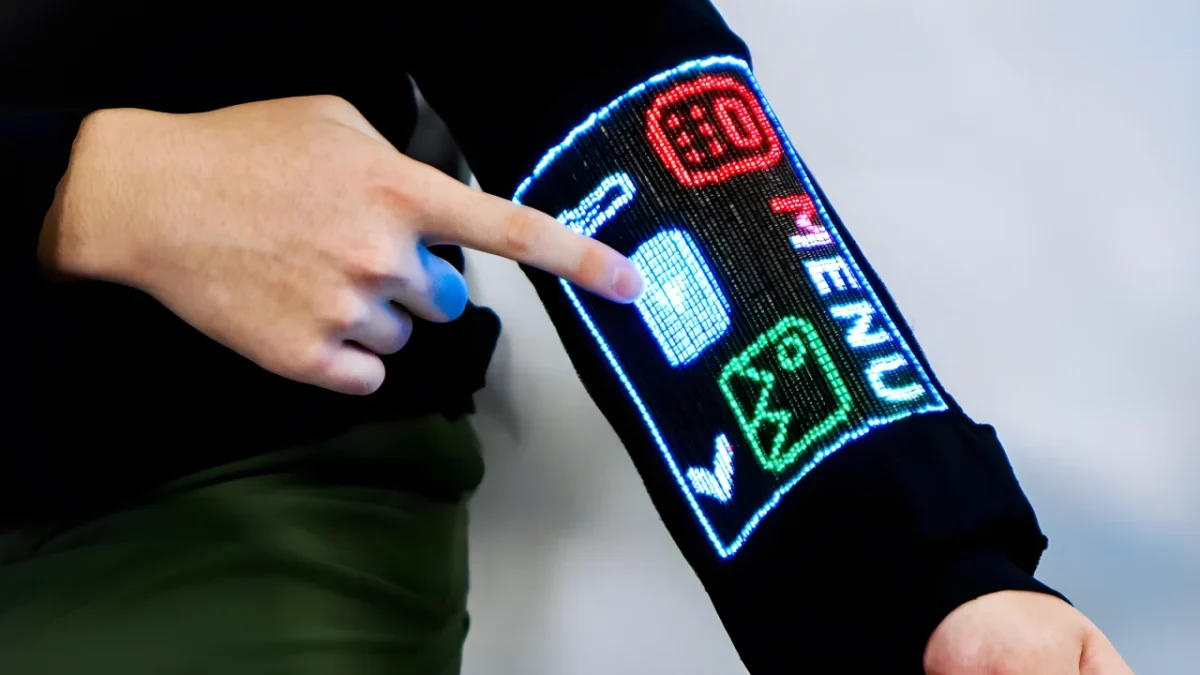
Your next computer screen might not slide into your pocket—it might actually be the sleeve of your jacket. Researchers at the National University of Singapore have developed an interactive, touch-sensitive display woven directly into clothing fabric that can play video, answer touch commands, and survive dozens of cycles in a standard washing machine.
This is not a traditional rigid glass display sewn onto a shirt. The textile itself functions as the monitor and input surface.
The breakthrough relies on specialized pressure-sensitive threads called digital pixel fibers. Measuring roughly 1 millimeter thick and nearly 33 feet long, each strand packs miniature LED chips, touch sensors, and microscopic copper wiring into a flexible polymer.
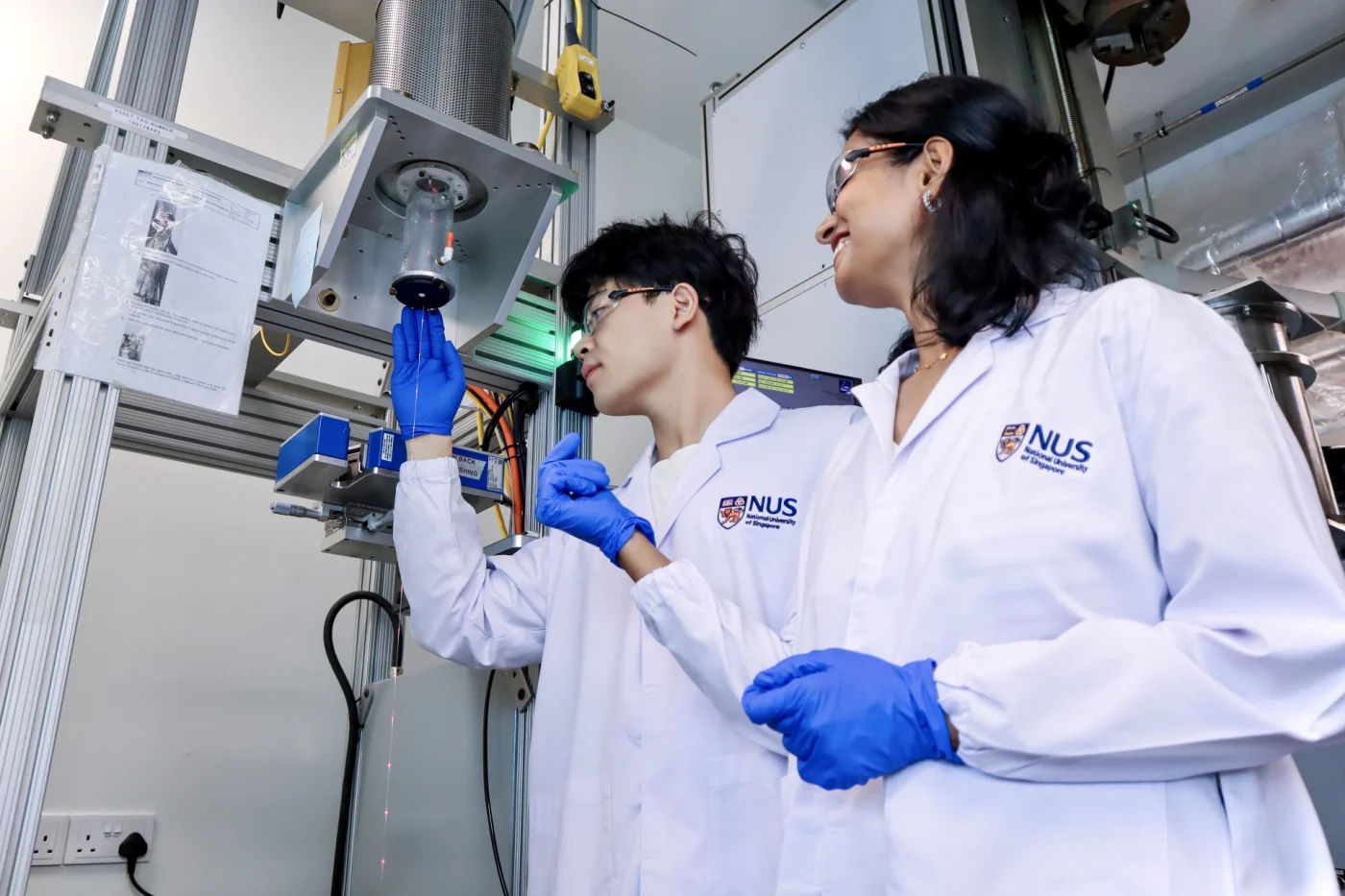
Using a thermal fiber drawing process that integrates thousands of microelectronic devices along a single fiber, the team created touch-sensitive and pixel layers within a thread just 1 millimeter thick and 10 meters long
How Engineers Built a Computer Screen Out of Thread
Creating a wearable fabric touchscreen required solving an immense hardware challenge: packing microelectronics into something that bends like thread without snapping delicate connections.
The research team, publishing their findings in the journal Nature, aligned thousands of miniature RGB LED chips along ultra-thin insulated copper wires. Using programmable lasers, they stripped away insulation at targeted contact points to solder over 5,000 chips across more than 20,000 microscopic electrical joints.
Next came thermal fiber drawing.
The team encased the electronic chain in a bulk polymer block, heated it until soft, and pulled it into an elongated, ultra-thin strand. This process sealed the microelectronics within a transparent, protective jacket while adding conductive, pressure-sensitive layers underneath each pixel.
“A controller sends digital instructions along the copper wires, telling each LED what color to produce and how brightly to shine. Each LED receives its instructions and passes the remaining data to the next one.”
When woven side by side, these strands form an interactive visual grid that handles input just like an ordinary smartphone panel.
Inside the Forearm Display Prototype
To demonstrate real-world use, the engineering team wove 54 digital pixel fibers into the forearm of an everyday shirt sleeve. With 96 addressable LEDs embedded along each strand, the array forms a working 96 × 54-pixel display.
While the resolution is modest compared to modern mobile devices, it easily displays distinct graphics, animations, notifications, and menus.
| System Spec | Prototype Metric |
|---|---|
| Display Grid | 96 × 54 pixels |
| Active Display Area | 168 × 105 mm (approx. 6.6 × 4.1 in) |
| Refresh Rate | 30 frames per second |
| Color Depth | 8-bit color |
| Fiber Thickness | 1 millimeter |
| Durability Benchmark | 50 machine washes, 1,000 bend cycles |
Myth vs. Reality: Is Smart Clothing Finally Washable?
A widespread misconception about electronic garments is that they are too delicate to handle everyday maintenance or real-world moisture. Past smart garments frequently relied on glued-on components that peel off or break after light handling.
This prototype challenges that limitation directly.
Because the thermal drawing technique seals the micro-chips inside a solid polymer coating, the fabric withstands 50 full machine wash cycles and over 1,000 bending cycles without degrading touch sensitivity or visual output.
The garment remains breathable and flexible despite housing thousands of active micro-connections.
Full Smartphone Hardware Woven Into Everyday Yarn
The display panel is only one part of the system. The researchers built an entire sensory package directly into the garment using the exact same fiber-drawing technique.
- Audio Input & Output: Integrated microphones and speakers support basic voice controls and audio playback.
- Biometric Monitoring: Built-in thermal sensors read and display core body temperature directly on the fabric.
- Movement Tracking: Motion sensors and an embedded magnetometer detect arm orientation to automatically rotate the graphic display.
- Auto-Dimming: Ambient light sensors adjust screen brightness depending on indoor or outdoor conditions.
The design effectively replicates the primary interface capabilities of early mobile phones without a single rigid glass panel.
Where Wearable Screens Go Next
Immediate commercial potential extends well beyond casual novelty. Industrial workers could read technical schematics or safety warnings right on their cuffs without handling bulky devices in hazardous zones.
In healthcare, patient clothing could track vital statistics continuously, eliminating loose wires while keeping readouts instantly accessible to medical staff.
Current limitations remain visible: a 1-millimeter fiber creates a relatively coarse weave, and the display resolution is noticeably pixelated. The engineering team is actively producing thinner threads and denser pixel arrays to push the interface closer to high-definition cloth.
📱 Wearable technology is shifting from gadgets you strap to your body to threads woven right into your wardrobe.
✨ While screen resolution still has room to mature, washing-machine durability solves one of the biggest hurdles facing real-world smart textiles.
👇 Would you replace your smartwatch with an interactive touchscreen sleeve? Drop your thoughts in the comments below!
 1
 2
 3
 4
