
The Mystery Behind Lake Michigan’s Giant Frozen Ice Rings: How Freezing Vortices and Underwater Currents Carve Massive Geometric Discs Across the Inland Sea

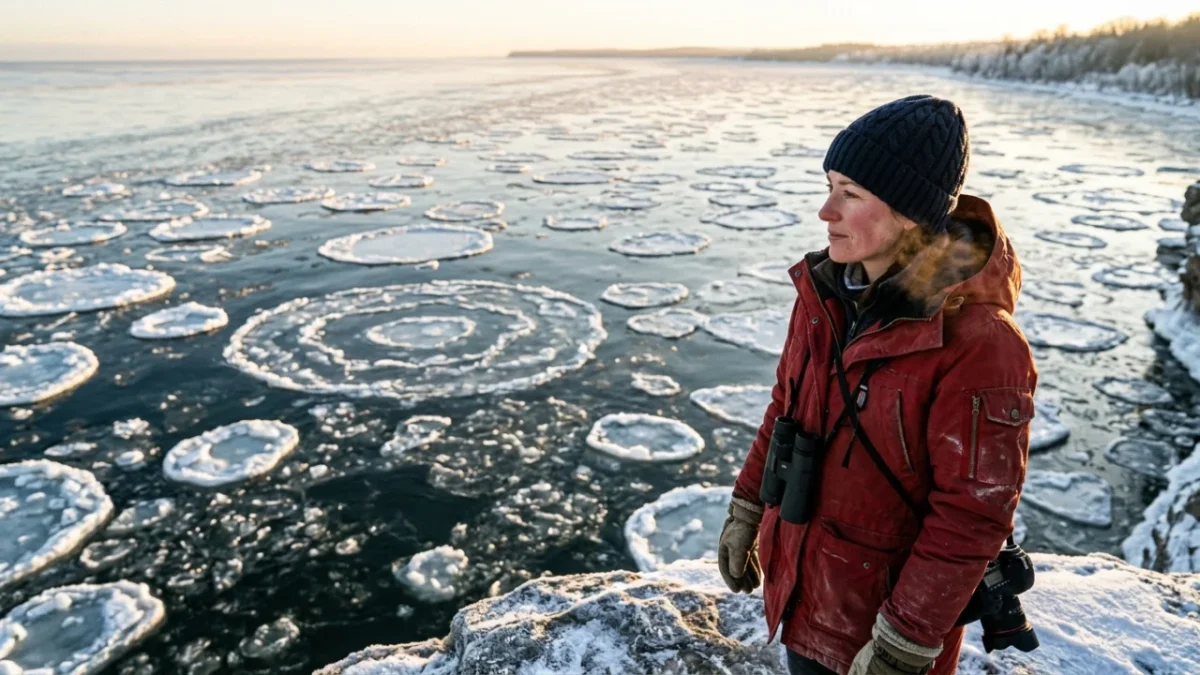
The mysterious frozen ice rings that appear across Lake Michigan are carved into near-perfect circles by slow-moving rotational vortices and wave agitation, which grind colliding slush together until its jagged edges wear smooth. These eerie circular formations emerge when freezing spray and underwater thermal currents turn massive expanses of open water into a churning field of geometric ice.
To anyone viewing the lake from coastal bluffs or high-altitude satellite passes, the spectacle looks almost synthetic.
Concentric rings of white rind float in clusters across the deep blue expanse, spinning languidly in the biting wind. Yet this striking visual display is entirely natural, driven by a delicate combination of surface temperatures, wind shears, and deep freshwater circulation.
The Physics of the Vortex: How Circular Ice Takes Shape
The formation of these bizarre features begins long before a solid sheet of ice can lock the lake surface in place.
When sub-zero air chills the surface water below zero degrees Celsius, microscopic ice crystals known as frazil ice form within the turbulent upper layers. In high winds and choppy swells, this slush cannot coalesce into a smooth, sheet-like freeze.
Instead, Lake Michigan’s relentless surface motion forces the freezing slush into a dynamic mechanical cycle.
- Frazil slurry generation: Unsettled surface water prevents sheet ice, creating dense floating patches of oily slush.
- Rotational eddy capture: Localised hydrodynamic eddies catch the slush, spinning it gently in place rather than letting it drift away.
- Edge-to-edge collisions: Continuous wave action bounces adjacent ice fragments against one another, buffing away sharp corners.
- Rim accretion: As colliding chunks splash water over their perimeters, the splash freezes instantly, building elevated outer rims that create the distinct look of frozen ice rings.
The resulting pancake-like structures range from the size of dinner plates to massive floating rings measuring several metres across.
Deep-Water Circulation and Thermal Upwelling
What makes Lake Michigan such a fertile incubator for these ice discs is its sheer volume and turbulent internal dynamics.
Unlike shallow inland reservoirs that freeze solid in early winter, deep inland seas retain massive reserves of heat within their lower strata. As winter winds push surface waters away from the shoreline, cold upwellings and counter-currents generate slow, spiralling vortices.
These underwater rotational forces act like giant planetary lathes, keeping ice fragments spinning and preventing large sheets from anchoring to the shoreline.
Beneath the Ice: An Ecosystem in Delicate Equilibrium
While the surface of the lake transforms into a rotating field of ice rings, the deep waters beneath house a finely balanced aquatic community.
Cold-water species rely heavily on steady thermal gradients to survive the winter months, feeding on baitfish populations that seek shelter from surface agitation. Maintaining the biological integrity of these waters requires active, long-term intervention.
Fisheries managers constantly monitor the delicate balance between top predators and available forage beneath the surface.
The Indiana Department of Natural Resources has adapted its management approach to protect this system, adjusting the 2027 stocking plan across key sites including East Chicago, Portage, and Michigan City. By reducing Chinook salmon stocking from 275,000 to 200,000 fish—representing an 11 per cent overall reduction compared to 2026—biologists aim to protect depleted baitfish reserves.
Biologists noted an increase in salmon numbers alongside falling average fish sizes and diminished baitfish numbers, signalling that predatory demand was outstripping available food supplies.
“With these stocking changes, we are hoping to stave off any further decrease to baitfish populations and maintain a strong and stable salmon fishery into the future,” explained Ben Dickinson, Lake Michigan fisheries biologist for the Indiana Department of Natural Resources.
The stocking adjustment also creates critical hatchery space to rear an additional 20,000 fall fingerling Skamania steelhead and introduce larger winter-run steelhead yearlings during the spring.
Reading the Signs of a Dynamic Inland Sea
The occurrence of frozen ice rings reminds observers that Lake Michigan behaves far more like a miniature ocean than an ordinary freshwater pond.
Its currents constantly shape both the physical environment above and the biological dynamics below. When the right temperature threshold meets sustained winter turbulence, the lake choreographs a geometric marvel that few other bodies of water can replicate.
As winter weather intensifies across the Great Lakes, spotting these rotating circles offers a rare glimpse into the hidden fluid dynamics of the continent’s most turbulent inland waters.
💡 The interaction between biting air and churning fresh water continues to produce natural phenomena that challenge our perception of winter landscapes.
🔍 Tracking the growth of ice rings provides direct insight into how underwater currents circulate during harsh cold snaps.
👇 Have you ever witnessed these rotating ice circles forming along the shoreline? Share your observations and thoughts below.
 1
 2
 3
 4