
Cutting Grass Just Once a Year Doubled Bug Populations in a Three-Year Study—Here’s What Actually Happened to Insect Diversity

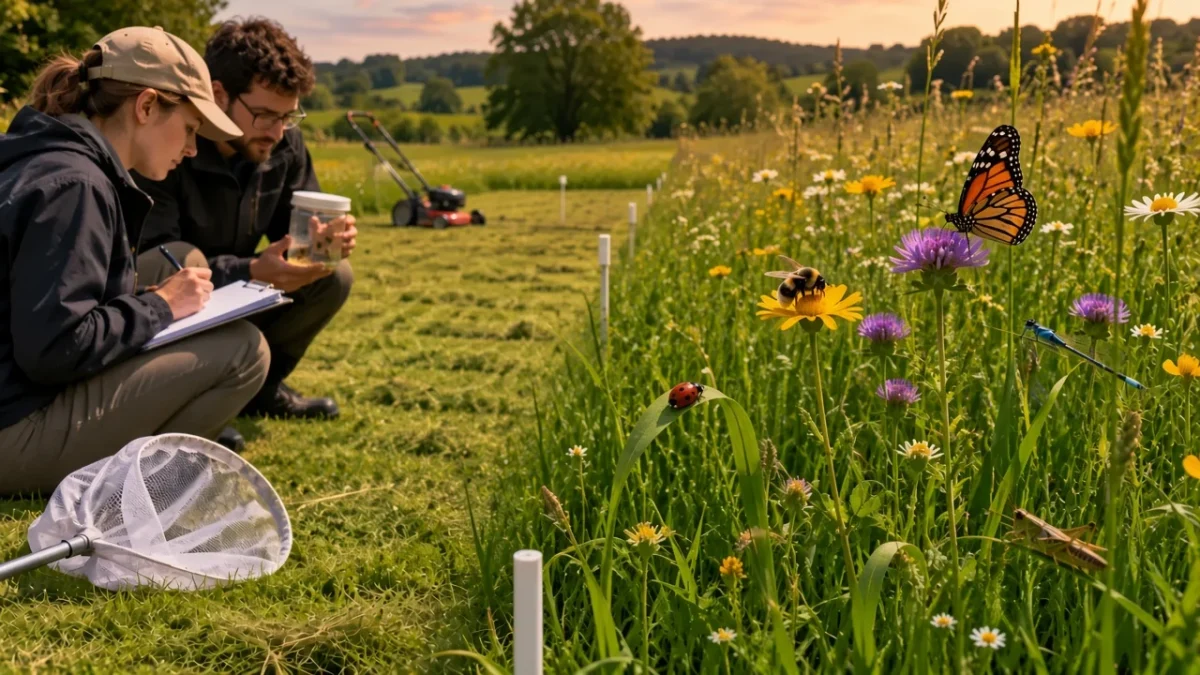
Slashing lawn mowing down to a single late-season cut almost doubles insect numbers within three years. Across 45 experimental test sites, total invertebrate abundance skyrocketed by 41% after year one and spiked by an astonishing 99% by year three compared to conventionally managed turf.
Yet researchers stumbled upon an unexpected paradox beneath the buzzing grass. While overall critter counts exploded, the actual variety of distinct species remained virtually frozen in place.
The findings, published in ScienceDirect under the study titled ‘Experimental reduction of land use increases invertebrate abundance in grasslands’, reveal exactly how basic shifts in land stewardship trigger massive population rebounds without immediately attracting new species to the fold.
How Researchers Tracked Millions of Insects Across 45 Grassland Sites
To evaluate the real-world impact of relaxed management, scientists affiliated with the Biodiversity Exploratories consortium established test sites across three distinct regions of Germany: Schwäbische Alb, Hainich-Dün, and Schorfheide-Chorin. Each territory hosted 15 dedicated research plots, totaling 45 locations with documented histories of medium to high land-use intensity.
Before the 2020 growing season kicked off, the team mapped out an isolated 30-meter by 30-meter experimental zone at each property immediately adjacent to a standard, continuously managed control plot.
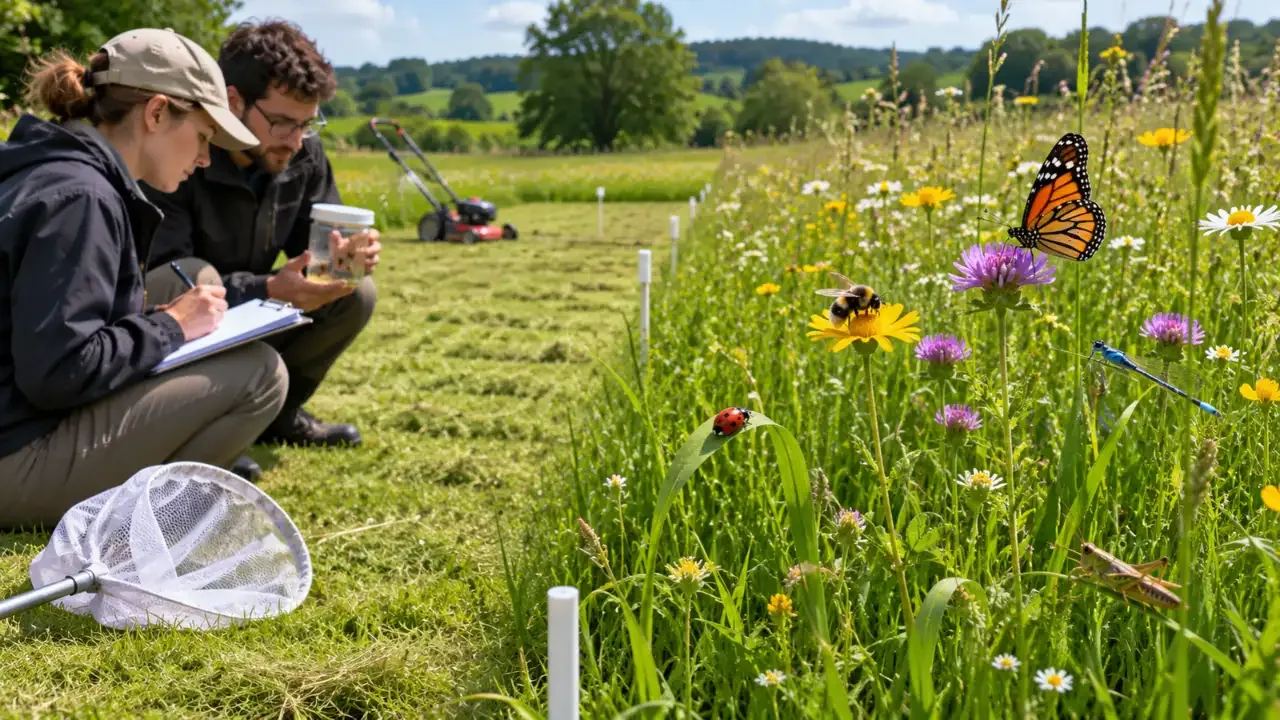
A grassland field site where land-use intensity and mowing schedules were experimentally monitored.
The intervention protocol was straightforward and strictly enforced:
- Single annual cut: Plots were mowed just once per calendar year, held off until late in the growing cycle between August and September.
- Zero chemical inputs: Synthetic fertilizer applications were completely eliminated.
- No grazing: Livestock grazing was banned from the experimental boundaries entirely.
Researchers collected insects using a customized suction sampler converted directly from an outdoor leaf vacuum. Field crews harvested specimens from two separate one-square-meter subplots per site, vacuuming the vegetation for exactly five minutes per square meter.
Field sweeps occurred in May 2021 and May 2023, systematically scheduled before surrounding property managers completed their earliest spring mow or grazing cycle. This deliberate timing confirmed the experimental zones functioned as native breeding grounds rather than temporary hideouts for displaced neighborhood bugs.
The Raw Numbers: A 99% Explosion in Insect Density
Field collections produced 83,343 invertebrates in 2021 across 44 accessible sites, followed by 115,490 specimens across all 45 sites during the 2023 follow-up. For data precision, researchers stripped ants, mites, and springtails from final baseline calculations.
The raw density shifts between the untouched zones and heavily manicured controls revealed massive population divergences within just 24 months.
| Management Style | Invertebrates per 2 m² (Year 1 vs. Year 3) |
|---|---|
| Conventional Control (Regular Mowing/Grazing) | 786 individuals (Year 1) → 859 individuals (Year 3) |
| Reduced Management (Single Late Cut) | 1,108 individuals (Year 1) → 1,708 individuals (Year 3) |
By year three, the relaxed plots held nearly double the living volume of the routinely trimmed control areas. Yet these massive population booms carried an important ecological asterisk.
The Biodiversity Myth: Why More Bugs Didn’t Mean More Species
Popular ecological thinking assumes that ditching the mower instantly creates an oasis where missing wildlife species flourish. The research team’s DNA metabarcoding analysis of 479 identified species proved otherwise.
“Species richness, Shannon diversity and Simpson diversity were almost identical between treatment and control after one year.”
Mean species richness sat at 35 distinct species inside the reduced-cut zones, virtually identical to the 34 species recorded in high-intensity control plots. The single-cut protocol gave existing survivor species the shelter and forage required to multiply rapidly, but it did not automatically restore lost biodiversity within short time horizons.
The Hidden Factors Driving Population Growth
The scale of invertebrate recovery did not occur in a vacuum. Broader neighborhood agricultural practices directly capped or accelerated the experiment’s success.
- Past mowing history: Test zones surrounded by acreage that had endured frequent cutting over previous years produced much smaller population rebounds.
- Prior soil fertility: Grasslands featuring higher existing nutrient fertilization experienced significantly larger overall surges in total numbers.
- Blade cutting height: Elevating the cutting deck higher off the soil during the late-season pass generated significantly stronger insect counts in year one.
- Staggered mowing dates: By year three, gains were dramatically greater on plots whose late harvest did not coincide on the exact same day as the surrounding farmland.
While budget restrictions prevented DNA sequencing for the 2023 haul, historical ecological benchmarks across these exact research stations confirm that total arthropod count serves as a direct, reliable proxy for overall insect biomass.
Lasting ecosystem recovery takes time. Providing unmanicured shelter cushions existing bugs from sudden destruction, laying the crucial ground game for long-term food web revival.
💬 How often do you maintain the grassy spaces around your home or neighborhood?
✨ Drop your thoughts in the comments below and share whether you would support delaying mowing schedules on public lands to support insect survival.
📱 Pass this data breakdown along to fellow gardeners, land managers, and wildlife enthusiasts who track land conservation trends.
 1
 2
 3
 4
