
Inside America’s Surrender Safe Havens: How Specialised Incubators Across Four States Are Quietly Transforming Emergency Infant Care

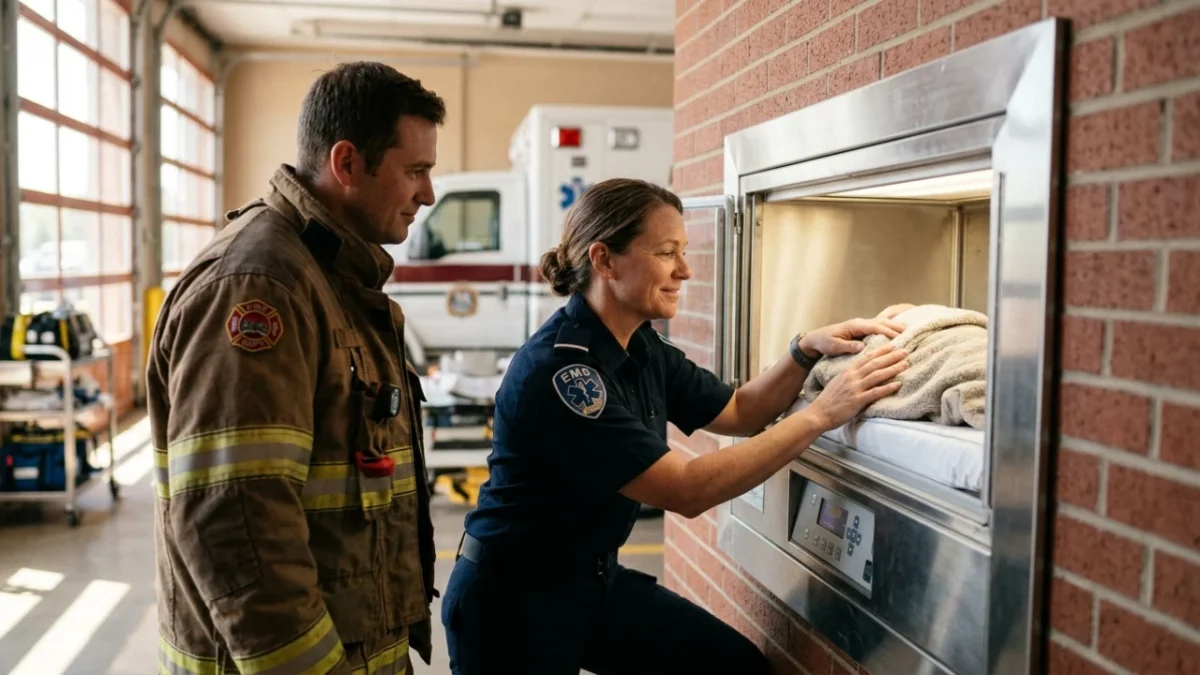
Specialised climate-controlled incubators built directly into emergency service stations are expanding at an unprecedented rate across America, offering desperate parents a secure, anonymous route to surrender newborns without face-to-face contact. Five brand-new installations spanning Iowa, Wisconsin, Missouri, and Texas are pushing the nationwide network past 485 sites, underscoring a dramatic transatlantic divergence in how public services manage crisis childcare.
The sudden surge in installations highlights an acute operational shift among American emergency responders. Instead of relying exclusively on traditional handovers, fire stations and hospitals are embedding automated medical-grade hatches into their exterior walls.
These devices are designed to remove fear, stigma, and panic during moments of extreme vulnerability.
Engineering an Anonymous Lifeline
The mechanics behind safe haven boxes are engineered to prioritise infant safety while guaranteeing absolute parental privacy. Fitted directly into the structural brickwork of hospitals, fire stations, and emergency medical services (EMS) bases, each hatch resembles an exterior access door leading to an interior medical bassinet.
Once an infant is placed inside and the door closes, an exterior magnetic lock engages automatically to prevent any retrieval from outside. That exact motion triggers an instantaneous, silent alarm notifying on-duty personnel inside the facility.
Trained medical crews retrieve the infant within mere minutes, initiating immediate neonatal assessment and clinical stabilisation.
- Automated thermal monitoring: Interior sensors keep temperatures strictly regulated in freezing winters and scorching summers.
- Dual alarm systems: Secondary alert channels ensure first responders receive notification even during local network disruptions.
- Direct clinical transfer: Infants move straight into specialised paediatric care pathways or immediate foster placement, circumventing public administrative delays.
A Flurry of New Sites Across Four States
The rapid expansion has seen three new hatches unveiled in quick succession, with two further operational sites launching immediately across regional hubs.
In Davenport, Iowa, MercyOne Genesis Davenport Hospital commissioned the state’s fifth device on Rusholme Street. Hospital leadership emphasised that having specialised paediatric and neonatal intensive care teams on site ensures immediate medical intervention without transit delays.
Across the state line in Baldwin, Wisconsin, Baldwin EMS brought the service to St Croix County after frontline paramedics highlighted the severe psychological distress associated with unassisted infant abandonments. Meanwhile, Kansas City Fire Department in Missouri completed its installation at Fire Station 14 on North Brighton Avenue, bolstering urban coverage.
The operational footprint is set to widen further with three simultaneous launches across San Antonio Fire Stations #7, #24, and #18, marking Texas’s 24th, 25th, and 26th sites, alongside a dedicated opening at Manitowoc Fire Rescue Station #3 in Wisconsin.
Disparate State Timelines Create a Patchwork Framework
While the physical design of the incubators remains uniform, the legal protections governing parents vary dramatically depending on state borders. Unlike the UK, where statutory child welfare protocols fall under universal safeguarding and local authority social services frameworks, American legislation creates stark regional boundaries.
- Iowa: State statutory provisions permit parents in crisis to legally relinquish infants up to 90 days old without legal penalty.
- Missouri: Matches the upper threshold, granting an anonymous surrender window of 90 days or younger.
- Texas: Restricts the statutory protection window strictly to infants aged 60 days or younger.
- Wisconsin: Enforces the narrowest timeline among the group, capping legal anonymity at infants 30 days or younger.
Rethinking Crisis Care and Family Welfare
The contrast between these American measures and European welfare systems is pronounced. In Britain, safeguarding mechanisms established under social service authorities focus heavily on multi-agency intervention, NHS community midwife engagement, and direct support networks designed to keep families intact wherever safe.
Yet for public safety teams in the United States, anonymous surrender boxes bridge an urgent operational gap. First responders repeatedly observe that individuals facing severe domestic trauma or acute mental distress often evade conventional hospital desks or social service offices out of intense fear of criminalisation.
By providing a sterile, secure handover mechanism, emergency services ensure that neonatal care begins before an infant suffers critical exposure or abandonment trauma.
💡 The rapid expansion of physical surrender hatches reflects how different legal jurisdictions approach extreme parental crisis and child safeguarding.
🔍 As technological infrastructure continues to enter emergency healthcare, public debate remains active over whether anonymous drop-offs solve frontline crises or highlight systemic gaps in community family support.
📌 Understanding these international models offers vital perspective on how emergency services balance parental anonymity with clinical child welfare.
👇 How do you view this approach to crisis childcare compared to traditional social service interventions? Share your perspective in the comments below.
 1
 2
 3
 4