
Inside the Rare ‘Smoking Hole’ Jet Disaster: Why a Plunge at 20,000 Feet Per Minute Can Obliterate an Entire Fuselage and Scatter Debris for Miles

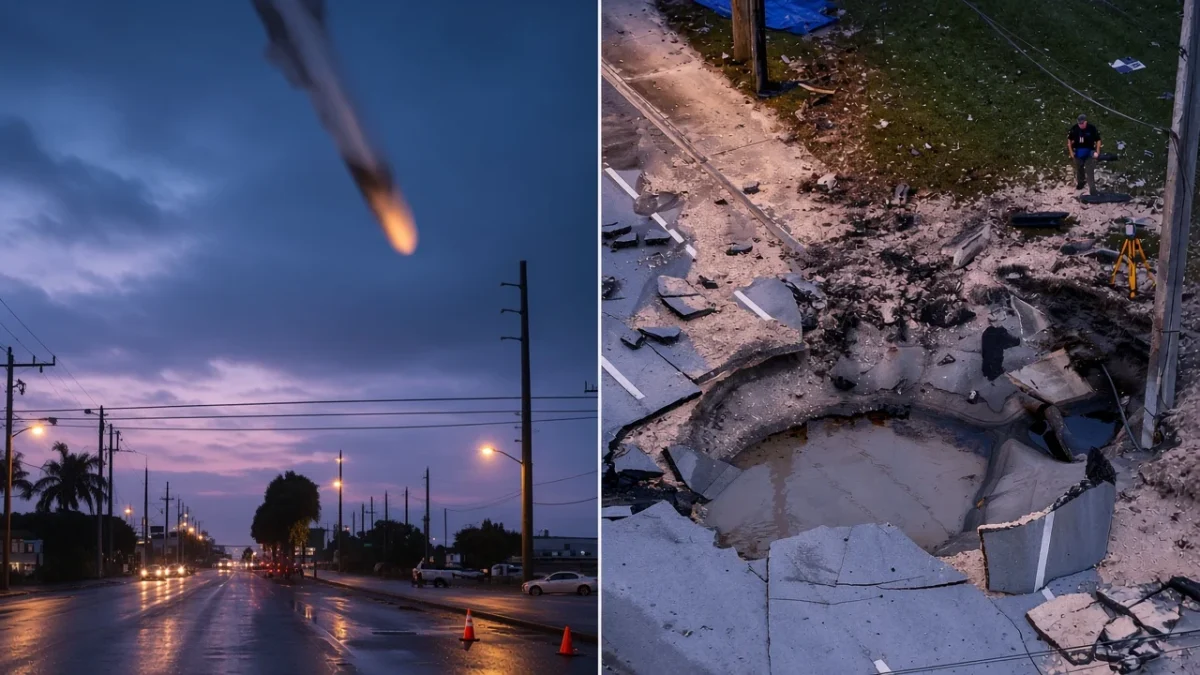
When a private jet plummets toward earth at an astonishing 20,000 feet per minute, the physics of impact change entirely. Rather than skidding across terrain or leaving recognizable aircraft sections behind, the plane creates a catastrophic impact crater that can completely swallow the main fuselage while scattering debris miles across the landscape.
That extreme reality became central to the investigation of a recent private jet crash in Greenacres, Florida, where a twin-engine Learjet 60 bound for the Bahamas abruptly fell out of the sky. The disaster claimed the lives of all nine people on board, leaving behind a scene that veteran aviation investigators describe as one of the most violent categories of air disasters.
What Is a ‘Smoking Hole’ Impact?
In commercial and general aviation, structural crashes fall into specific investigative classifications depending on velocity, descent angle, and trajectory. Air safety specialist Anthony Brickhouse, an industry investigator with nearly three decades of experience, notes that extreme vertical dives create rare, high-energy impact profiles.
“When aircraft crash, we put it into typically one of four different categories. And the nickname that we use for that — we call it a ‘smoking hole’-type accident.”
In these high-angle, high-velocity events, an aircraft strikes the ground at or near terminal velocity. The kinetic force instantly pulverizes the forward fuselage, compressing metal, engines, and avionics directly into the earth rather than distributing them horizontally across a traditional runway path.
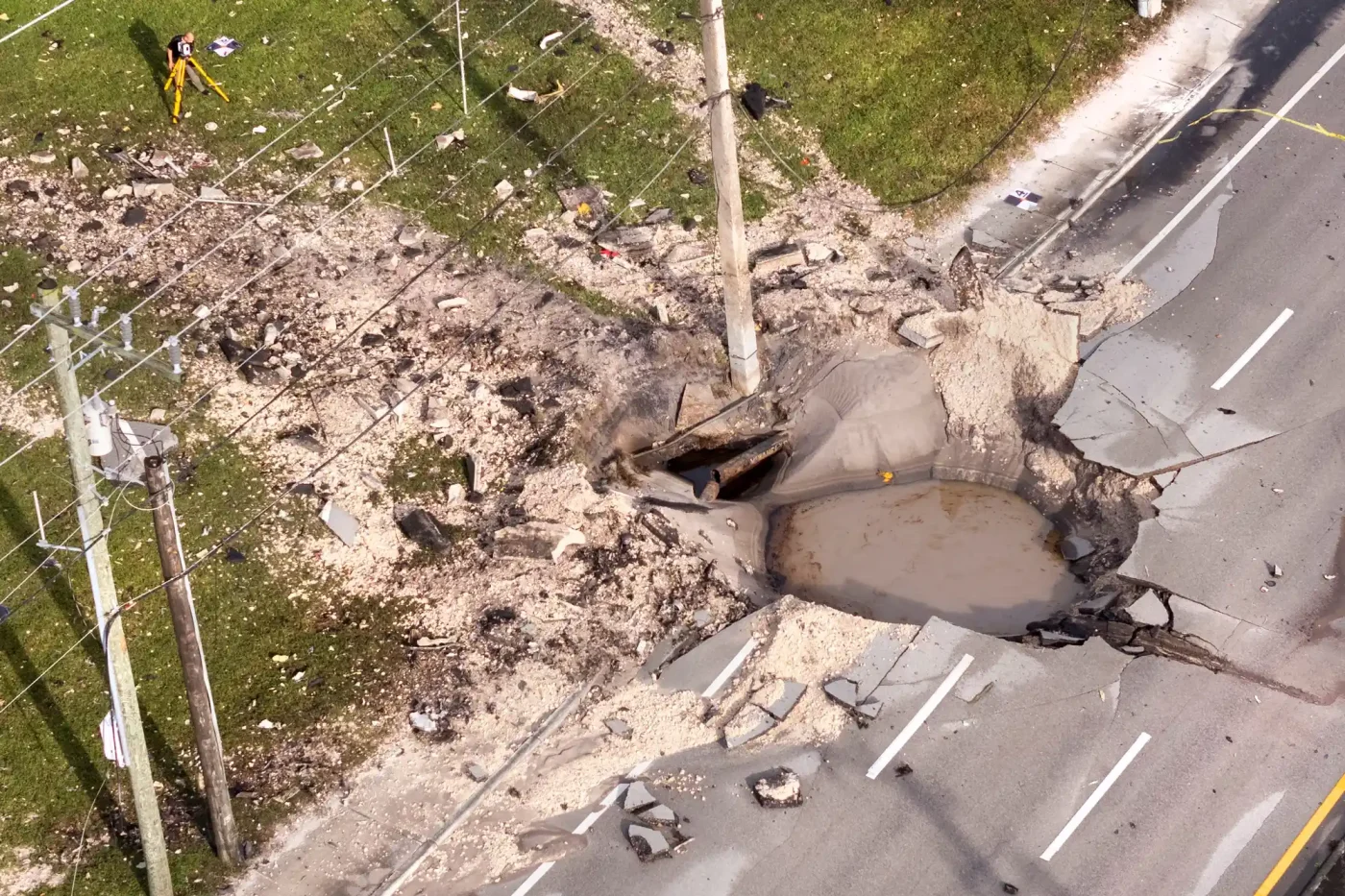
Investigators examine the site where a Lear jet crashed in Greenacres, Florida.
According to data benchmarks tracked by Airbus and the International Air Transport Association (IATA), this profile is typical of a catastrophic loss of control in-flight (LOC-I). LOC-I represents the single deadliest accident category in global aviation, frequently triggered by aerodynamic stalls, severe weather, or sudden mechanical breakdowns.
The Physics Behind a 20,000-Foot-Per-Minute Fall
The horrifying final moments of the flight were documented through emergency radio transmissions captured by LiveATC.net. Co-pilot Nathalia Filgueiras made desperate calls to air traffic controllers as the aircraft entered an unrecoverable dive.
“We’re descending 8,000 — mayday, mayday — we’re descending 10,000 feet per minute,” Filgueiras alerted the tower. Moments later, her final transmission confirmed the jet’s flight computers were overwhelmed: “We are in an overspeed condition descending 20,000 feet per minute.”
To put that figure into perspective, standard passenger descents average between 1,500 and 2,500 feet per minute. A vertical plunge exceeding 20,000 feet per minute means the airframe is racing earthward at more than 225 miles per hour straight down, generating forces far beyond engineered design thresholds.

Emergency personnel survey the wreckage distribution area following the Florida private plane crash.
Why Did Debris Land Miles Away?
A widespread misconception among the public is that aircraft remain intact until they strike the ground, with wreckage scattering strictly upon impact. Scientific crash analysis proves the opposite: when planes breach aerodynamic structural limits, mid-air disintegration often begins thousands of feet in the sky.
National Transportation Safety Board (NTSB) Member Tom Chapman confirmed that investigators discovered wreckage as far as 3.8 miles from the central crater. This physical evidence strongly indicates that extreme aerodynamic drag tore sections of the airframe apart before ground impact.
“In normal operations, you don’t really get close to that maximum speed,” Brickhouse explained. “And the problem is once you go beyond it, it’s pretty easy to do structural damage to an aircraft. In some situations, the structural damage isn’t visible… In other situations, the damage would be visible. And in the most extreme case, the aircraft could structurally break apart.”
| Investigation Phase | Primary Focus |
|---|---|
| Crater & Ground Impact Zone | Analyzing main engine impact angle, high-velocity compression, and flight recorder recovery. |
| Peripheral Debris Field (Up to 3.8 Miles) | Drone site documentation of airframe parts shed during overspeed structural failure. |
The Critical Minutes Before Impact
The aircraft had departed Austin-Bergstrom International Airport in Texas, destined for North Eleuthera Airport in the Bahamas. Just minutes before the steep dive, the flight crew had reported manageable ice accumulation and moderate turbulence, sounding calm and in control.

Federal investigators and first responders work the scene of the crashed Learjet.
Less than three minutes after that report, conditions deteriorated beyond recovery. The tragedy claimed nine lives, including captain Jeff Gregory, co-pilot Nathalia Filgueiras, tech founder Adam Robinson, his wife Helen Sharp, their two young children, Emma, 4, and Charlie, 2, alongside passengers Rachael Reed, Charmi Fehr, and Anita Maria Cetina.
“I’ve heard a lot of recordings during my 28-and-a-half years doing this, and it was chilling to listen to. You can’t help but think about the two pilots and what they’re thinking, and the fact that they’re doing everything that they potentially could and yet they don’t have control.”
Federal teams continue analyzing flight data and radar wreckage distribution to uncover what initiated the sudden spiral into an irreversible dive.
💬 Understanding how rapid descent rates affect aircraft structural integrity is critical to deciphering these rare aviation disasters.
✨ As the NTSB examines wreckage scattered across nearly four miles, the findings will provide vital answers for aviation safety protocols worldwide.
📱 Drop your thoughts in the comments below and share this breakdown to follow the latest updates on federal aviation findings.
 1
 2
 3
 4
