
NASA’s Autonomous Rover Smashes All-Time Mars Record in Just Five Years: How Perseverance Rewrote the Rules of Deep Space Exploration

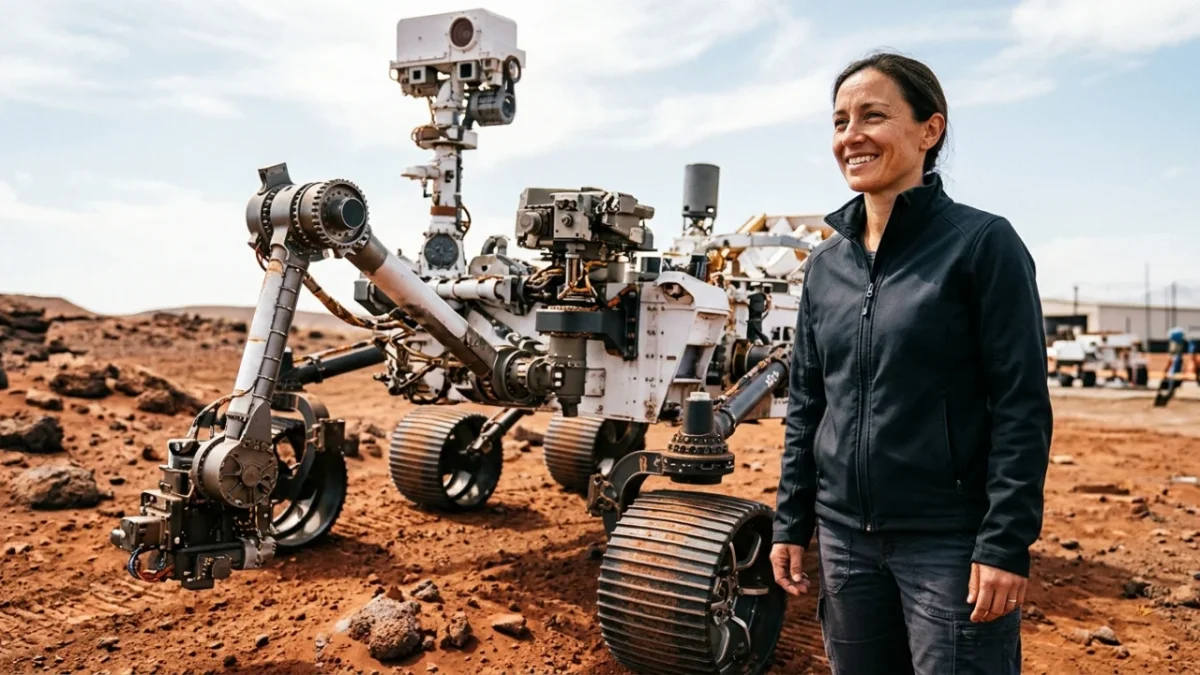
The NASA Perseverance rover has officially broken the all-time off-world driving record, clocking 28.10 miles (45.22 kilometres) across the Martian landscape in just over five and a half years. By surpassing the historic benchmark of 28.06 miles set by the Opportunity rover—a feat that originally required nearly 15 years to achieve—the robotic explorer has rewritten expectations for planetary exploration.
The milestone was achieved along the rugged western rim of Jezero Crater, an ancient impact basin scientists believe previously contained a lake and river delta. Rather than relying on constant, time-delayed guidance from ground stations on Earth, the machine covered that vast distance largely on its own computational power.
This leap forward marks a profound transformation in how deep space missions navigate hostile ground.
The Breakthrough Technology Driving Autonomous Exploration
The decisive factor behind this acceleration is AutoNav, an onboard autonomous navigation system designed by engineers at the Jet Propulsion Laboratory (JPL) in Pasadena, California. Unlike older hardware that stopped frequently to await direct instructions across millions of miles of space, AutoNav processes high-resolution imagery in real time to map obstacles and chart efficient paths between designated waypoints.
The technological gap between generations of Martian rovers is staggering:
- Processing capacity: The NASA Perseverance rover evaluates up to 600,000 measurement points during every individual terrain assessment, compared to just 20 points assessed by NASA’s pioneering Sojourner rover.
- Autonomous operational reliance: Perseverance has utilised AutoNav for more than 90% of its cumulative distance, whereas Opportunity relied on autonomous driving for approximately 5% of its journeys.
- Daily velocity: The vehicle can cover up to 1,351 feet (412 metres) per Martian sol, cutting dead time caused by signal delays between Earth and Mars.
Key mission leaders, including aerospace engineer Diana Trujillo, who served as tactical mission lead at JPL overseeing robotic arm deployment and sequence planning, engineered the routines that made this autonomy dependable.
JPL project manager Steven Lee confirmed that all mobility mechanisms remain fully operational, pointing out that the baseline mission initially called for no more than 12.4 miles of travel.
Unlocking Signs of Ancient Habitability
While speed and endurance records showcase engineering prowess, the rover’s primary objective remains astrobiological. Jezero Crater was targeted specifically because its sediment layers preserve evidence of conditions that could once have supported primitive microbial life.
The vehicle has already drilled and sealed 29 rock and regolith cores across different geological zones. Among its most closely scrutinised discoveries is a rock formation known as Cheyava Falls, where onboard sensors registered a potential biosignature requiring deeper laboratory analysis.
The Push Toward Rainbow Falls and Idubi
NASA has authorised a comprehensive mission extension that funds operations through the end of 2028. The current itinerary steers Perseverance through the Lac de Charmes region toward a sector designated as Idubi, where researchers hope to sample traces of ancient hydrothermal networks.
Following that survey, the rover will press on toward Rainbow Falls, a 328-foot-wide exposure of ancient crust thrust upward during the cataclysmic impact that created Jezero Crater billions of years ago.
From Deep Space Autonomy to Terrestrial Industry
The advanced mapping and automated systems developed for planetary exploration are concurrently feeding back into critical terrestrial programmes. In a joint demonstration of operational crossover, NASA Administrator Jared Isaacman and U.S. Secretary of Agriculture Brooke Rollins recently signed a formal Memorandum of Understanding to modernise agricultural data sharing.
The initiative integrates NASA orbital modelling and surface measurement datasets into farm management frameworks, using space-grade field modelling to improve acreage estimations and crop resilience.
Whether navigating uncharted sands on Mars or refining resource management on our home planet, automated robotic systems are expanding human reach faster than ever planned.
💡 What excites you most about the rapid rise of autonomous robotic exploration across our solar system?
👇 Share your thoughts and join the conversation in the comments below.
 1
 2
 3
 4