
Oxford Street Pedestrianisation Starts as Mayor Sadiq Khan Hails a Dramatic Transformation for Central London

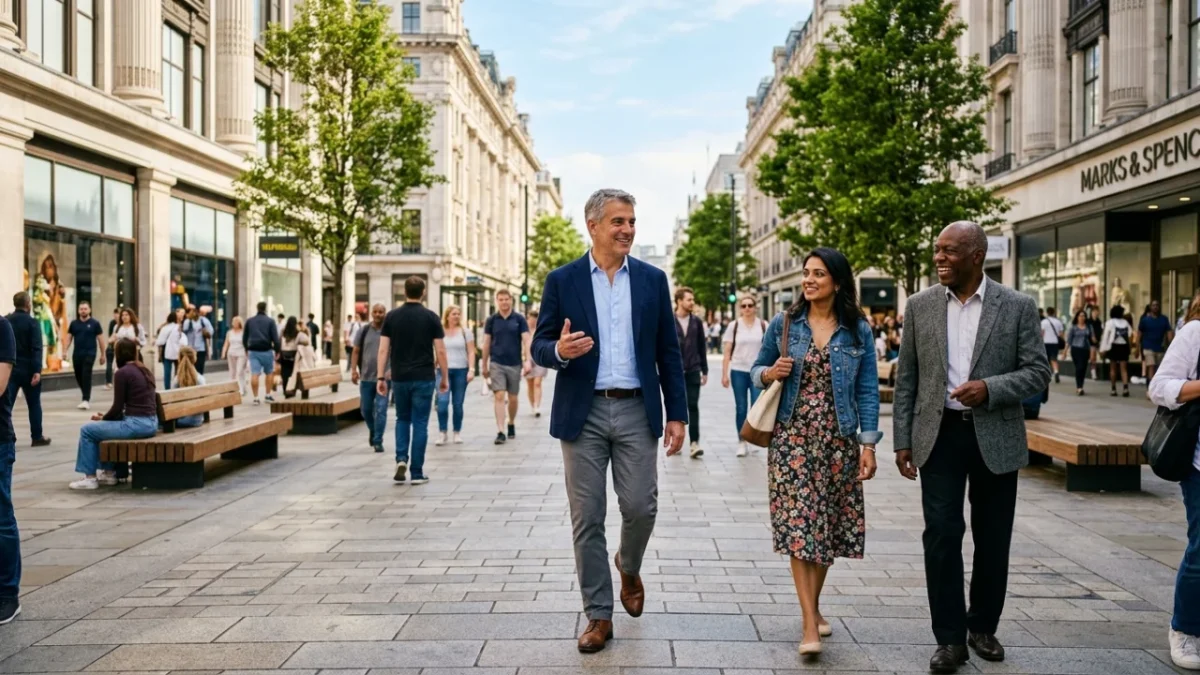
Work has officially begun to transform Oxford Street into a fully pedestrianised boulevard, marking what Mayor of London Sadiq Khan has hailed as a “momentous occasion” for the heart of the capital. The transformative project removes vehicular traffic to rebuild the retail corridor into an accessible, open-air public thoroughfare.
For more than a decade, rival proposals to ban buses, taxis, and cars along Europe’s premier commercial avenue had been locked in contentious debate. Now, the capital is moving forward with an overhaul intended to safeguard central London’s commercial future against shifting consumer habits and competition from destination shopping centres.
The bold shift represents one of the most substantial interventions in the West End since the congestion charge reshaped central transit networks.
A Historic Shift for Europe’s Busiest Commercial Avenue
The initiative aims to address chronic congestion, pedestrian overcrowding, and poor air quality along the iconic 1.2-mile thoroughfare. By clearing the road surface entirely for walking, the Greater London Authority seeks to deliver a high-footfall environment that re-establishes the district as an international retail powerhouse.
City leaders have consistently pointed to surging footfall around the Elizabeth line as proof that passenger flows require substantially wider walkways and safer pedestrian crossings. Congested pavements and heavy bus lanes have frequently produced severe pinch points between Marble Arch and Tottenham Court Road.
The commencement of works signals an end to decades of gridlock across boardroom tables and council chambers alike, setting a definitive direction for central urban planning.
Overcoming the Long-Standing Capital Stalemate
Earlier iterations of the car-free plan repeatedly stalled due to disputes over rerouted bus arteries, residential access, and the displacement of delivery traffic into neighbouring Marylebone and Mayfair. Resolving those friction points required extensive collaboration with transport regulators and regional commercial stakeholders.
Under the stewardship of Sadiq Khan, City Hall has championed the scheme as vital to securing long-term economic resilience. Urban development teams are coordinating infrastructure adjustments to manage redirected transport services while maintaining reliable access to key transport hubs.
Key Priorities for the Transformation
The project focuses on several crucial operational and civic goals:
- Reallocating surface transit: Adjusting Central London bus corridors to guarantee direct links to major Underground and rail interchanges without crowding narrow residential side streets.
- Upgrading public realm amenities: Introducing modern street furniture, expanded pedestrian walkways, and dedicated green infrastructure to encourage extended dwell times for visitors.
- Revitalising brick-and-mortar retail: Creating a modern outdoor shopping environment capable of competing with premier indoor centres across the South East.
- Improving safety and accessibility: Eliminating mixed-traffic conflicts to drastically cut accident risks while upgrading access for disabled visitors and parents with prams.
Retail trade bodies across the capital have stressed that clear timelines and reliable alternative transport routes will remain essential to sustaining consumer confidence throughout the construction phases.
What the West End Overhaul Means for Shoppers and Commuters
While the long-term vision promises an expansive open-air promenade, the physical changes will require significant adjustments for the tens of thousands of commuters who traverse the corridor daily. Transport planners must ensure that surrounding roads do not become choked with diverted black cabs and delivery vehicles.
Local businesses are watching the timeline with intense scrutiny. With consumer spending facing ongoing economic pressures, merchants are relying on City Hall to deliver visible public-realm improvements without disrupting trade during crucial shopping seasons.
As heavy machinery replaces double-decker buses on Oxford Street, the capital enters an era where pedestrian priority defines its most famous thoroughfare.
💡 The permanent conversion of Oxford Street could serve as a direct blueprint for high street regeneration schemes right across Great Britain.
🔍 How city planners balance pedestrian spaces with accessible public transport links will determine whether this grand design succeeds in the long run.
👇 Do you support the total pedestrianisation of Oxford Street, or are you concerned about redirected traffic in surrounding areas? Share your views below.
 1
 2
 3
 4