
Scientists Injected 130 Gallons of Red Dye off Martha’s Vineyard—and Discovered an Invisible Ocean Barrier

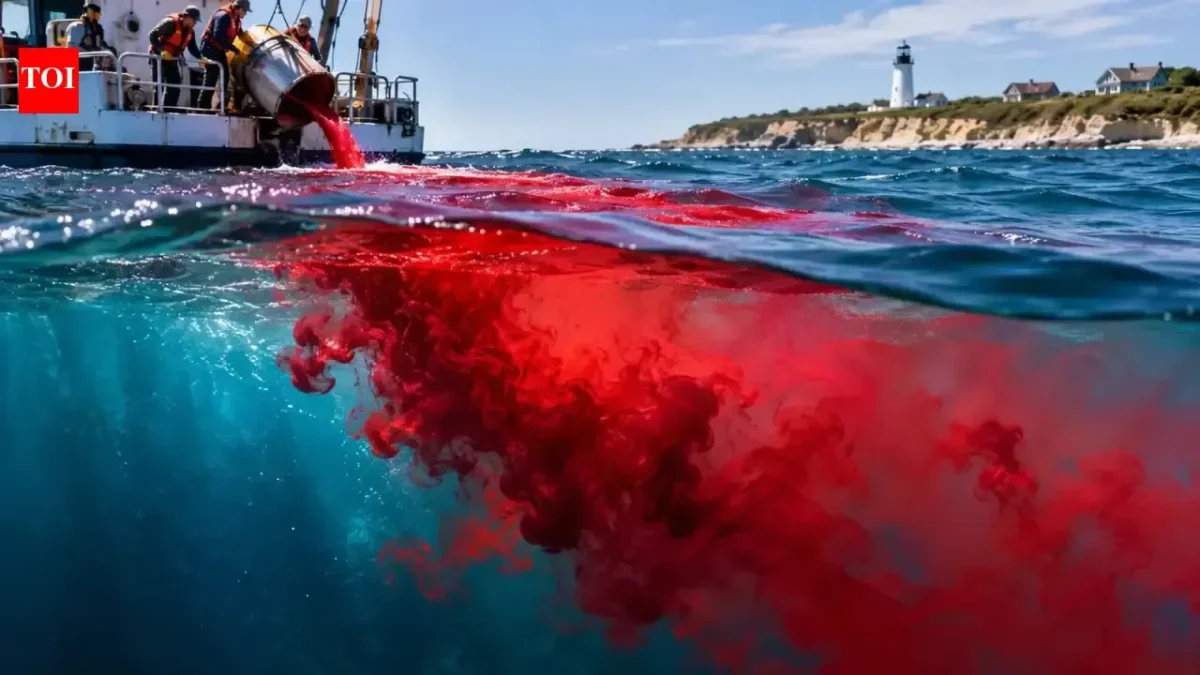
Pumping 130 gallons of fluorescent red dye into the Atlantic Ocean revealed an invisible underwater barrier: 99% of the chemical tracer remained locked in the surface layer, failing to sink into the ocean depths below. When oceanographers tracked the plume south of Martha’s Vineyard, Massachusetts, they discovered that vertical water movement virtually stops at a distinct density threshold, cutting mixing rates by a factor of 140.
The findings, published in Continental Shelf Research, show that the ocean does not blend like a stirred pot of water. Instead, the sea acts as a heavily compartmentalized system where surface currents move rapidly, yet deep downward penetration occurs at an agonizingly slow crawl.
To pinpoint how marine pollutants, heat, and nutrients travel through coastal waters, researchers had to turn the ocean bright pink.
Why Scientists Turned the Atlantic Ocean Red
Oceanographers aboard the research vessel R/V Connecticut released 75 kilograms (roughly 165 pounds) of rhodamine dye approximately 28 kilometers (17 miles) south of Martha’s Vineyard. The team pumped 130 gallons of a customized rhodamine-ethanol solution directly into the sea, calibrating the liquid to match the exact density of the surrounding surface water.
Rhodamine serves as a neutrally buoyant chemical tracer. Because it matches seawater density, it drifts naturally with the currents rather than sinking like a stone or floating to the top.
By coupling dye concentration measurements with high-frequency radar technology and real-time current tracking, the scientists followed a single water parcel across a 33-hour survey window. What they witnessed overturned assumptions about how quickly materials disperse beneath crashing waves.
The 140x Drop: How the Pycnocline Traps Surface Water
Near the surface lies the mixed layer, a dynamic zone churned continuously by wind, breaking waves, and atmospheric forces. According to the National Oceanic and Atmospheric Administration (NOAA), this turbulent boundary layer governs vital transfers of heat, freshwater, momentum, and gases between the air and the sea.
Within this churned upper zone, the dye spread quickly. Researchers calculated a vertical diffusivity rate of roughly 7 × 10⁻⁴ square meters per second.
However, directly beneath this zone sits the pycnocline—a sharp boundary where water density climbs rapidly due to temperature and salinity shifts. Once the dye hit this invisible ceiling, vertical diffusivity plummeted to just 5 × 10⁻⁶ square meters per second.
Vertical mixing inside the ocean’s surface layer proved roughly 140 times greater than mixing across the stratified boundary below it.
That extreme drop created an impenetrable barrier for virtually the entire experiment. Over the full 33-hour observation run, 99% of the dye remained trapped squarely above the pycnocline.
| Ocean Zone | Vertical Diffusivity Rate |
|---|---|
| Upper Mixed Layer (Surface water stirred by winds and waves) | ~7 × 10⁻⁴ m²/s (Vigorous vertical spreading) |
| Pycnocline Base (Dense, stratified subsurface barrier) | ~5 × 10⁻⁶ m²/s (140x reduction in mixing) |
The Hidden Dynamics of Downward Leakage
While 99% of the dye stayed in the upper zone, trace amounts did make it beneath the mixed layer. Yet its appearance baffled researchers at first glance.
The dye detected below was patchy and failed to align with the thick plume directly above it. Rather than sinking steadily downward like rain through air, the water crossed the density barrier in isolated, intermittent bursts.
The team determined that downward penetration happens across timescales of several days—not hours. Currents then swept that escaped water horizontally, making it pop up miles away from where it originally breached the boundary.
Myth vs. Reality: How Ocean Currents Move Material
A widespread assumption in marine science is that dynamic surface turbulence naturally forces floating debris, runoff, and chemical spills down into deep ocean reservoirs. The Martha’s Vineyard ocean dye experiment proved the opposite.
- The Myth: Heavy winds and turbulent waves drive surface contaminants uniformly into the lower ocean column within hours.
- The Reality: Strong density stratification traps water at the surface, turning the pycnocline into a physical buffer that halts deep vertical sinking.
- The Lateral Driver: High-frequency radar showed that sideways current speed overwhelmingly dictates where material travels, with turbulent diffusion playing only a minor secondary role.
These precise boundary metrics give oceanographers the exact mathematical values required to model how marine systems respond to crises. Tracking the path of oil spills, agricultural runoff, and warming ocean heat requires knowing not just where surface currents flow, but where the water column slams the door shut.
💬 What surprises you most about how the ocean separates its water layers?
📱 Drop your thoughts in the comments below and share this with science lovers.
✨ Stay tuned for more deep dives into the hidden mechanics shaping our natural world.
Source: timesofindia.indiatimes.com
 1
 2
 3
 4