
She Bought an Abandoned 128-Year-Old Church for Just $45,000 to Build Her Dream Home – Now Her $400,000 Renovation Gamble Could Break Her

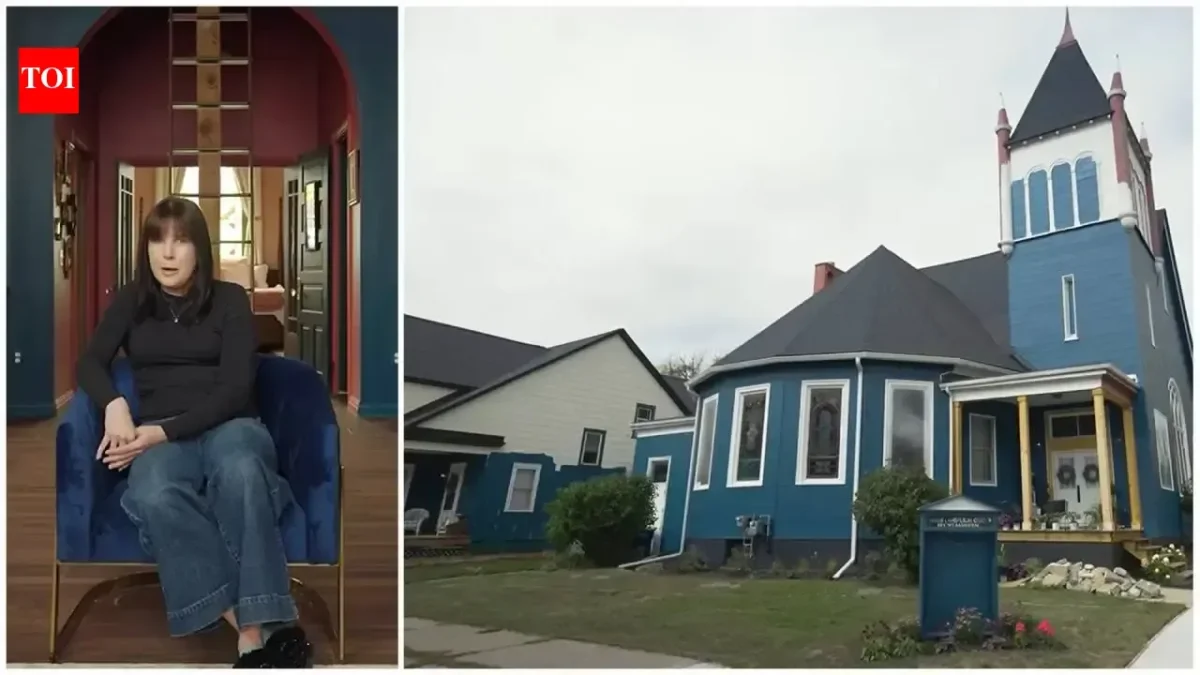
When 45-year-old Whitney Anderson parted with $45,000 in cash to secure a crumbling, 128-year-old abandoned church in rural Michigan, she knew the purchase was only the beginning of a high-stakes gamble. Having already poured roughly $194,000 into the derelict structure since June 2024, she faces an escalating financial commitment that could top $400,000 before the restoration ends in 2028.
Anderson openly acknowledges the precarious nature of the venture, which she has christened her “chouse” — a church converted into a residential home.
“It’s still 50/50 if this is gonna be a sustainable chouse house, whatever you want to call it, or if it’s going to be what bankrupts me,” Anderson admitted in an interview with CNBC Make It. Yet, despite the towering costs and sleepless nights, she insists that the quiet serenity inside the sanctuary keeps her grounded.
Trading Manhattan Skies for a Neglected Michigan Sanctuary
Before launching her ambitious abandoned church renovation, Anderson lived in New York for more than three decades. The aspiration to inhabit a consecrated building was not an impulse buy; it had taken root during childhood visits to church alongside her grandparents.
Her fascination was sparked not by rigid religious doctrine, but by historical architecture and heritage craftsmanship. As Anderson explained, “It wasn’t necessarily a religious thing, but it was a stained glass thing.”
Determined to make the ambition a reality, Anderson spent between three and four years methodically saving approximately $250,000. Her search ended on property platform Zillow when she stumbled upon a listing for a neglected parsonage that included the adjacent church building.
The sellers had originally listed the house and church combination for $125,000, while marketing the land plot separately for $19,900. Seizing on the severe disrepair of the historic buildings, Anderson negotiated the price down to $45,000, paying entirely in cash to avoid the compounding burden of a mortgage.
The Gruelling Reality of Structural Ruin
Securing the keys proved to be the easiest step in the entire endeavour. When building works commenced in June 2024, Anderson confronted widespread water ingress and decades of deferred maintenance that threatened the very integrity of the timber framing.
Both the main chapel and the adjoining house required immediate, heavy-duty interventions before any living quarters could be rendered habitable.
- Total roof and gutter replacement: Contractors had to seal both properties against water penetration to arrest worsening timber decay.
- Major floor re-engineering: The church hall featured an extreme 18-inch slope, which demanded the installation of bespoke 44-foot structural I-joists to level the foundation.
- Full electrical overhaul: Decades of obsolete, degraded wiring were completely stripped out and replaced to bring the complex up to modern safety standards.
- Hands-on personal labour: Anderson carried out demolition, subfloor installation, plasterboard work, and interior decorating herself to stretch her remaining funds.
Despite previous experience reviving run-down properties, Anderson described this particular undertaking as a “house flip on steroids”, made more demanding because she was building a permanent residence rather than seeking a quick commercial sale.
She lived on site for roughly 18 months, effectively camping in raw, unheated spaces while managing unfamiliar contractors in a remote town where she initially knew no one.
Repurposing History: From Pews to Kitchen Islands
Rather than stripping the chapel of its heritage, Anderson set out to salvage as much authentic period joinery as possible, ensuring the property retained its character.
Original timber pews were dismantled and shortened to fashion unique dining chairs, while leftover pew sections were crafted into an expansive library wall equipped with bespoke shelving and a rolling library ladder. The dining table itself was constructed predominantly from reclaimed church seating.
In the kitchen, an antique entrance door and a salvaged communion table discovered among the debris were refashioned into a statement kitchen island. Anderson paired these reclaimed elements with a pellet stove for cost-effective winter heating, exposed historic brickwork, and preserved every vantage point framing the stained-glass lancet windows.
National Television and the Push Toward 2029
The project received welcome momentum in March 2025 when Anderson joined the cast of Magnolia’s Home Reimagined. The production assisted with cabinetry, high-grade kitchen appliances, countertop slabs, and custom joinery labour for her library wall, providing a timely boost to her diminishing reserves.
Even with external support, the running cost has climbed to roughly $194,000, forcing Anderson to pause certain works while she rebuilds her bank balance. Critical tasks, including intricate repairs to several historic stained-glass panels and finishing the master bathroom, remain on hold.
Her longer-term commercial vision centres on transforming the adjoining parsonage into a boutique bed and breakfast by late 2028 or the spring of 2029. While repurposing ecclesiastical buildings occasionally attracts criticism from those who prefer former places of worship to remain untouched, local neighbours have largely commended her for rescuing a local landmark from demolition.
Anderson remains resolute about seeing the restoration through to completion, convinced that the sanctuary she is constructing will justify every penny spent.
💡 Tackling a derelict heritage conversion requires an extraordinary blend of capital, patience, and physical resilience. As property prices push traditional buyers toward unconventional structures, projects of this scale reveal both the immense romance and the brutal financial peril of rescuing historical buildings.
🔍 Restoring irreplaceable features like stained glass and century-old timber joinery often costs significantly more than standard modern refurbishments, requiring specialist conservation skills that quickly test domestic budgets.
📌 For Anderson, the calculated risk of transformation outweighs the safety of keeping her savings untouched in an ordinary bank account.
👇 Would you ever risk your life savings to convert an abandoned church or historic chapel into a modern home? Share your thoughts and renovation experiences in the comments below.
Source: timesofindia.indiatimes.com
 1
 2
 3
 4