
Submerged Off Norway’s Coast, a 66-Pound Grooved Rock May Rewrite Maritime History as the World’s Oldest Anchor

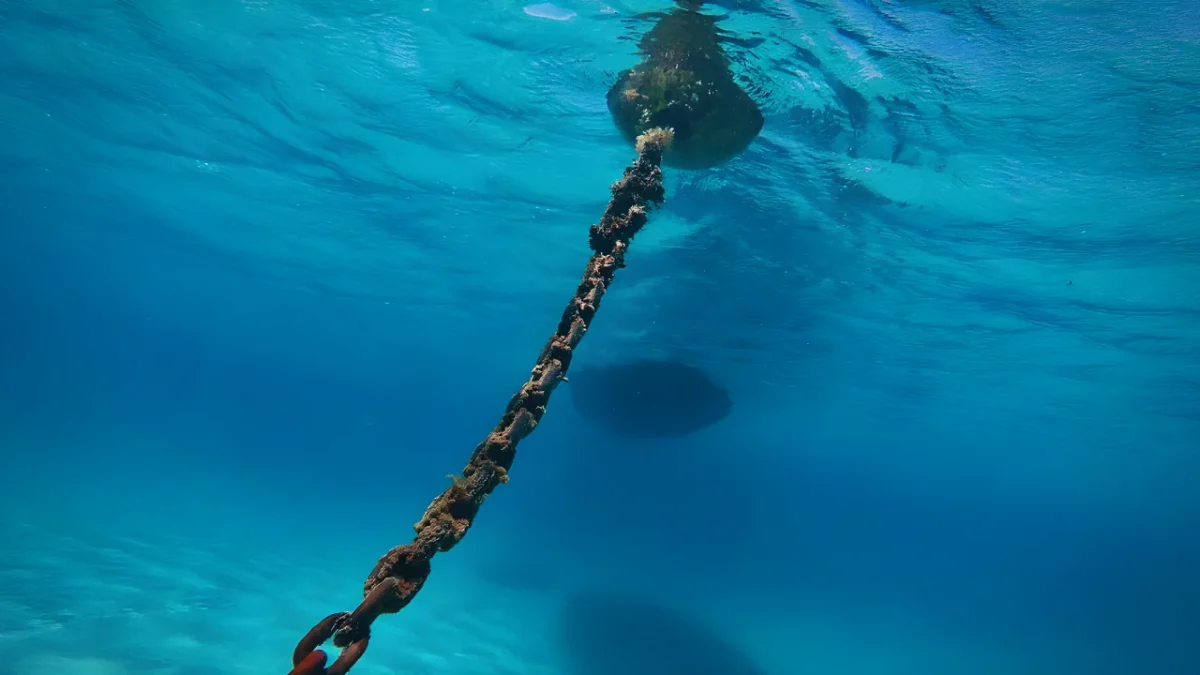
Submerged 65 feet beneath the choppy surface of the North Sea, a deliberately shaped 66-pound boulder may officially rewrite the history of navigation. Marine archaeologists exploring the waters around Hespriholmen—a tiny, uninhabited rocky islet west of Norway’s mainland—uncovered a grooved stone that researchers believe is the world’s earliest recognized ancient anchor. Dating between 5,000 and 9,000 years old, this single relic predates previous Mediterranean discoveries from the Bronze Age by millennia, challenging long-held assumptions about prehistoric maritime engineering.
The discovery occurred during a reexamination of a Stone Age greenstone quarry first rediscovered in 1923. Stone Age craftsmen traveled to this isolated outpost to extract raw greenstone used to craft ceremonial axes distributed across Norway. Yet resting inside an underwater waste heap, one peculiar artifact immediately caught the dive team’s attention: a heavy, intentionally rounded stone featuring a carved channel encircling its entire midsection.
That deliberate groove offered immediate clues to researchers investigating prehistoric tools.
“I’m absolutely convinced that this served as an anchor. Such a find almost anywhere else would not have been so remarkable, but when it’s lying here in a waste heap from an Early Stone Age quarry, I have no doubt.” — Leif Inge Astveit, University Museum of Bergen
Challenging the Myth of Primitive Stone Age Boating
A widespread misconception across maritime archaeology suggests that Stone Age seafarers possessed rudimentary navigation skills and had no concept of deep-water anchoring. Prevailing historical wisdom maintained that early hunters and gatherers simply beached their dugouts or canoes on shorelines rather than anchoring in open currents.
The physical realities of Hespriholmen completely dismantle that assumption. The islet spans just three acres and is surrounded by treacherous swells, rocky shallows, and volatile tides. Bringing a vessel directly ashore without destroying it would have been nearly impossible under typical North Sea conditions.
To safely extract greenstone without losing their vessels to the crashing surf, prehistoric miners needed a reliable way to keep their craft motionless in deep water.
“It seemed very well balanced, easy to pull up with a simple rope. None of us has ever seen anything like it. This is very special.” — Arild Skjaeveland Vivas, Stavanger Maritime Museum
Engineering the 66-Pound North Sea Mooring
The physical design of the artifact reveals practical, intentional engineering. The carved channel running the stone’s circumference served a direct functional purpose: securing a heavy rope without the line slipping off under tension.
Weighing 66 pounds, the stone provided sufficient mass to pin a vessel against North Sea tides while remaining manageable for a small crew to haul back to the surface. Independent researchers, including NTNU University Museum professor emeritus Hein Bjerck, endorse the interpretation, pointing to its unmistakable location within the mining debris.
| Feature | Hespriholmen Artifact Profile |
|---|---|
| Estimated Age | 5,000 to 9,000 years old (Stone Age) |
| Total Weight | Approximately 66 pounds |
| Depth Found | 65 feet below surface |
| Key Modification | Continuous hand-carved perimeter groove |
| Previous Record Holder | Mediterranean Bronze Age stone anchors |
What Kind of Boat Did It Anchor?
The presence of an advanced ancient anchor inevitably forces experts to rethink the crafts operating in northern Europe during the period. While hollowed-out log boats were widely used in southern Scandinavia, experts emphasize that a heavy wooden dugout would have struggled in the volatile waters around this remote islet.
Researchers suspect these intrepid miners relied instead on sophisticated skin-on-frame boats—similar to traditional umiaks used by Inuit communities—or robust ocean rafts. These flexible, buoyant hulls could absorb wave impacts while resting safely tethered to the seabed below.
Archaeologists estimate that prehistoric workers removed up to 15,000 cubic feet of greenstone from Hespriholmen over generations—equivalent to roughly 40 modern truckloads. Hauling that volume across open sea required specialized logistics, making a dependable mooring device essential to the entire extraction process.
💬 Discoveries like this prove our prehistoric ancestors possessed far more mechanical ingenuity than conventional history credits them for.
✨ As the find undergoes formal peer review, it stands as a game-changing look into humanity’s earliest maritime roots.
👇 How advanced do you think Stone Age seafaring really was? Drop your thoughts in the comments below!
 1
 2
 3
 4
