
Archaeologists Solve the Age of a Massive 180-Foot ‘Antennae Tomb’ in Western Sahara, Uncovering a 4,000-Year-Old Skeleton

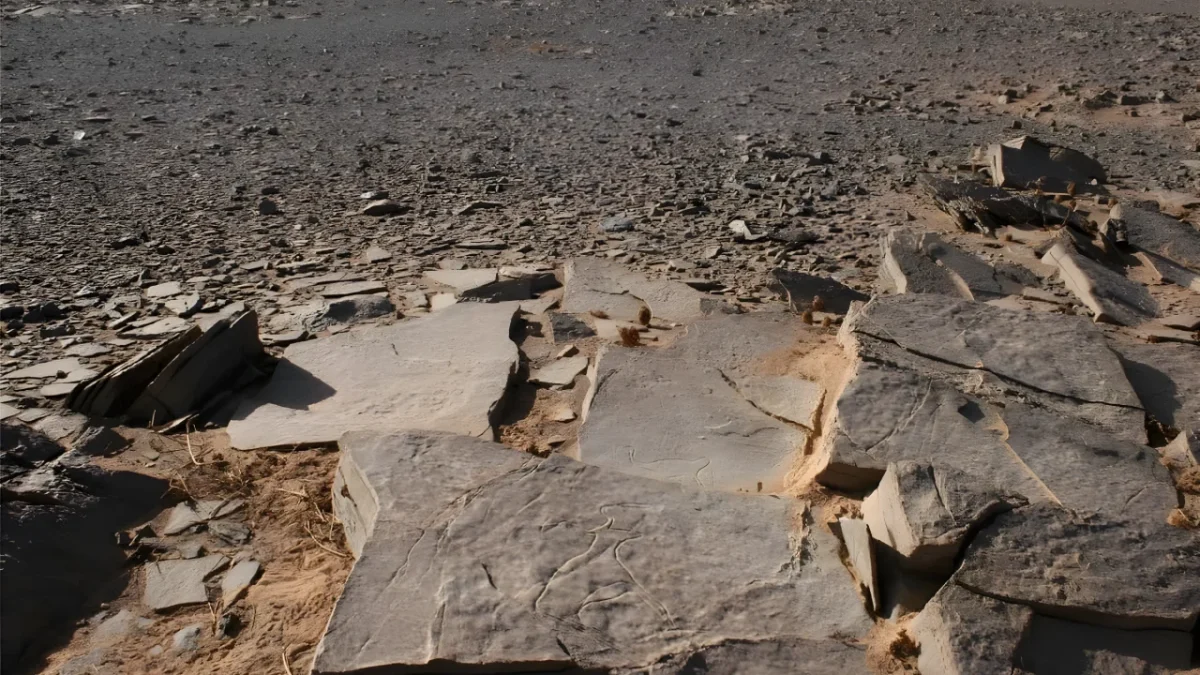
A massive 180-foot-long stone tomb rising from the remote gravel plains of northern Western Sahara has officially yielded its secrets. Scientists have dated the burial structure to between 2467 and 2150 BC, confirming that an undisturbed skeleton discovered beneath its central mound was laid to rest more than 4,000 years ago alongside four delicate ostrich eggshell beads.
The monument sits near a dry desert riverbed known as Wadi Lawash el Telli. While mysterious stone landmarks dot the Sahara, extreme desert conditions and degraded organic remains have made them notoriously difficult to excavate and date.
Now, research published in the African Archaeological Review delivers the first direct radiocarbon timeline for an antennae tomb in the Atlantic Sahara. Yet while the burial date is finally settled, the true purpose behind its massive stone arms pointing toward the desert horizon remains an unsolved riddle.
The Anatomy of a 179-Foot Desert Enigma
The monument measures 54.5 meters (179 feet) across the arid terrain. At its western anchor sits an oval mound of carefully piled limestone slabs, spanning 12.5 meters along its primary axis and standing less than three meters tall.
What makes the structure instantly recognizable from above are two straight, sprawling rows of stone that branch out from the mound in an open V shape. Researchers refer to these elongated stone rows as antennae.
Every slab used in the monument was collected locally and stacked completely dry, without mortar. Because the stones were light enough to be hauled by single individuals, building the structure did not require an empire—a small, coordinated community could have erected the entire monument.
One striking detail caught the survey team’s attention: both stone antennae stretch toward 102 degrees from geographic north, orienting the open arms just slightly south of due east.
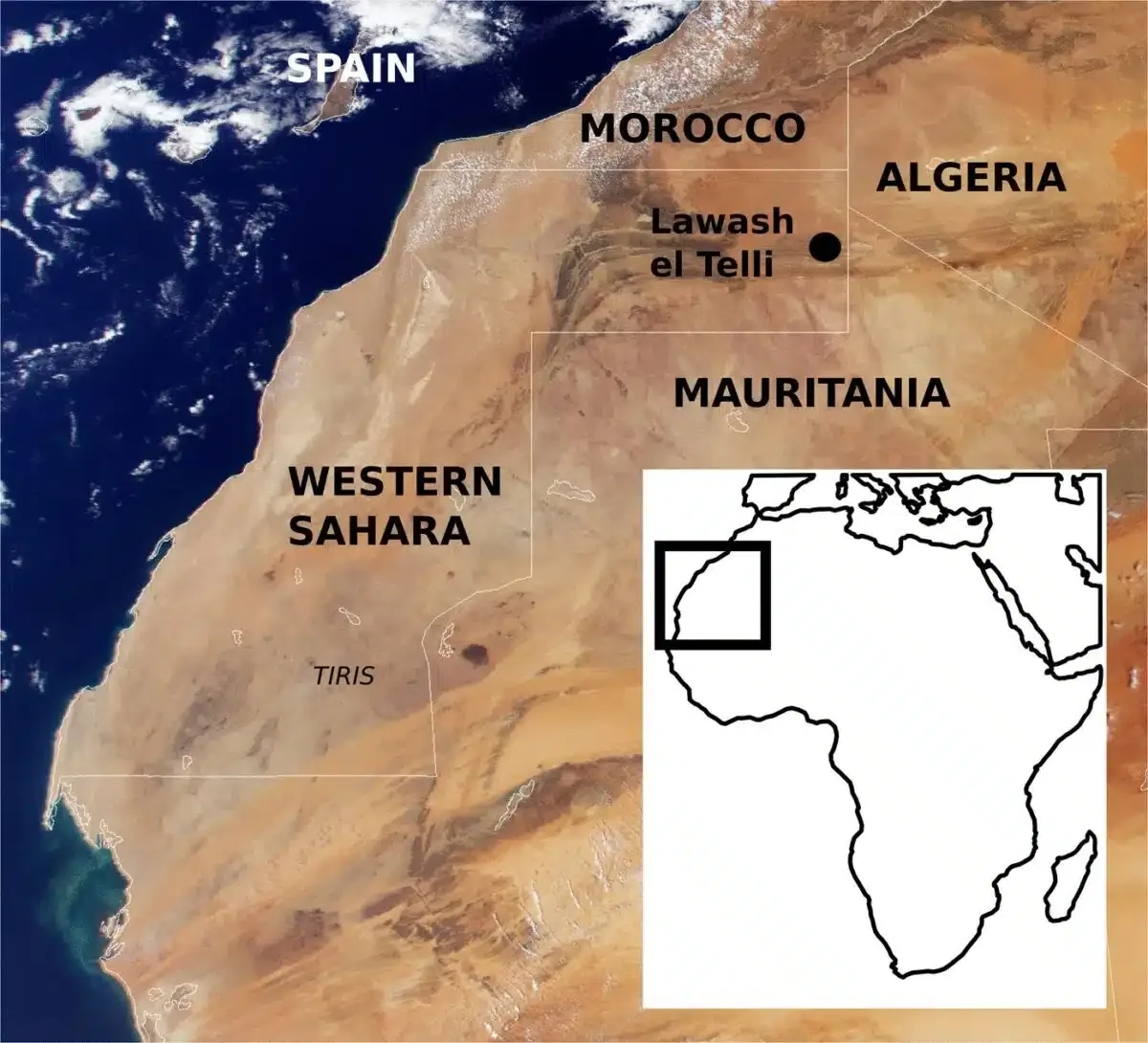
Location of Lawash el Telli in northern Western Sahara
A Pristine Burial Beneath Massive Slabs
Archaeologists first excavated the central mound at Lawash el Telli in April 2018. Beneath heavy capstones, they uncovered an intact, undisturbed grave that had escaped ancient looters for over four millennia.
The individual was laid directly on the original ground surface rather than inside an excavated pit. The body was arranged lying on its back, with the head oriented toward the south and legs bent toward the west.
An examination of the surviving teeth revealed that the person died in young adulthood, between 25 and 35 years old. Because the fragile pelvis had decomposed over thousands of years, researchers could not confirm biological sex.
Tucked beside the deceased were just four small personal artifacts: circular beads crafted from ostrich eggshell, likely remnants of an ancient necklace or hair ornament commonly traded across prehistoric North Africa.
Directly dating human remains in hyper-arid environments often requires testing the mineral fraction of bone when ancient collagen has completely degraded.
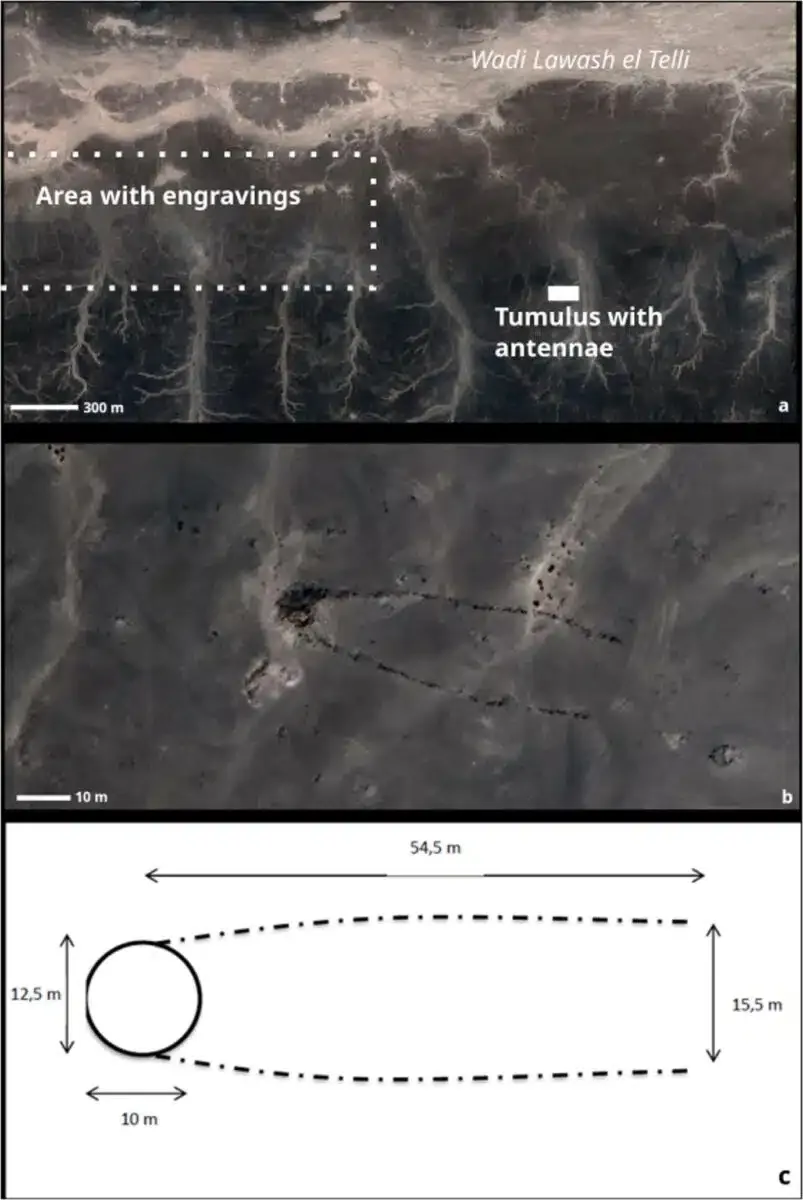
Aerial views and diagram of the stone tomb at Lawash el Telli in Western Sahara
Overcoming the Dating Hurdle
Pinpointing the exact era of the Lawash el Telli tomb proved to be an agonizing technical challenge. Initial tests conducted in 2018 hit a dead end because the bone samples lacked sufficient collagen, the primary organic protein required for standard radiocarbon assays.
The breakthrough came when scientists pivoted to testing the mineral apatite fraction of two skeletal elements. Both tests yielded consistent results, placing the burial squarely in the third millennium BC.
- Excavation (2018): Researchers uncover the undisturbed skeleton beneath limestone slabs at Wadi Lawash el Telli.
- Initial Collagen Dating Failure: Severe desert aridity leaves zero recoverable organic collagen for standard testing.
- Mineral Fraction Breakthrough: Testing the mineral matrix yields matching chronological dates of 2467 to 2150 BC.
Separating Fact from Fiction: Sahara Stone Monuments
Giant stone alignments in deserts often spark rampant speculation regarding astronomical observatories or massive labor forces. The empirical evidence paints a much more grounded reality.
| Common Misconception | Documented Archaeological Fact |
|---|---|
| Built by vast armies or lost civilizations | Constructed from small, local limestone slabs manageable by small family or tribal groups |
| Deep underground royal crypt | Surface-level single interment placed directly on the desert soil under stacked rocks |
| Random pile of cleared field stones | Carefully engineered 179-foot alignment deliberately oriented 102 degrees east |
| Lifeless desert at the time of construction | Surrounding rock art reveals an ecosystem once home to cattle, giraffes, and elephants |
Just kilometers away sits Sluguilla Lawash, a massive prehistoric open-air gallery containing roughly 1,140 carved rocks and 2,068 individual figures spanning 27 kilometers. The carvings depict cattle, ostriches, giraffes, elephants, and rhinos—evidence of a shifting climate that once sustained abundant wildlife.
Many of these carvings match the regional Tazina tradition, dated between 6,500 and 3,500 years old. The nearby antennae monument marks the era when local pastoral groups shifted away from simple below-ground burials toward towering stone architecture.
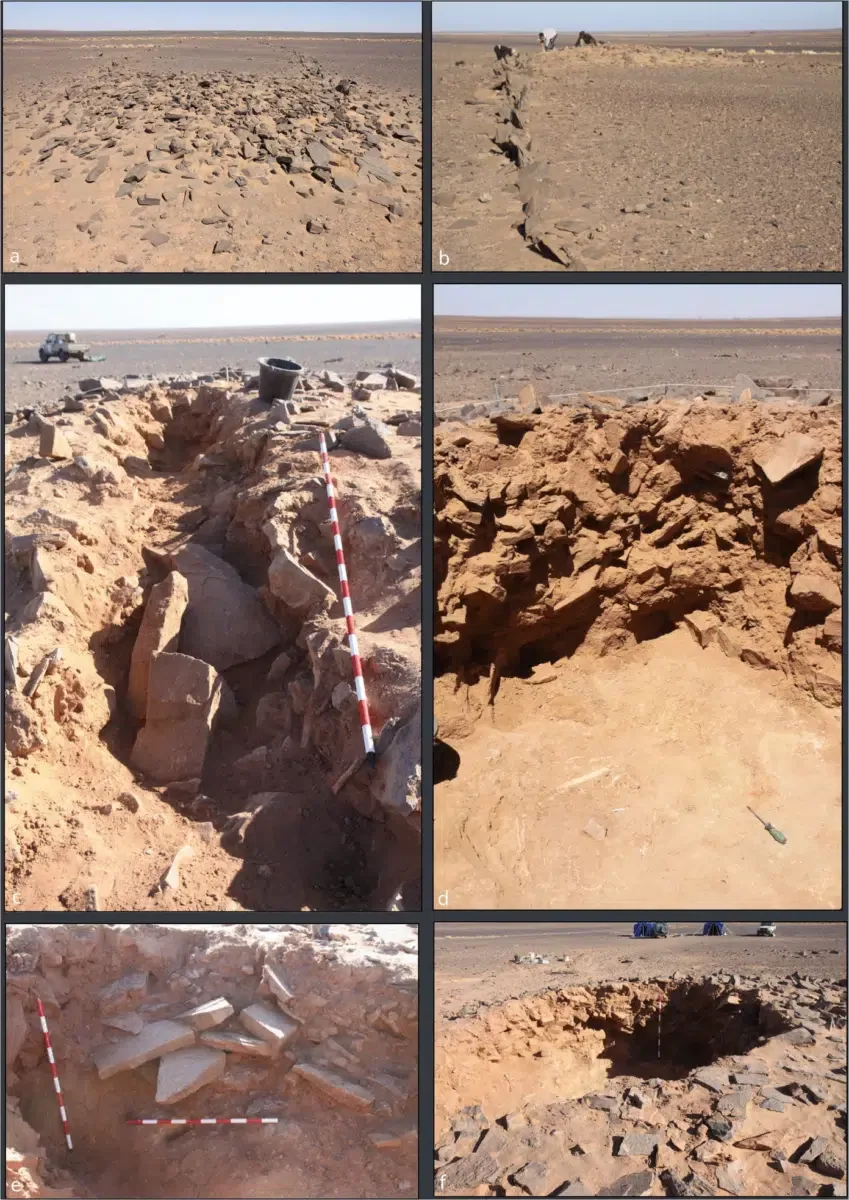
The stone burial mound, one of its long antennae, and stages of the excavation
Why prehistoric builders directed those 179-foot limestone rows toward the eastern sunrise remains an enduring archaeological question. But the identity of the young nomad who inspired the monument is no longer lost to time.
✨ The vast sands of the Sahara continue to surrender their oldest secrets to modern science.
💬 Ancient burial rites often tell us far more about how early cultures viewed the cosmos than how they lived day to day.
👇 What do you think those massive eastward-pointing stone antennae were built to signal? Drop your thoughts in the comments below!
 1
 2
 3
 4
