
Buried Alive Side by Side: How a Fractured Amphibian and a Furry Ancestor Solved a 250-Million-Year-Old Mystery at Oliviershoek Pass

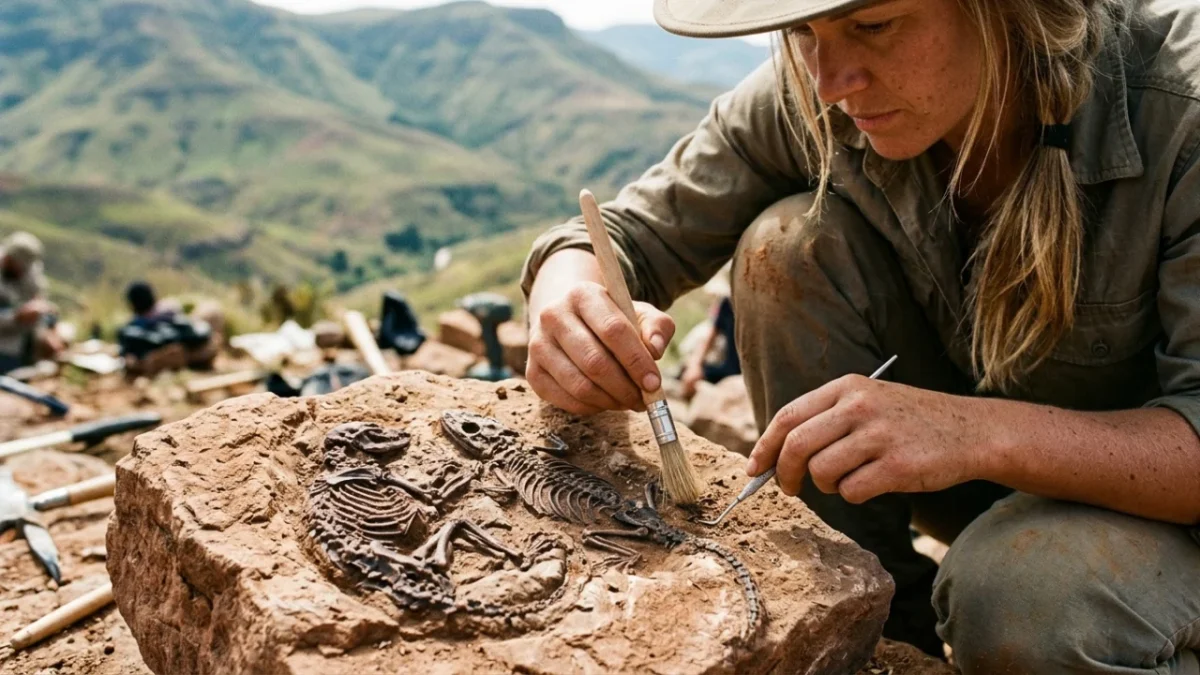
When palaeontologists cracked open a dense sandstone burrow cast unearthed near South Africa’s scenic Oliviershoek Pass, they discovered two completely unrelated ancient skeletons curled together in perpetual sleep: an injured amphibian resting against the spine of a mammal ancestor. The remarkable Thrinaxodon Broomistega fossil captured a fleeting moment of interspecies tolerance 250 million years ago, directly following Earth’s greatest mass extinction.
The discovery baffled scientists for decades after its initial recovery from the Karoo Basin. Why would an early terrestrial carnivore share its personal sanctuary with a wounded outsider?
The answer lay hidden within the rock itself, waiting for particle physics to illuminate a tragic prehistoric emergency.
The Odd Couple of the Karoo Basin
The specimen preserves two astonishingly distinct animals sealed within a tight subterranean space. The primary occupant, Thrinaxodon liorhinus, belonged to the cynodonts—a lineage of proto-mammals that boasted whiskers, specialized teeth, and early adaptations toward warm-bloodedness.
Tucked directly over the cynodont’s ribs lay Broomistega putterilli, a temnospondyl amphibian adapted for aquatic survival. Outside this burrow, both animals lived entirely separate lives in a harsh, devastated landscape.
This unusual association prompted multiple theories, from predation to accidental post-mortem washing. Yet neither animal displayed marks of scavenging, dismemberment, or territorial combat.
What the Synchrotron Radiation Revealed
Because preparing the fragile block with traditional tools risked destroying the intertwined bones, researchers took the fossil to the European Synchrotron Radiation Facility. The ultra-bright X-ray beam pierced the dense rock without causing physical damage, producing high-resolution three-dimensional digital reconstructions of the buried chamber.
- Broken Ribs: The digital cross-sections revealed that the Broomistega suffered several fractured ribs before death, with healing bone indicating it was crippled but alive when it crawled inside.
- Aestivation Stance: The Thrinaxodon was curled in a tight ring, mirroring modern mammals during torpor or seasonal aestivation to survive extreme heat and drought.
- Passive Intrusion: The amphibian had wormed its way into the burrow headfirst, settling over the sleeping cynodont without disturbing its dormant host.
- Sudden Burial: A rapid influx of fine mud—likely generated by a flash flood—flooded the tunnel, suffocating both creatures instantly and preserving them undisturbed for an eternity.
Surviving the Great Dying in Subterranean Sanctuaries
The shared tomb dates directly to the Early Triassic period, in the immediate wake of the Permian-Triassic extinction event. Often dubbed the Great Dying, this planetary catastrophe wiped out roughly 90 per cent of all marine life and 70 per cent of terrestrial vertebrate species.
The ancient Karoo became an unforgiving crucible of volatile temperature swings, scarce water, and frequent flash floods. Burrowing became the ultimate survival strategy against scorching winds and erratic weather.
For small vertebrates, digging underground offered a stable microclimate insulated from lethal surface extremes.
Palaeontologists conclude that the injured Broomistega, desperate for shelter and unable to dig its own tunnel, took advantage of an open burrow entrance. Because the resident Thrinaxodon was deep in a state of torpor, it never reacted to the uninvited guest.
Rewriting the Rules of Ancient Animal Behaviour
Fossils that preserve physical anatomy are common, but fossils that capture direct animal behaviour frozen mid-action are vanishingly rare. The partnership captured at Oliviershoek Pass offers unprecedented proof of burrow-sharing—known as synhospitality—dating back a quarter of a billion years.
Modern animals often practice this out of necessity. Desert tortoises regularly tolerate snakes, lizards, and small mammals within their underground tunnels when extreme weather strikes.
The Thrinaxodon Broomistega fossil proves this survival instinct emerged long before dinosaurs ruled the Earth.
💡 Prehistoric survival frequently hinged not on fierce competition, but on opportunistic cohabitation during climatic crises.
🔍 Advanced non-invasive scanning technology continues to uncover hidden interactions between long-extinct species without breaking a single fossilised bone.
📌 What do you find most surprising about this 250-million-year-old subterranean truce? Share your perspective in the comments below.
 1
 2
 3
 4