
Driverless Monorail Smashes Into Fallen Construction Crane in São Paulo, Raining Heavy Debris Onto Crowded Highway Below

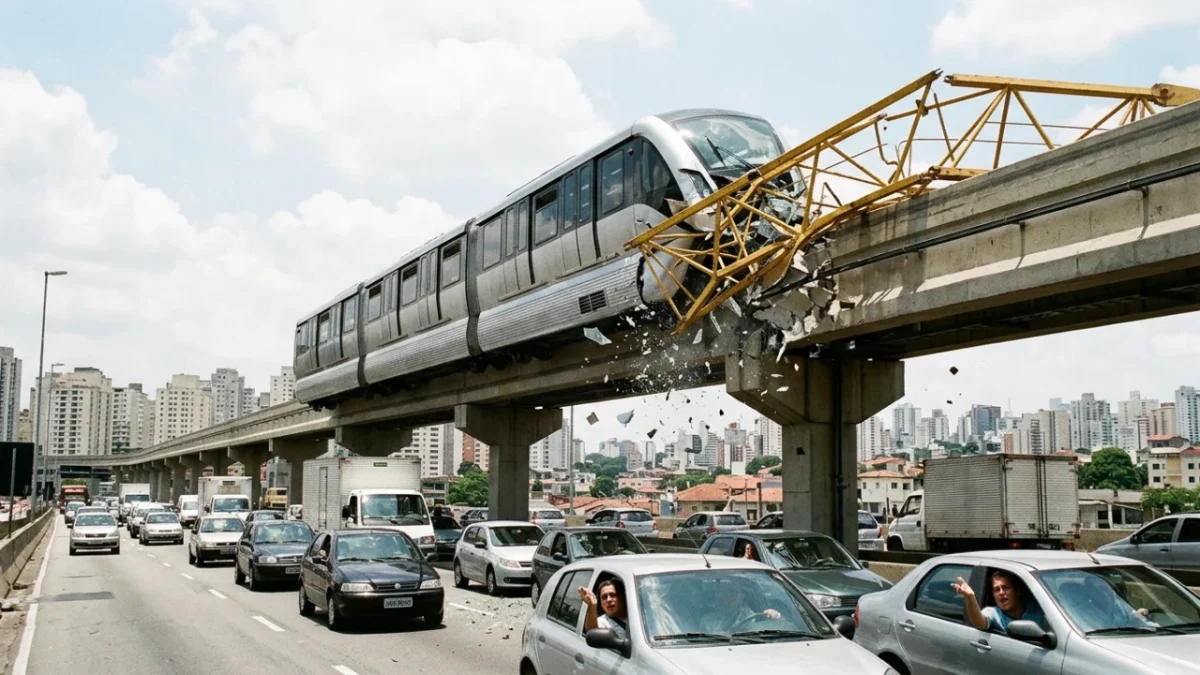
A driverless transit train travelling along an elevated beam collided directly with a collapsed construction crane in eastern São Paulo, sending mangled wreckage plummeting into live traffic on the busy highway beneath.
The high-impact driverless train crane collision occurred along Avenida Professor Luiz Ignácio de Anhaia Mello in the Vila Prudente district. While commuter cars beneath the tracks dodged falling metal by mere metres, all passengers aboard the automated service escaped physical injury.
The crane operator sustained injuries during the structural collapse and received on-site rescue care before transport to medical facilities.
How the Elevated Disaster Unfolded on Line 15-Silver
The collision unfolded near Camilo Haddad station on São Paulo’s Line 15-Silver (Linha 15-Prata), a key mass-transit monorail route operating on elevated concrete tracks. A crane operating at an adjacent work site suddenly failed, toppling directly across the raised guideway.
Operating under automated control without an onboard human driver, the train encountered the heavy machinery directly in its path. The system was unable to brake in time, ramming into the steel boom at transit speed.
The impact tore the construction equipment apart, launching twisted metal, fractured components, and heavy debris over the parapets and straight onto the roadway below.
Vehicles navigating the avenue beneath experienced a harrowing near-miss as heavy chunks smashed into a perimeter wall and damaged parked cars, leaving through-traffic scrambling to avoid the falling steel.
Rapid Evacuation and Commuter Disruption
Emergency response crews rushed to the Vila Prudente corridor to secure both the street level and the elevated guideway. Rescuers quickly reached the injured crane operator, while transit teams coordinated the immediate evacuation of everyone trapped aboard the impacted monorail.
Transit authority Metrô stepped in swiftly to manage the fallout along the corridor, dispatching alternative bus operations to move stranded passengers between stations.
- Casualties: Zero fatalities among commuters and drivers; the crane operator was treated for non-fatal injuries.
- Ground impact: Wreckage shattered against roadside structures and parked vehicles without crushing passing traffic.
- Transit response: Emergency buses deployed to bridge disrupted connections across Line 15-Silver.
System Vulnerabilities and the Limits of Automation
Autonomous rail networks rely extensively on track sensors and emergency signal cut-offs to prevent collisions. However, an external obstruction falling directly across elevated beams from outside the transit perimeter presents an acute operational hazard for automated lines.
When heavy equipment abruptly breaches an overhead envelope between signalling blocks, braking margins shrink dramatically. Investigators are examining why the crane collapsed and how automated obstacle-detection protocols respond to physical intrusions descending from overhead construction zones.
Municipal authorities have withheld an official cause pending a full engineering inspection of the construction site and the structural integrity of the monorail beam.
💡 The dramatic incident underscores the critical safety challenges facing dense metropolitan transit systems when heavy private development occurs mere feet from elevated, high-speed rail lines.
🔍 As urban corridors worldwide expand automated mass transit beside active high-rise construction, fail-safe perimeter monitoring is facing renewed international scrutiny.
👇 Do modern automated trains need advanced visual radar to stop for fallen overhead debris, or should construction exclusion zones simply be made wider? Share your thoughts below.
 1
 2
 3
 4