
October Hunter’s Moon Lights Up the Sky Tonight—Here Is the Real Science Behind Its Massive Orange Glow and Why It Is Not a Supermoon

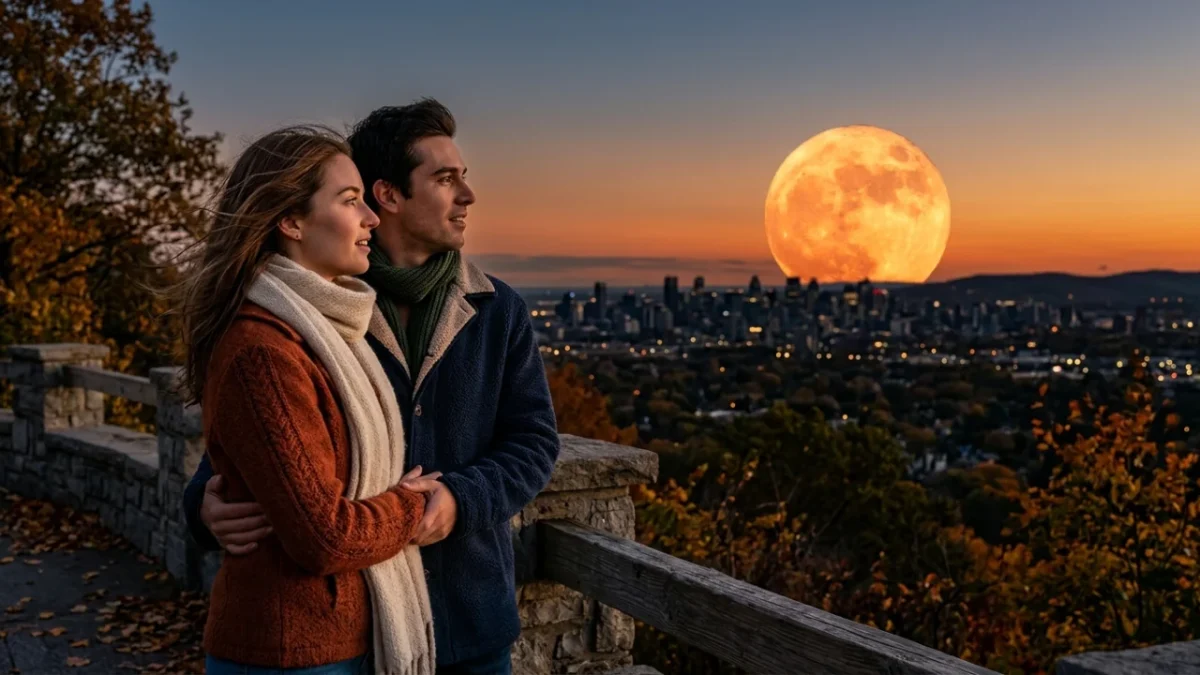
The luminous sphere dominating the skyline tonight is the celebrated October Hunter’s Moon, but despite widespread speculation sweeping across social media, astronomical data confirms it is an ordinary full moon rather than an amplified supermoon. While its fiery size near the horizon will stop evening commuters in their tracks, the breathtaking spectacle is a masterclass in atmospheric physics rather than unusual lunar proximity.
Lunar cycles dictate that peak illumination arrives as our natural satellite sits directly opposite the Sun, casting brilliant light across the British autumn landscape.
Yet thousands looking eastward will swear the lunar disk appears substantially larger and noticeably more amber than usual.
The Supermoon Myth Debunked by Orbital Science
A true supermoon requires the lunar orb to reach its full phase while simultaneously travelling near perigee, the point in its elliptical orbit closest to Earth. Tonight’s October Hunter’s Moon does not meet those rigorous physical criteria.
The moon’s orbit is eccentric rather than circular, constantly expanding and contracting its distance from our planet. When an ordinary full moon peaks further along this cosmic path, it does not achieve the heightened threshold needed to claim supermoon status.
The visual drama you see tonight is an atmospheric reality rather than a gravitational shortcut.
The Low-Horizon Optical Trick
When the moon rises just above rooftops and tree lines, its light travels through a significantly thicker blanket of Earth’s atmosphere than when overhead.
This air layer scatters short blue wavelengths, permitting only the longer, fiery red and amber bands to reach human eyes. Combined with the famous optical trick where the brain compares the low moon against distant buildings, the orb appears colossal and deeply coloured.
Why This Autumn Spectacle Earned Its Name
Centuries before modern artificial lighting, rural communities across the Northern Hemisphere relied entirely on lunar phases to organise seasonal labour. The October Hunter’s Moon historically follows the Harvest Moon, heralding the rapid approach of winter.
With fields freshly cleared of crops, wild game stepped into open farmland to scavenge, leaving them clearly visible under the unusually persistent dusk light.
Astronomers and skywatchers highlight several key aspects to appreciate during this evening’s event:
- Extended Evening Brightness: Because the moon’s orbit meets the horizon at a shallow autumn angle, it rises remarkably close to sunset for several successive evenings.
- Dynamic Colour Shift: The striking copper hue fades rapidly within an hour, transitioning into brilliant silver-white as the orb climbs into clearer skies.
- Astrological Alignment: Astrologers mark this celestial event in the sign of Taurus, historically associating the period with themes of financial security, stability, and preparation for leaner months.
You do not need specialised telescopes or binoculars to enjoy the display, as the naked eye easily captures the dramatic transition at moonrise.
💡 For the most dramatic view, find an unobstructed vantage point facing due east just as the sun sets, allowing natural landmarks to enhance the famous illusion.
🔍 Checking local Met Office forecasts will help you pinpoint when cloud breaks offer optimal visibility across your area.
📌 As autumn temperatures continue to drop, tonight’s luminous sky offers a classic reminder of the seasonal shift heading into November.
👇 Have you spotted the glowing orange horizon where you are tonight? Share your view in the comments below.
 1
 2
 3
 4