
Scientists Recreated 5,000-Year-Old Egyptian Blue Using 12 Ancient Recipes—and Finally Solved Why Its Shades Drastically Shift

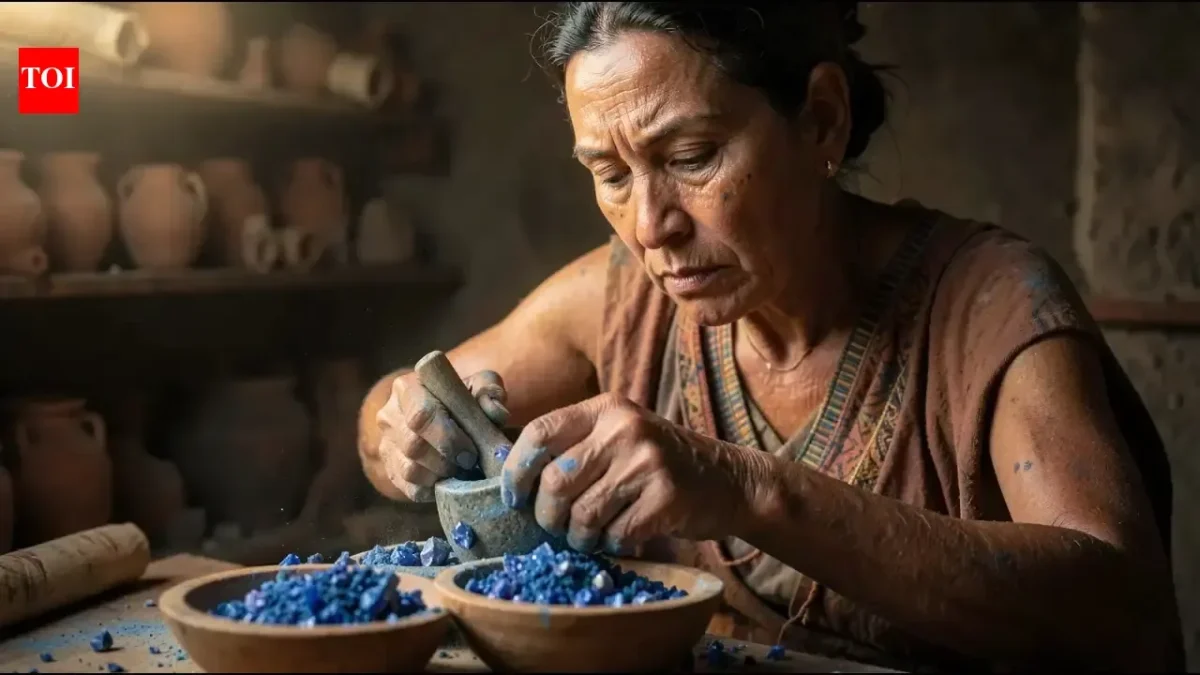
Egyptian blue can shift dramatically from an intense, brilliant azure to a dull grey-green or yellowish hue, and modern material science has finally proven exactly why. By reconstructing the world’s oldest synthetic pigment across 12 distinct laboratory recipes, researchers discovered that the final shade does not simply come down to cooking time, but rather an intricate chemical balancing act between crystal formation, particle sizing, and cooling speed.
Led by Washington State University in collaboration with the Smithsonian’s Museum Conservation Institute and the Carnegie Museum of Natural History, the study directly tested how subtle shifts in workshop ingredients transformed this 5,000-year-old compound.
The breakthrough, published in npj Heritage Science, uncovers how ancient artisans manipulated raw minerals—and why two artifacts coated in the exact same recipe can look completely different to the naked eye.
The 1,832°F Kitchen: How Researchers Rebuilt an Ancient Formula
Dating back to roughly 3100 BCE, Egyptian blue gave dynastic artisans a reliable, manufactured alternative to rare, costly minerals like lapis lazuli and turquoise.
At its chemical core sits cuprorivaite, a calcium copper silicate that gives the compound its signature hue. Yet ancient pigment cakes were never chemically pure.
To pinpoint how impurities alter the visual result, the research team blended silica, a calcium source, and various copper sources—including laboratory-grade copper oxide, azurite, and malachite. Some batches included sodium carbonate (soda) to act as a flux, lowering melting thresholds and encouraging chemical reactions.
The team fired 12 experimental formulations at 1,000 degrees Celsius (1,832 degrees Fahrenheit) for intervals spanning between 1 and 11 hours. They then deployed advanced tools, including X-ray diffraction, electron microscopy, and X-ray nano-computed tomography, comparing their lab-grown samples against original pigments scraped from two Egyptian artifacts dating back 2,300 to 3,400 years.
The project was intended to highlight how modern science can reveal hidden stories in ancient Egyptian objects, explained Washington State University researcher John McCloy.
The Color Riddle: Why Did Some Batches Turn Green?
For decades, many assumed a greener or paler Egyptian pigment was simply degraded by time or low on copper.
The experimental results completely bust this myth: Egyptian blue does not rely solely on how much blue-producing mineral it contains to project a vivid hue.
The WSU-led experiments revealed that achieving a deep, saturated blue requires cuprorivaite to make up at least 35% of the total weight. However, pushing that concentration above 50% yielded virtually no additional color benefit.
Instead, secondary minerals dictated whether the pigment looked like bright sky or murky pond water. Formulations containing soda formed a copper-bearing, glassy matrix that skewed the visible tone straight into green. Similarly, the presence of wollastonite—a calcium silicate mineral capable of holding copper—pulled the pigment away from pure azure.
The Hidden Role of Copper Sources and Cooling
The origin of the raw copper proved equally decisive.
A formula built with malachite formed a striking blue after just 1 hour inside the kiln. In contrast, an identical batch prepared with azurite emerged looking grey-green, an outcome the research team suspects stems from trace mineral impurities.
Cooling dynamics played an equally surprising role in crystal growth. A sample allowed to cool slowly inside the furnace yielded approximately 70% more cuprorivaite than an identical mixture cooled rapidly in open air, resulting in a significantly bluer finished product.
Physical particle size also changed everything: when researchers sorted a commercial sample, particles ground finer than 38 micrometers appeared noticeably paler and less saturated than coarser grains.
| Process Factor | Visual & Structural Impact |
|---|---|
| Cuprorivaite Content | Requires >35% by weight for deep blue; plateaus above 50% |
| Soda Addition (Flux) | Forms copper-rich glass phases that shift pigment toward green |
| Slow Furnace Cooling | Produces ~70% more blue crystals compared to rapid air-cooling |
| Fine Particle Grinding | Scatters light, making particles below 38 micrometers look pale |
| Substrate Surface | Underlying material alters final perceived shade on artifacts |
From Pharaohs to Forensics: Ancient Tech in Modern Labs
Beyond its visible beauty, Egyptian blue holds an extraordinary physical trick: when illuminated under specific wavelengths, it emits invisible near-infrared luminescence.
Conservators use this infrared glow to detect microscopic traces of the pigment on statues that appear completely bare to the naked eye. But modern engineers see applications far beyond museum conservation.
Because the pigment fluoresces reliably under infrared light, researchers are exploring its use in high-security anti-counterfeiting inks and advanced latent fingerprint recovery at crime scenes.
Artifacts featuring this legendary synthetic compound, alongside recreated experimental batches, are slated for display at the Carnegie Museum of Natural History’s upcoming Egypt on the Nile exhibition, opening May 1, 2027.
✨ Ancient Egyptian artisans were executing complex chemical engineering thousands of years before modern laboratories existed.
📱 These newly cracked recipes give conservators the exact chemical blueprints needed to preserve vulnerable antiquities worldwide.
💬 What do you find most impressive about ancient manufacturing techniques? Drop your thoughts in the comments below!
👇 Share this discovery with history buffs and science enthusiasts in your network.
 1
 2
 3
 4
