
The Hidden Thermodynamic Tax: Why Every Single Click and Calculation Drains Electricity—And How Nanoscale Magnetic Vortices Could Break the Cycle

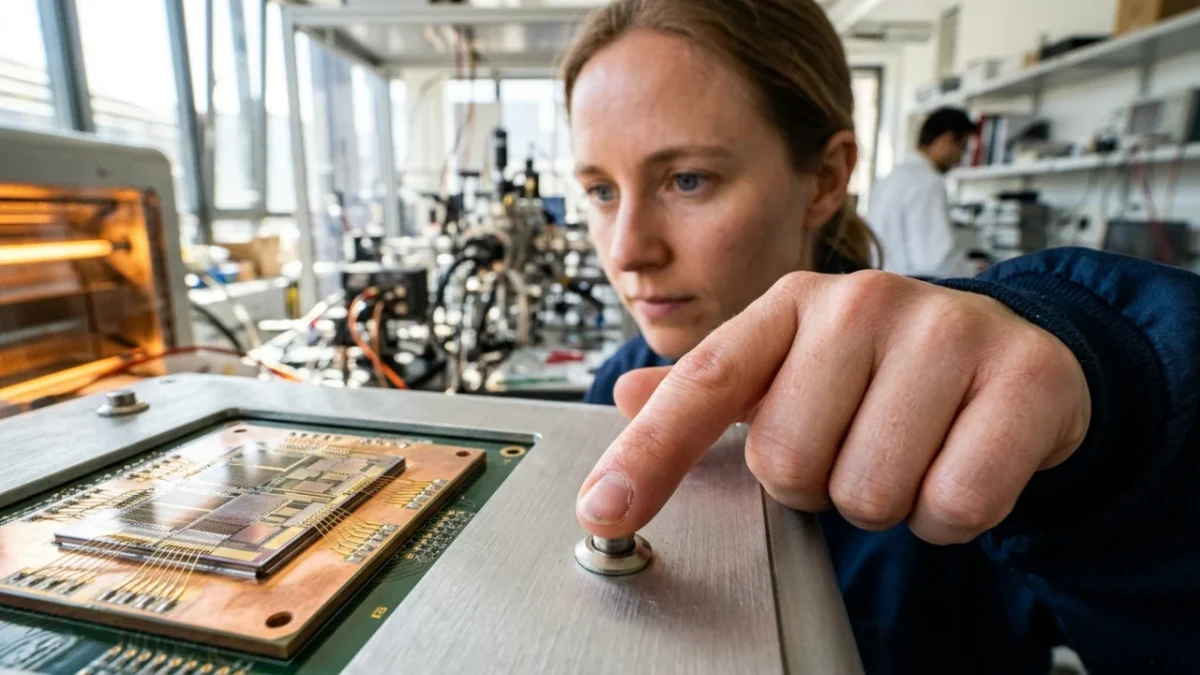
Computers consume electrical power because processing information requires physically shifting billions of electrical charges through microscopic barriers, generating thermodynamic resistance and inescapable heat with every single calculation. Every logic gate flipped from a zero to a one forces electrons through silicon channels, converting pure electric potential directly into thermal waste.
Whether you are running an intense photo-editing suite on a desktop Mac or querying an artificial intelligence engine, your hardware is locked in a constant physical struggle. The energy you draw from the wall does not vanish into the ether; it pays the mechanical toll of moving charge against atomic resistance.
As computational demands spiral across data centres and home workstations, understanding this physical barrier has become the defining technology puzzle of our era.
The Physics of the Friction: Why Moving Bits Demands Work
At the microscopic core of modern processors sits the field-effect transistor. Modern silicon chips pack tens of billions of these microscopic switches onto a surface no larger than a British postage stamp.
To register a single binary state, a transistor must charge or discharge a tiny capacitor, establishing an electrical field that either permits or blocks the flow of current. Pushing those electrons into place requires constant voltage.
Because no conductor is entirely frictionless at room temperature, this frantic shuffle of electrons creates electrical resistance. The inevitable byproduct of that resistance is heat—a physical reality that computer engineers have spent decades trying to suppress.
Thermodynamics enforces an unforgiving baseline. Resetting or altering an information state requires expending a minimum amount of thermodynamic energy, meaning that calculating is fundamentally a physical, work-heavy process rather than an abstract mathematical exercise.
The Silicon Bottleneck: Heat, Resistance, and Data Bloat
Conventional computer architectures separate memory from processing. Every time a processor executes a command, it must physically shuffle data back and forth along microscopic metallic tracks between the processor cores and the system memory.
This perpetual transit consumes substantial wattage before any actual arithmetic occurs. The faster a chip runs, the more frequently it forces electrons down these narrow pathways, causing power consumption to climb sharply.
To keep high-performance hardware from literally burning itself out, engineers rely on sprawling copper heat pipes, liquid cooling systems, and noisy exhaust fans. Yet despite these cooling innovations, traditional architecture is rapidly approaching physical limits where silicon cannot shrink any further without massive electrical leakage.
The Magnetic Alternative: Rewriting the Rules with Spintronics
Rather than pushing physical electrons back and forth along metal tracks, researchers are seeking ways to calculate using the inherent magnetic properties of particles—a field known as spintronics.
A breakthrough published in Nature Nanotechnology reveals that microscopic magnetic vortices called skyrmions could finally provide a way out. Conducted at the Institute of Physics at Johannes Gutenberg University in Mainz, Germany, alongside the Norwegian University of Science and Technology (NTNU), the research demonstrates real-time control over these nanoscale structures.
Asle Sudbø, director of NTNU’s Centre for Quantum Spintronics (QuSpin), notes that these tiny magnetic whirlpools can store and manipulate information in an entirely new way. Instead of requiring constant currents to maintain a binary state, skyrmions hold their structure naturally within an atomic lattice.
During the study, researchers filmed an organised skyrmion lattice melting in real time while simultaneously altering the size and shape of individual vortices on the fly. This level of physical control means data can be stored, shifted, and processed without shifting massive streams of electric charge.
- Zero Charge Shuffling: Information moves via spin waves and magnetic alignment rather than bulky electrical current.
- Drastically Lower Heat: Because electrons do not physically charge down a wire, parasitic resistance drops near zero.
- Biological Brain Efficiency: Processing resembles biological synapses, which complete immense cognitive tasks using barely 20 watts of power.
- Non-Volatile Retention: Magnetic states remain stable even when current is removed, eliminating the standby power drain of modern RAM.
The Path Toward Neuromorphic Hardware
The human brain remains the gold standard of energy-efficient computation. It manages sensory analysis, motor control, and abstract thought simultaneously while consuming less power than a standard household lightbulb.
Biological brains accomplish this by uniting memory and processing into the same neural structures. Transistor-based supercomputers, by contrast, burn through megawatts of high-voltage industrial power to execute similar pattern recognition tasks.
By mimicking biological systems through magnetic skyrmion lattices, future computing hardware could break free from the traditional cycle of heat dissipation and forced cooling. Asle Sudbø emphasises that mastering these nanoscale vortices could fundamentally revolutionise the way computers are designed.
While silicon processors will continue to power our consumer devices for years to come, spintronics proves that calculation does not inherently require colossal electrical waste. The ongoing mastery of nanoscale magnetism may soon deliver computing power that is practically weightless on the electric grid.
💡 The bridge between mathematics and physical energy remains one of the most fascinating frontiers in modern science.
🔍 As computing hardware inches closer to biological efficiency, our relationship with domestic energy bills and industrial data centres could change permanently.
📌 Does the energy footprint of modern computing influence the hardware you choose to buy, or should manufacturers simply prioritise raw performance? Join the discussion below.
 1
 2
 3
 4