
Tiny Pantry Invaders Can Chew Through Cardboard and Foil: How to Stop the Destructive Drugstore Beetle

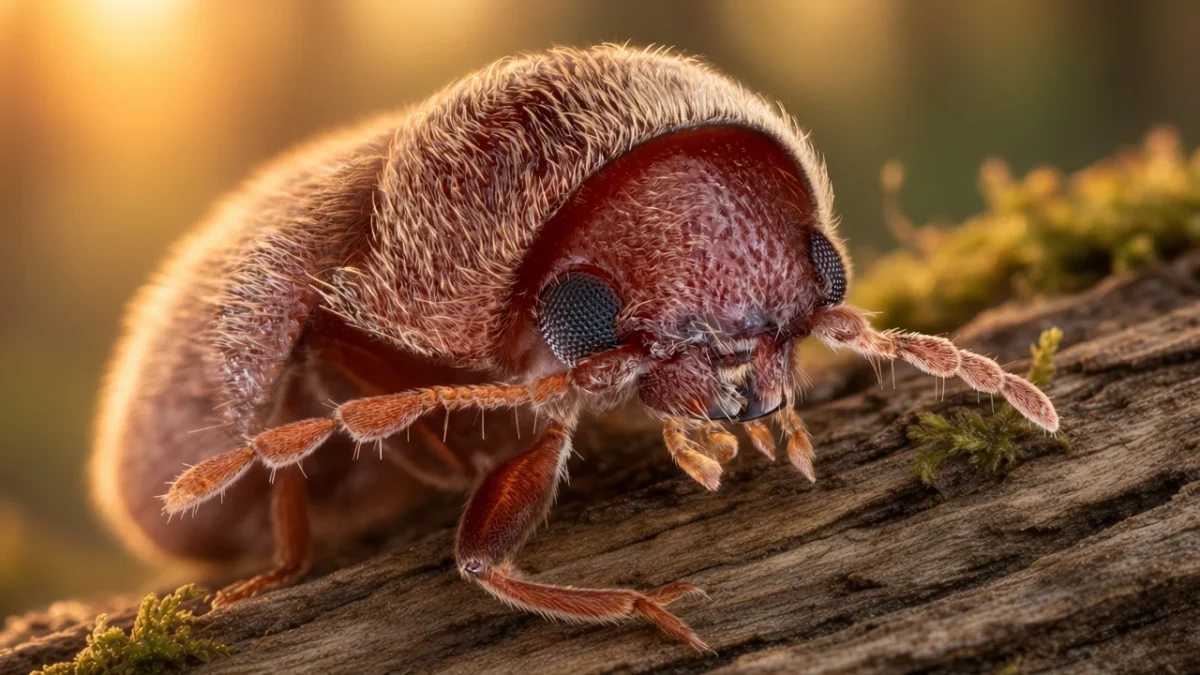
Measuring just two to four millimeters long, the drugstore beetle is one of the most stubborn pantry pests capable of invading dry goods, chewing through sealed cardboard, and multiplying unnoticed year-round. If you toss contaminated groceries straight into your kitchen trash can, surviving larvae and eggs will simply crawl back out and launch a fresh infestation.
Stopping this tiny insect requires destroying it at the source before you throw anything away. The only two verified ways to neutralize them in infested food supplies are sustained sub-zero freezing at 0°F (-18°C) for several days or exposure to boiling water.
Originally hailing from the arid regions of Africa, Stegobium paniceum—commonly known as the bread beetle or drugstore beetle—thrives on warm temperatures. While summer window breezes let them slip inside easily, standard heated living spaces kept around 77°F (25°C) allow them to reproduce indoors during winter without missing a beat.
Why Standard Food Packaging Fails Against Drugstore Beetles
Drugstore beetles frequently sneak into kitchens undetected inside pre-packaged dry items bought at local stores. Adult females lay roughly 100 eggs either singly or clustered directly across dry food surfaces, producing several overlapping generations every year.
When the eggs hatch, the emerging larvae cause severe damage. Surprisingly, the larvae stretch up to five millimeters long—making them noticeably larger and far more mobile than the fully grown beetles.
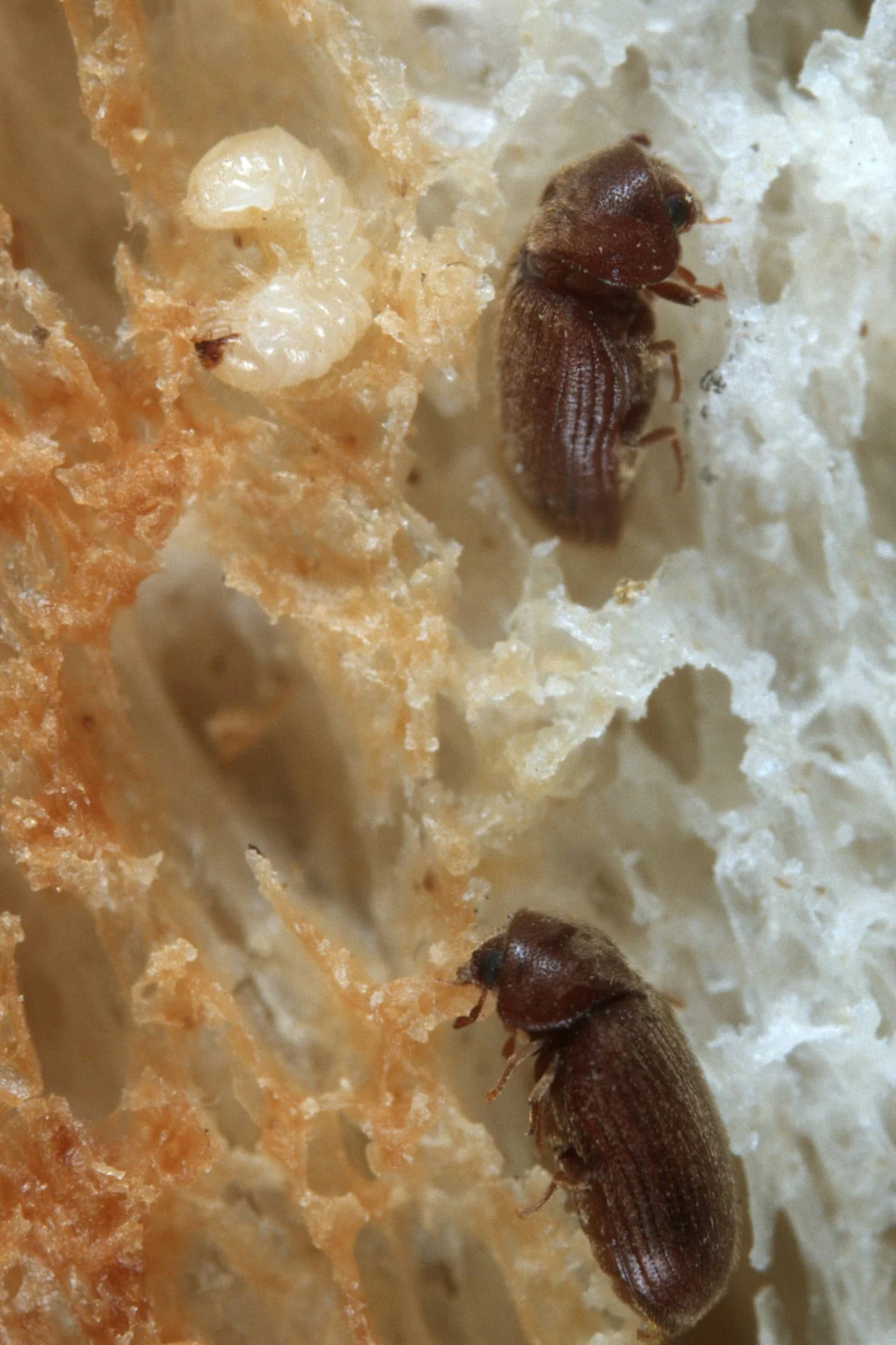
Drugstore beetle and larva inside white bread.
These agile larvae easily navigate hairline cracks and package folds. They routinely chew directly through paper packaging, cardboard boxes, plastic wrappers, and heat-sealed container seams to reach food.
Their destructive diet covers virtually anything dry containing carbohydrates. Beyond bread, grain products, and flour, larvae readily devour spices—including hot chili powder and paprika—as well as chocolate, coffee beans, tea leaves, bouillon cubes, dry pet kibble, fish meal, and even wallpaper paste.
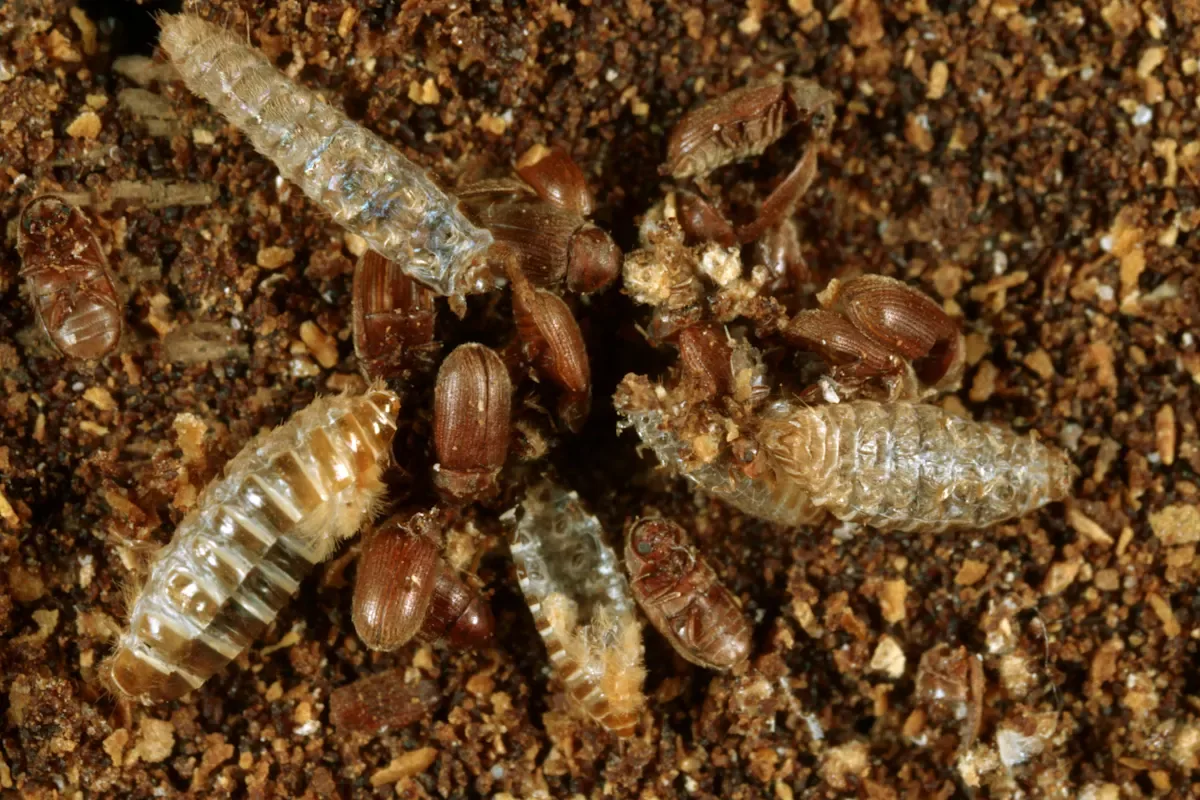
Larval skins and dead beetles on paprika powder.
Along with physical destruction, the feeding larvae contaminate everything they touch with fine webbing, shed skins, frass, and insect feces.
A common misstep is assuming thin plastic storage tubs can lock these insects out; hungry larvae easily penetrate weak seams and unsealed lids.
From Pupation to Flight: The Lifecycle Breakdown
After feeding voraciously for two to three months, larvae seek firm, dense substrates to build pupal chambers. They drill deep into materials like drywall, particle board, dense styrofoam, or hard solid food blocks.
Following roughly two weeks inside the pupal stage, fully formed beetles emerge from tiny exit holes. Adult beetles do not eat at all; their sole mission is flight and rapid reproduction.
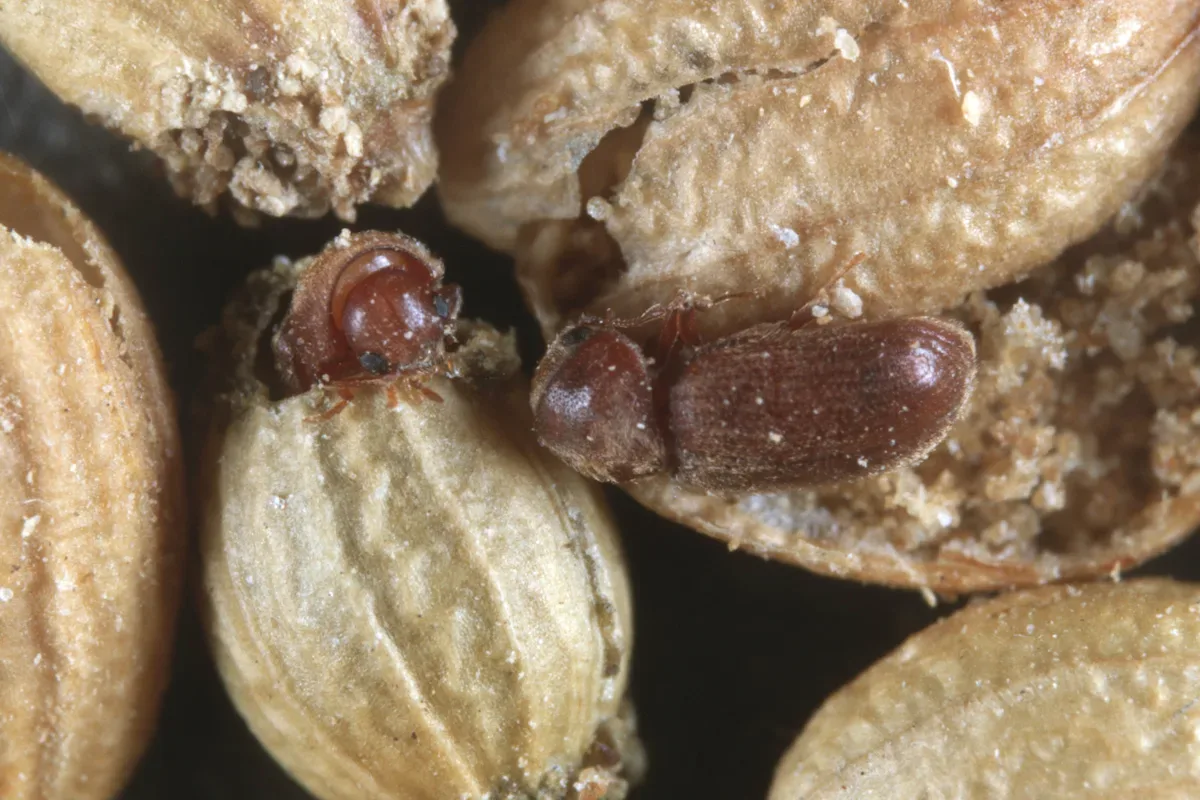
Drugstore beetles deposit eggs among coriander seeds.
Because adult beetles fly proficiently and pursue household light fixtures, they spread rapidly from room to room, migrating into libraries and living spaces where they chew historical book bindings and artwork.
The Two Effective Elimination Methods
Never discard infested pantry boxes straight into an open wastebasket. Surviving insects will simply crawl back out and re-enter your cabinets.
- Deep Freezing: Seal contaminated dry goods in airtight bags and store them in a deep freezer set to 0°F (-18°C) or lower for several consecutive days to eliminate every egg, larva, and pupa.
- Thermal Boiling: For infested solid food products like hard nuts or dried pasta, submerge them in boiling water for several minutes to kill all active organisms instantly before disposal.
For wandering adult beetles on shelves and walls, vacuuming works immediately. However, you must place the used vacuum bag into your freezer between cleanings to prevent trapped beetles from crawling out the nozzle.
Drugstore Beetle Traits vs. Standard Household Pests
Because the drugstore beetle shares a compact, reddish-brown oval silhouette with wood-boring and carpet beetles, homeowners frequently misidentify the threat without close inspection.
| Pest Characteristic | Drugstore Beetle (*Stegobium paniceum*) Reality |
|---|---|
| Primary Food Source | Any dry carbohydrate, spices, grains, dog biscuits, and book bindings |
| Packaging Penetration | Chews through plastic foil seams, paper, and thin cardboard boxes |
| Adult Feeding Stage | Does not feed as an adult; damage is strictly caused by developing larvae |
| Ideal Growth Temperature | Reproduces rapidly around 77°F (25°C) and thrives indoors year-round |
| Airtight Defense Barrier | Heavy glass jars equipped with rubber gaskets and wire-clamp seals |
Long-term protection requires ditching standard snap-on plastic containers in favor of heavy glass jars with airtight rubber gaskets. In historic libraries and archives where chemical sprays cannot be used on antique books, pest control specialists even deploy tiny parasitoid wasps that target beetle eggs naturally.
💬 Have you ever discovered pantry pests chewing straight through sealed boxes in your kitchen?
✨ Taking swift action with temperature control stops a minor grocery pest from turning into a full-scale household nightmare.
👇 Drop your thoughts in the comments below and share your go-to pantry defense tips!
 1
 2
 3
 4
