
Declared Extinct for Decades After a Deadly Fungal Plague: How the Elusive Mindo Harlequin Toad Quietly Survived in Ecuador’s Cloud Forests

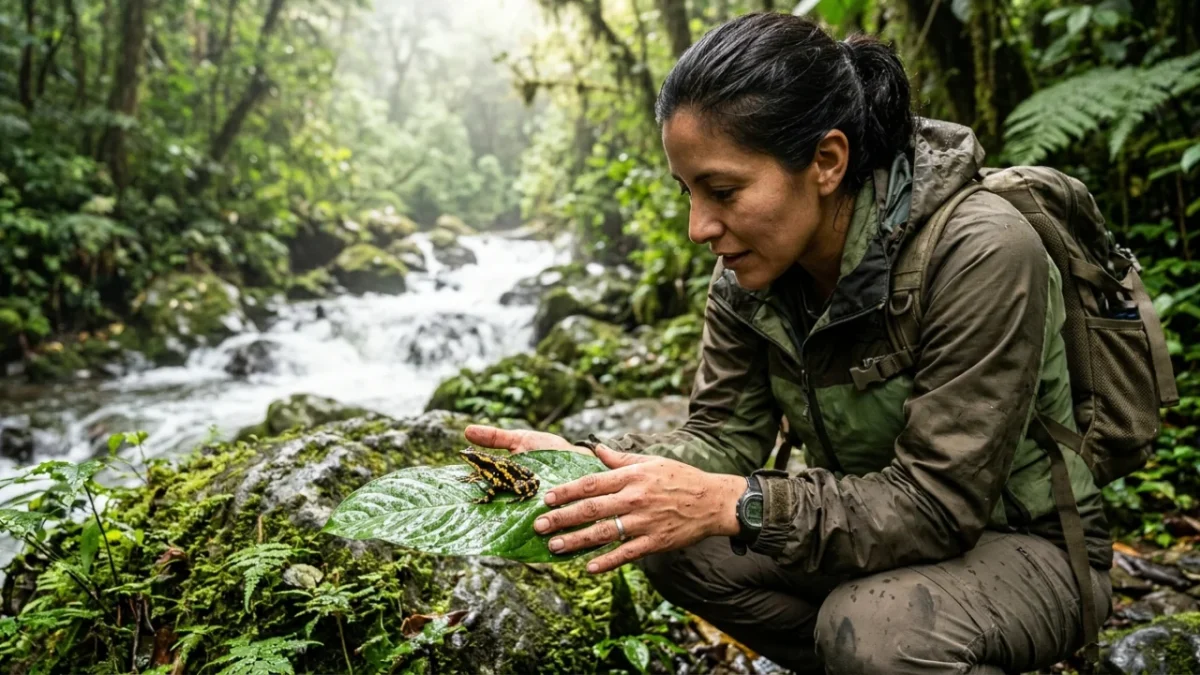
The legendary Mindo Harlequin Toad has defied scientific consensus, surviving in deep Andean cloud valleys despite decades of fear that a catastrophic fungal outbreak had eradicated the entire species. When researchers confirmed living populations clinging to life along remote stream banks in Ecuador, it shattered the assumption that this delicate jewel of the forest was lost forever.
For more than thirty years, biologists systematically surveyed the humid subtropical ridges of Pichincha without catching a single glimpse of the amphibian. The sudden reappearance of Atelopus mindoensis represents a monumental victory for conservation biology, proving that hidden microclimates can provide lifelines against catastrophic global declines.
Yet finding these survivors is only the opening chapter of a much more fragile rescue mission.
The Silent Disappearance: What Drove the Toad to the Brink
During the late 1980s, an aggressive pathogen known as Batrachochytrium dendrobatidis, or the chytrid fungus, swept across the high-elevation ecosystems of Central and South America. The disease attacks keratin in amphibian skin, crippling their ability to breathe and regulate hydration.
The genus Atelopus suffered some of the most devastating mortality rates ever documented in modern zoology. Across the Andes, dozens of vibrant species vanished within single breeding seasons, leaving forest streams strangely quiet.
The disappearance of the Mindo Harlequin Toad followed a grimly predictable pattern:
- Fungal proliferation: Cool, misty cloud forest temperatures created the perfect breeding ground for chytrid spores to saturate forest waterways.
- Habitat degradation: Expanding agriculture, logging, and infrastructure development fragmented the narrow corridors the amphibians required to feed and disperse.
- Microclimate sensitivity: Unlike adaptable generalist species, these toads rely on ultra-specific humidity levels and clean, fast-flowing mountain streams to breed.
By the turn of the century, international red lists formally categorised the toad as critically endangered and possibly extinct, as multiple targeted expeditions returned empty-handed.
The Rediscovery in the Forest Mist
The miraculous breakthrough occurred when field researchers and community monitors explored protected private reserves tucked away in the Chocó-Andean corridor. Hidden beneath dense foliage near torrential mountain cascades, a tiny breeding population was found persisting against every statistical odd.
Herpetologists quickly gathered genetic samples, documenting individual skin patterns and physical health indicators to evaluate whether these survivors carry innate resistance to fungal pathogens.
Decoding the Secrets of Natural Resistance
Laboratory evaluations of swabbed individuals reveal critical clues about how this population survived where so many neighbouring colonies perished.
Field scientists discovered that certain natural skin secretions contain antimicrobial peptides capable of suppressing chytrid growth. Combined with unique behavioural thermal regulation—such as perching on sunlit leaves to raise body temperatures above the pathogen’s thermal tolerance—these toads developed a narrow biochemical defence.
Biologists are now monitoring water chemistry, stream flow rates, and ambient temperatures to determine how microclimates cushion endangered amphibians against wider regional threats.
What This Stunning Survival Means for Global Conservation
Finding living toads proves that pockets of untouched habitat can act as natural arks during mass mortality events. However, conservation authorities emphasize that rediscovery does not equal recovery.
Field teams face several acute hurdles as they work to stabilise the remaining population:
- Zero margin for error: Because the confirmed population numbers remain exceptionally small, a single landslide, pollution spill, or severe drought could wipe out the entire lineage.
- Captive breeding initiatives: Establishing ex-situ colonies in biosecure research centres provides a critical safeguard against catastrophic field collapses.
- Reserve corridor expansion: Securing protected land buffers around native streams prevents agricultural run-off from contaminating fragile tadpole nurseries.
The rediscovery demonstrates that field surveys in remote mountainous regions must remain relentless. Species written off as casualties of the past may still be holding ground in the shadows, waiting for human intervention to safeguard their remaining territory.
💡 Long-term survival hinges on strict environmental enforcement and continuous habitat protection across remaining forest reserves.
🔍 Every rediscovered species offers irreplaceable scientific insights into disease resistance, evolutionary adaptation, and ecosystem resilience.
👇 What do you think is the most effective way to protect fragile mountain ecosystems from future disease outbreaks? Share your thoughts in the comments below.
 1
 2
 3
 4