
Hunter’s Moon Reaches Peak Illumination Across the US: Why Tonight’s Vivid Autumn Sky May Trigger High Tide Warnings and Viewing Disruptions

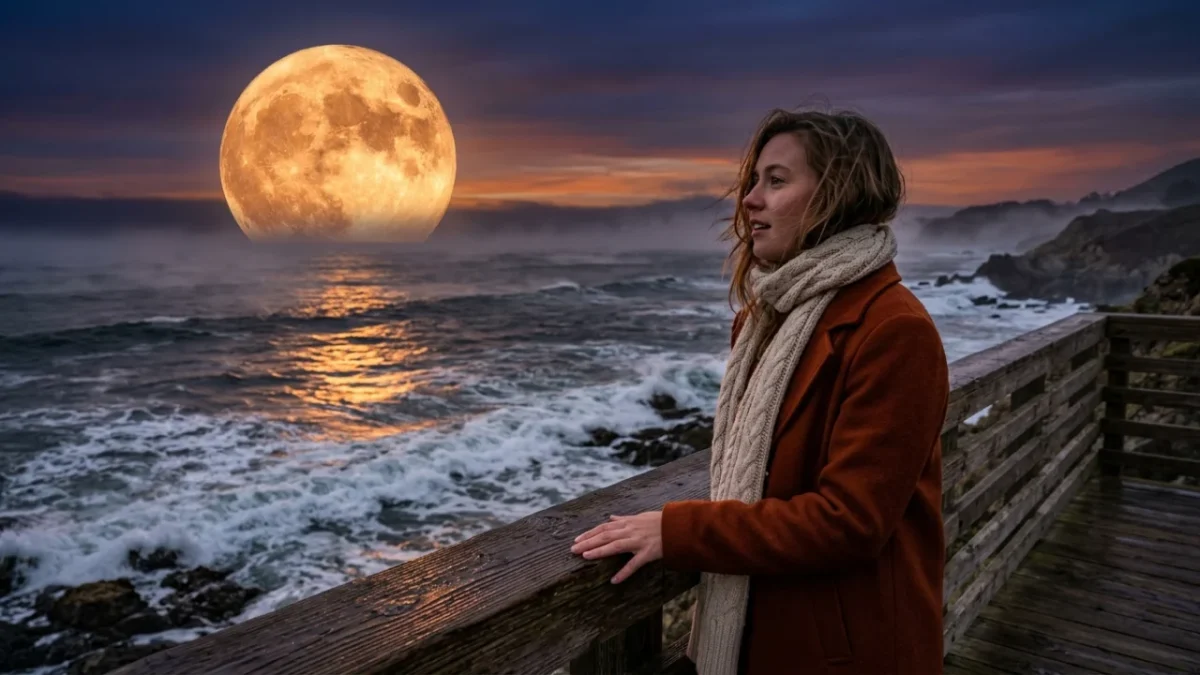
The October full Hunter’s Moon has reached peak illumination at 12:12 AM EDT across the United States, casting a striking orange-yellow glow through the atmosphere while driving significant astronomical high tides along vulnerable coastal regions. While night skies in several areas showcase a remarkably vivid spectacle, approaching weather systems and marine layers are threatening viewing conditions for thousands of skywatchers.
This celestial showcase marks the official transition deeper into late autumn, arriving directly after September’s Harvest Moon.
For observers stepping outside across the country, no specialised equipment or optical lenses are needed to witness the phenomenon. The vivid amber display occurs naturally as lunar light filters through thick atmospheric layers near the horizon, dispersing shorter blue wavelengths and leaving rich warm tones visible to the naked eye.
The Science and Folklore Behind the Autumn Glow
The name of this particular lunation carries deep seasonal roots. According to historical records preserved by the Old Farmer’s Almanac, bare fields following the harvest season historically allowed hunters to spot migrating wildlife with greater ease under late-autumn skies.
Because the moon rises shortly after sunset for several evenings in succession, it provided extended light during prime evening hours before the arrival of winter conditions.
When the full Hunter’s Moon sits low along the eastern horizon, an optical scattering effect intensifies its appearance, creating a bold disc that appears significantly larger and richer in colour than an ordinary overhead moon.
Skywatching Conditions and Rising Coastal Hazards
While clear conditions prevail across many central and interior states, localized atmospheric disturbances are challenging skywatchers along western shores. An incoming weather system and a dense marine layer have begun sweeping thick high cloud cover across coastal valleys, partially obscuring the lunar disc during peak night hours.
The astronomical alignment brings more than just visual drama to coastal areas. When the moon reaches full phase, gravitational forces align to produce astronomical spring tides, creating measurable effects along shoreline communities:
- Astronomical High Tides: Gravitational pull intensifies tidal ranges, elevating morning high-water lines across bays and surrounding low-lying areas.
- Coastal Flood Advisories: Minor flooding concerns emerge in bayshores where elevated ocean waters combine with seasonal tidal fluctuations.
- Persistent Temperature Drops: Accompanying air masses are dragging overnight temperatures down into the 40s across multiple inland valleys, signalling an unseasonably cool spell.
Key Factors Influencing Viewing Quality
Catching an uninterrupted view of the Hunter’s Moon depends heavily on local atmospheric stability. High-altitude moisture and developing sea fog can swiftly diffuse moonlight, transforming what should be a sharp golden orb into a diffuse, milky glare.
Meteorologists tracking regional conditions note that while central viewing locations benefit from brisk, clear air, regions directly along coastal perimeters may experience only brief windows of clarity between encroaching cloud banks.
For those outside facing clear skies, looking towards the eastern horizon shortly after sunset yields the most dramatic perspective, capturing the warm chromatic distortion before the moon ascends into deeper navy skies.
💡 Finding an unobstructed horizon away from intense urban light pollution will substantially improve the clarity of the lunar disc throughout the night.
🔍 As cooler seasonal air masses settle in, shifting weather patterns will continue to reshape outdoor conditions heading into the remainder of the week.
👇 Have you spotted the vivid orange glow of the Hunter’s Moon from your neighbourhood? Share what the night sky looks like in your area in the comments below.
 1
 2
 3
 4