
James Webb’s Baffling Early Cosmic Discoveries Have Triggered the Creation of Lumina, a 1.5-Billion-Light-Year Supercomputer Universe Built to Test Reality

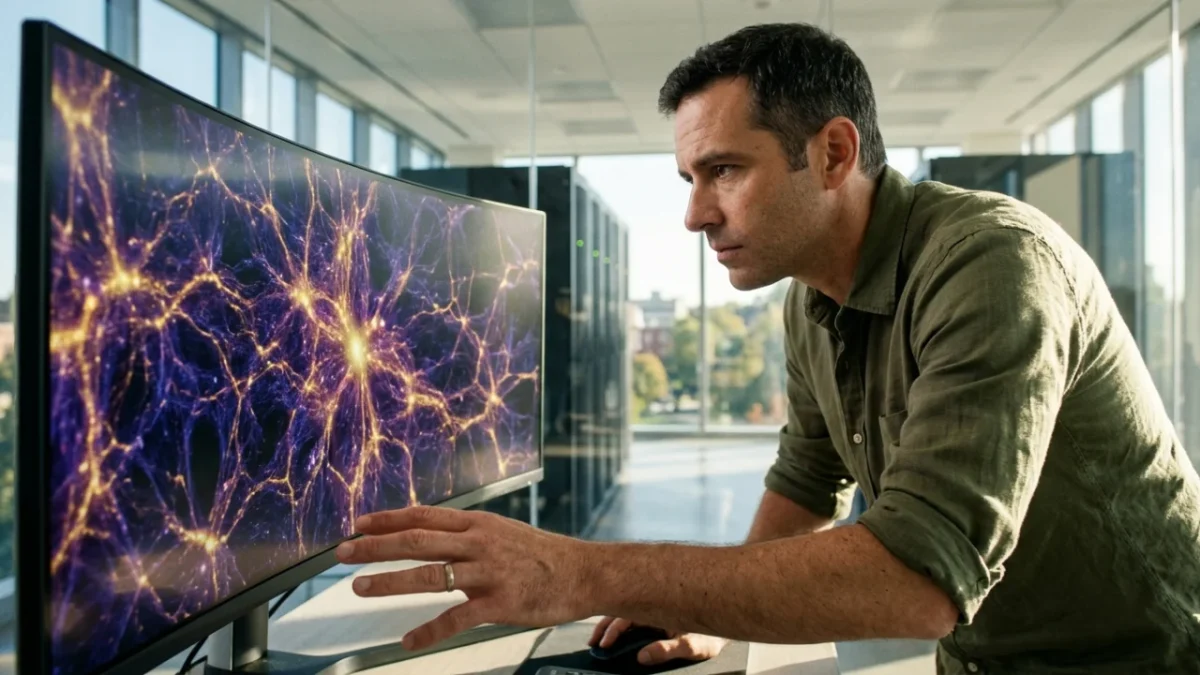
Astrophysicists at the Center for Astrophysics | Harvard & Smithsonian have constructed the largest simulation of the early cosmos ever engineered, pitting 1.5 billion light-years of virtual space against real observations from the James Webb Space Telescope to determine whether modern physics can survive what the observatory is finding. Named Lumina, this computational model reconstructs the universe’s first two billion years across an unprecedented volume to test if existing cosmological theories still hold true.
The observatory has continually challenged established timelines by detecting fully formed, intensely luminous galaxies and massive structures far earlier than traditional astrophysical models predicted.
Now, researchers are using raw supercomputing power to recreate the Big Bang’s aftermath, tracking whether ordinary matter, dark matter, and primordial radiation can naturally assemble into the structures James Webb observes.
The Frontier Supercomputer and the 15,000-Processor Crucible
Generating a universe capable of answering the questions raised by James Webb required unprecedented computational scale. Researchers deployed the Frontier supercomputer at Oak Ridge National Laboratory in Tennessee, harnessing more than 15,000 graphics processing units to calculate the intricate physics governing the infant cosmos.
Lumina encompasses a virtual cube measuring approximately 1.5 billion light-years on each side, representing a volume more than 100 times larger than any comparable radiation-hydrodynamics simulation ever attempted.
Lead author Oliver Zier, an ITC Fellow at the Center for Astrophysics | Harvard & Smithsonian, highlighted the necessity of matching theory with telescopic vision. Zier explained that to truly understand the data arriving from the telescope, theorists must turn mathematical equations into precise predictions that can be visualised and tested directly against real sky surveys.
This immense processing capacity allows scientists to simulate vast, expanding intergalactic gulfs while simultaneously resolving the fine details of individual star-forming nurseries and infant black holes.
Resolving the Deep Cosmic Paradoxes of the James Webb
The core objective of the Lumina project, published in the Monthly Notices of the Royal Astronomical Society, is to establish a rigorous baseline for modern cosmology. When observational data from telescopes aligns with Lumina’s predictions, scientists can be confident that our foundational laws of gravity and matter are sound.
When the virtual universe fails to replicate the physical observations gathered across deep space, researchers are forced to reconsider the fundamental rules of cosmic evolution.
Aaron Smith, an assistant professor of physics at the University of Texas at Dallas and co-author of the study, noted that the model provides a complete view of early cosmic transformations, following ordinary gas as it ignited into the first luminous structures.
Tracking the Epoch of Reionisation
Lumina is the first cosmological simulation capable of capturing helium reionisation in real time while allowing the energetic feedback from that process to alter the surrounding universe inside the model. By tracing the transition of both hydrogen and helium gas from neutral fog into charged plasma, the team can study several critical mechanisms:
- Radiation Hydrodynamics: How intense light emitted by the earliest stars swept across hundreds of millions of light-years to clear opaque primordial hydrogen.
- Gas Transfer Between Galaxies: The physical channels through which raw fuel moved into nascent star systems to trigger intense starburst activity.
- Helium Transformation: The precise secondary epoch when energetic radiation from early galactic nuclei stripped electrons from helium atoms across vast cosmic voids.
- Dark Matter Scaffolding: How unseen gravitational wells channelled ordinary gas into the dense nodes where cosmic monsters first ignited.
Testing the Fundamental Blueprint of the Universe
Data gathered by the James Webb telescope has already identified perplexing cosmic structures, from unexpectedly mature galactic collisions to dense, mysterious objects in the deep field that defy simple classification. Lumina now offers a framework to determine whether those observations represent rare anomalies or an entirely unmapped phase of cosmic physics.
The research team plans to use Lumina alongside incoming data from both James Webb and the upcoming Nancy Grace Roman Space Telescope to examine how radiation from the Big Bang influenced star-forming regions over cosmic history.
By comparing synthetic sky maps produced by Frontier against the infrared images captured in deep space, astronomers can finally establish whether the early universe followed the expected cosmic blueprint, or whether the standard model requires an overhaul.
💡 The boundaries of our cosmological knowledge are moving faster than ever as observational astronomy and supercomputing converge.
🔍 With 15,000 supercomputer processors recreating the dawn of time, every new deep-field exposure has the potential to validate or rewrite fundamental physics.
👇 Do you believe observations from deep space will ultimately confirm our existing physics, or force a complete rewrite of cosmological models? Share your thoughts below.
 1
 2
 3
 4