
In 1933, Amelia Earhart Secretly Rewrote the Rules of Modern Fashion by Creating Functional Aviator Separates to Fund Her Dangerous Ambitions

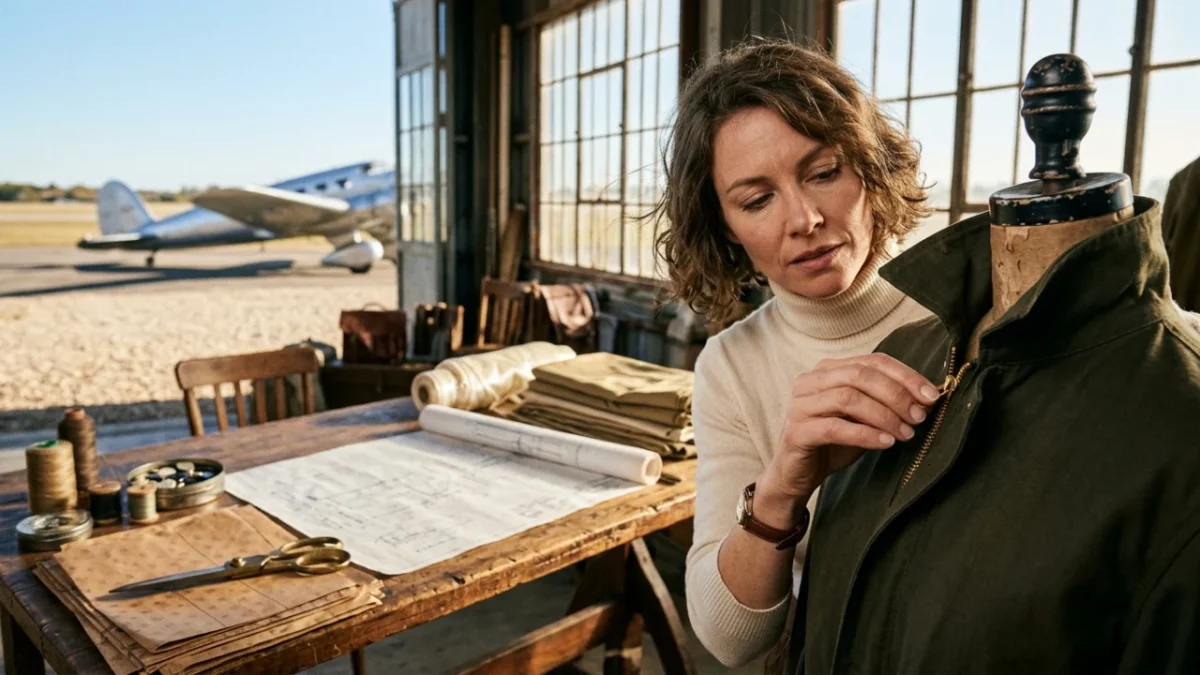
In the autumn of 1933, record-breaking pilot Amelia Earhart walked onto the sales floor of Macy’s in New York City not to discuss transoceanic navigation, but to unveil a revolutionary ready-to-wear clothing line engineered specifically for active women. Long before celebrity endorsements became an industry staple, Earhart recognised that women were trapped in stiff, fragile garments that prohibited natural movement, and she set out to solve that problem with aviation-grade practical tailoring.
Driven by the pressing need to finance her record-setting flights during the depths of the Great Depression, she introduced functional garments that challenged the rigid conventions of the era. The result was Amelia Earhart fashion, a bold commercial venture that brought the aerodynamic, utilitarian principles of the airfield straight to retail clothing racks across the United States.
Her designs offered an audacious counterweight to the prevailing trends of the early 1930s, prioritizing rugged materials, easy care, and unprecedented freedom of movement.
An Aerial Icon Tackles the Tyranny of the Dressing Room
By 1933, Earhart had already achieved international celebrity as the first woman to fly solo across the Atlantic Ocean, yet her private bank accounts told a far more precarious story. Long-distance aviation demanded astronomical funding for fuel, mechanics, and cutting-edge instruments, while corporate sponsorship opportunities remained scarce for female aviators.
Earhart seized on an ingenious dual-purpose solution: design a line of everyday apparel that answered her own frustrations with women’s clothing while generating continuous royalty revenue. Working alongside her husband, publisher George Palmer Putnam, she partnered with the Fashion Merchandisers Bureau to bring industrial functionality to commercial department stores.
The collection premiered simultaneously in thirty premier department stores across thirty American cities, including Marshall Field’s in Chicago and Macy’s in Manhattan. Earhart refused to merely lend her famous name to a generic licensing deal; instead, she personally selected the patterns, oversaw manufacturing specifications, and drafted garment cuts on her own sewing machine at home.
The Engineering Behind the Wardrobe
Earhart approached tailoring as an aeronautical design problem. Rather than constructing decorative dresses that required domestic staff to maintain and delicate laundering to preserve, she insisted that every garment satisfy the practical realities of travel, work, and movement.
She introduced durable materials rarely seen in high-street women’s fashion, turning to sturdy cotton twill, tweed, flannel, and authentic parachute silk. She eliminated fussy buttons that easily snagged, replacing them with industrial metal zips and decorative closures shaped like miniature aeroplane propellers and wing bolts.
Radical Separates for Real Bodies
Earhart’s most disruptive contribution to retail clothing was an innovation modern shoppers now take entirely for granted: the concept of separates. In 1933, off-the-rack women’s clothing was sold exclusively as single, matched sets that forced a woman to purchase identical sizes for both her bust and hips.
Recognising that few human bodies conform to rigid industrial moulds, Earhart insisted that retailers sell her blouses, jackets, trousers, and skirts independently so customers could mix and match sizing for a tailored fit.
- Extended Shirt Tails: Blouses were engineered with unusually long tails to prevent them from slipping out of skirts or trousers when the wearer bent, reached, or climbed into a cockpit.
- Washable Technical Fabrics: Many pieces utilised pre-shrunk, washable materials that could be cleaned at home without expensive, chemical-heavy dry cleaning.
- Functional Deep Pockets: Rejecting purely decorative seams, she built deep, reinforced utility pockets capable of holding maps, notepads, and tools.
- Flat-Felled Seams: Earhart adopted heavy-duty machine seams derived from military flight gear to resist tearing under physical strain.
Through these tactical design choices, Earhart dismantled the outdated assumption that women’s clothing should prioritize passive ornamentation over active agency.
A High-Flying Venture Grounded by the Great Depression
Despite critical acclaim and initial consumer excitement, the clothing line faced brutal economic headwinds. The devastating financial pressures of the Great Depression forced the venture to shutter after roughly a year of active production, as household budgets across the country contracted sharply.
Yet, the structural footprint Earhart left behind outlasted the label itself. By demonstrating that women demanded trousers, durable separates, and functional workwear, she laid the groundwork for the modern sportswear movement that would define American and global fashion in the decades that followed.
💡 Earhart proved that everyday apparel should elevate human capability rather than constrain it, transforming the garment industry from within by treating functional design as an essential human right.
🔍 Today, her vision lives on in every pair of utility trousers, every mix-and-match rack, and every deep pocket built into contemporary ready-to-wear fashion.
📌 Did you realise Amelia Earhart pioneered the concept of mix-and-match separates? How much does functional design influence your everyday wardrobe choices? Share your perspective below.
Prefer this source in Google
What to read next

Aaron Rodgers and Steelers Quarterbacks Spark Massive Social Media Mockery in Paris After Bizarre Peaky Blinders Fashion Blunder
Aaron Rodgers and the Pittsburgh Steelers quarterback room ignited immediate social media ridicule ahead of kickoff at the Stade de France after…

Nearly One Million Egg-Laying Chickens Culled at Massive Commercial Facility as Highly Contagious Avian Influenza Hits Major US Producer
Nearly one million egg-laying chickens have been slaughtered at the second-largest egg-producing farm in the United States after an aggressive wave of…

Brazilian actress Lua Blanco dies at 39 after secret battle with metastatic bowel cancer, family confirms
Brazilian actress and singer Lua Blanco has died at the age of 39 following a rapid, private battle with metastatic bowel cancer,…

Jessica Biel Breaks Silence on 7th Heaven Reboot: Why the New Drama Will Ditch 90s Censorship to Tackle Modern Family Realities Without the Original Stars
Jessica Biel has revealed that the upcoming 7th Heaven reboot will radically break from the squeaky-clean restrictions of the 1990s original, confronting…
 1
 2
 3
 4