
Scientists Finally Cracked Rome’s 1,600-Year-Old Color-Changing Glass Mystery—Using Nanoparticles and Sugar

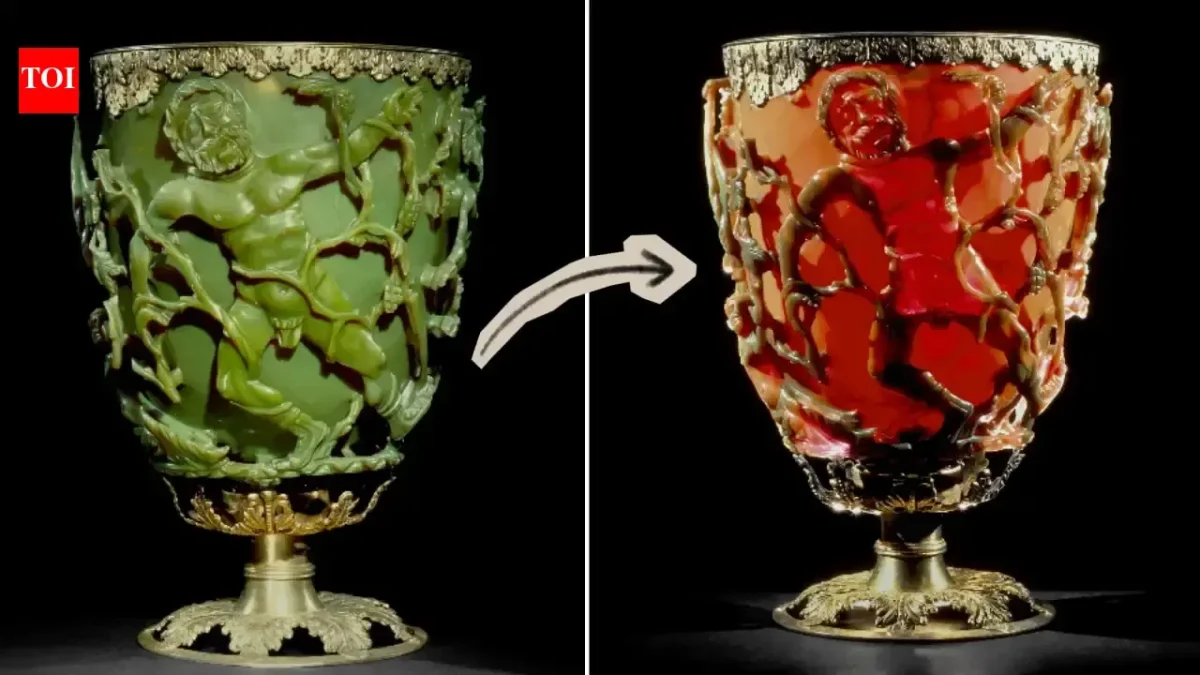
Ancient Roman glassmakers pulled off an advanced optical trick 1,600 years ago that modern science has spent decades trying to reliably copy: crafting a chalice that appears jade green in normal light, but glows ruby red the moment light shines through it. Researchers at the University of Sheffield have now cracked that ancient formula, successfully reproducing the exact color-shifting effect of the fourth-century Lycurgus Cup glass using a repeatable, modern recipe.
The breakthrough unlocks the mechanics behind one of the ancient world’s most sophisticated materials. Led by technician Dr. Lisa Hollands and Roman glass specialist Professor Caroline Jackson, the team engineered a base glass designed to replicate Roman materials, finally pinpointing how ancient artisans suspended microscopic metal particles to bend light.
The secret lies in an intricate branch of physics that the Romans mastered long before the periodic table existed.
How Roman Craftsmen Engineered Ancient Nanotechnology
The original artifact, preserved at the British Museum, is a fourth-century Roman drinking cup with silver-gilt fittings along its rim and base. It stands as the only surviving Roman “cage cup”—an elaborate vessel where craftsmen painstakingly ground away the outer glass to leave figures connected only by tiny bridges—that exhibits this optical behavior.
Scientists classify this material as dichroic glass. The cup’s dual coloration comes from minute traces of gold and silver embedded directly into the glass matrix.
These metals form nanoparticles thousands of times smaller than a single grain of sand. Because these particles are smaller than the wavelengths of visible light, their size and physical geometry dictate how light waves bounce or pass through.
The effect depends on the position of the light source and the way the glass absorbs and scatters different wavelengths of light.
When light reflects off the exterior, the particles scatter short wavelengths, giving the vessel an opaque jade-green finish. When a light source sits behind or inside the vessel, the glass absorbs those wavelengths and transmits rich red light directly to the viewer.
Myth vs. Reality: Did the Romans Use Magic or Chemistry?
A widespread misconception is that ancient glass color variations were simply happy accidents born from dirty foundry crucibles. However, the exact gold-to-silver balance required to produce uniform dichroic scattering proves Roman workshops practiced deliberate chemical control.
Replicating that environment required months of trial and error in the laboratory. Hollands and Jackson tested different furnace styles, varying oxygen levels, and distinct raw compounds to get precious metals to suspend correctly rather than sinking or clumping.
The turning point involved an unexpected culinary ingredient: regular table sugar. Introducing sugar into the molten mix helped adjust the chemical reduction process, coaxing the silver and gold into the exact nanoparticle state needed for the color shift.
Comparing the Optical States of Dichroic Glass
Understanding how the material behaves requires looking at how light direction completely transforms its visual properties:
| Lighting Condition | Visual Appearance |
|---|---|
| Reflected Light (Illuminated from the outside) | Opaque Jade Green |
| Transmitted Light (Illuminated from behind or within) | Luminous Ruby Red |
From Ancient Myth to Modern High-Tech Applications
The original cup depicts a dramatic scene from classical mythology: King Lycurgus of Thrace being ensnared by Ambrosia, a follower of Dionysus who transforms into a strangling grapevine. To showcase the newly revived recipe, researchers commissioned contemporary glass artist Elliot Walker, winner of Netflix’s competition series Blown Away.
Walker merged the historical narrative of Lycurgus with the posture of the classical Farnese Atlas sculpture, utilizing blown glass to maximize how light hits the curved walls. The resulting sculpture is slated for its public debut at the Millennium Gallery during Sheffield’s Festival of the Mind, before heading into the permanent collection at the Turner Museum of Glass.
Yet the true payoff extends far beyond museum galleries and art history circles.
The exact nanoparticle interactions that give the Lycurgus Cup glass its ruby glow are central to next-generation materials science. Researchers are analyzing how light-manipulating glasses can improve the efficiency of solar energy panels, optimize sensors in optical healthcare diagnostics, and refine quantum hardware.
Furthermore, mastering how heavy elements sit within durable vitreous matrices provides critical baseline data for stabilizing and immobilizing radioactive waste for long-term storage.
💬 Ancient craftspeople were manipulating nanoscale metals centuries before modern microscopes were invented.
✨ It turns out Rome’s greatest artistic mystery was a blueprint for modern physics all along.
📱 Drop your thoughts in the comments below: Are you surprised ancient artisans managed nanoscale chemistry without modern equipment?
 1
 2
 3
 4
