
The 1985 Bomb Scare That Accidentally Created Europe’s Largest Fancy Dress Spectacle as Derry Celebrates 40 Years of Chaos

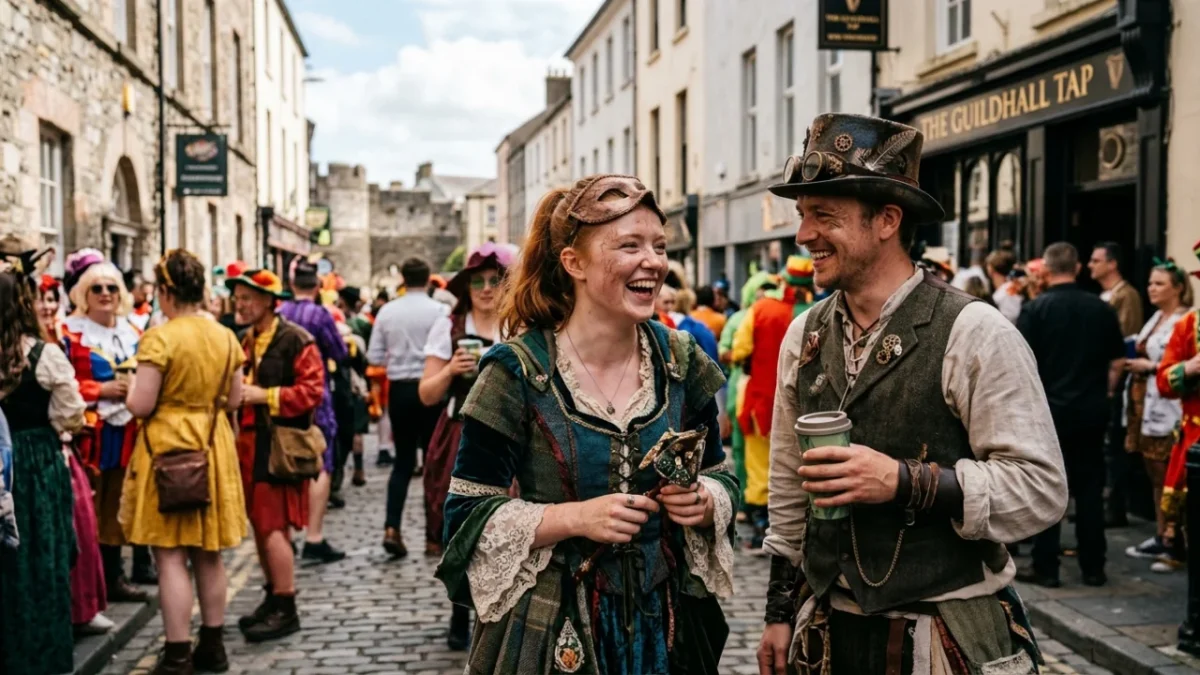
Europe’s largest Halloween street festival, drawing over 100,000 costumed revellers to Northern Ireland, traces its entire 40-year history back to an unexpected 1985 bomb alert that forced an entire pub into the street. What began as an impromptu pub crawl outside Doherty’s Bar has expanded into an internationally celebrated spectacle of fancy dress, outdrawing major American events and reviving ancient Celtic folklore.
American tourists now cross the Atlantic specifically to witness the sheer scale of the gathering. Crowds pack the medieval walled city, squeezing into pubs in elaborate outfits ranging from classic cinema terrors to hyper-local British television parodies.
The four-day extravaganza showcases an appetite for disguise that has overtaken high streets, community halls, and sports venues across the British Isles.
From a 1985 Pub Evacuation to Europe’s Largest Masquerade
The phenomenon was never the result of a corporate marketing campaign. In October 1985, Brian Doherty hosted a small costume party inside Doherty’s Bar on Magazine Street.
When a security alert forced staff and patrons onto the pavement, the costumed gathering refused to disperse. Instead, they took the celebration through the city centre, effectively staging the city’s first unscripted street parade.
By 1986, neighbouring venues joined the tradition, sparking a rapid movement across the community. The local council stepped in during the 1990s to help manage logistics, allowing the festival to grow into a shared cultural landmark that transcended political divisions.
The city held an unusual advantage when it came to costume design. At the turn of the 20th century, the area served as a prominent shirt-making centre housing more than 40 textile factories. Generational sewing expertise remained woven into local households, allowing families to stitch bespoke creations rather than relying on off-the-peg synthetic outfits.
The Subversive Humour Behind British and Irish Costumes
Walk through the festivities today and the spectrum of disguises reflects a distinctly satirical sense of humour. Alongside standard sightings of Beetlejuice and Pennywise the clown, revellers construct complex sight gags that celebrate television and everyday urban life.
Cardboard milk floats paying tribute to classic episodes of Father Ted mingle beside groups dressed in the school uniforms of Derry Girls. Further afield across the Irish Sea, the same inventive streak dominates UK celebrations, where fancy dress netball tournaments feature participants competing as Donald Trump or Willy Wonka, while London revellers model themselves on red double-decker buses and city pigeons.
Even small community hubs have harnessed the power of the disguise. Across the border in Ballyshannon, the Abbey Arts Centre used a fancy dress screening of the 1995 film Casper to fundraise for its upcoming community pantomime, proving that disguise remains a cornerstone of local charity and theatre.
The Shift From Hollywood Tropes to Ancient Folk Rituals
While plastic masks and supermarket capes dominate high streets, the Derry festival maintains a direct dialogue with pre-Christian customs. Halloween itself originated in Ireland through Samhain, an ancient Gaelic festival observed for over two millennia to mark the end of harvest and the onset of winter.
Ancient communities believed the boundary separating the living from the dead thinned during this transition. Disguises and carved turnip lanterns were adopted to confuse wandering spirits—practices that emigrants later transported across the Atlantic, where the native pumpkin replaced the root vegetable.
Inside the Guildhall, beneath a monumental illuminated model of the Moon, the Armagh Rhymers embody these ancient roots without modern synthetic fabrics. Performing with accordions, fiddles, and bodhráns, their musicians conceal their faces behind towering wicker and straw masks sculpted into the shapes of horses, bulls, and hares.
- Textile heritage: Decades of industrial shirt-manufacturing left local families with superior tailoring and costume-making craft.
- Communal resilience: The 1985 pub evacuation turned a moment of disruption into an enduring cross-community celebration.
- Folk identity: Modern street parties now sit alongside the 2,000-year-old Gaelic traditions of Samhain and ritual masking.
- Satirical edge: Revellers routinely swap commercial horror masks for homemade satirical tributes to local sitcoms and civic icons.
From amateur sports tournaments in Liverpool to packed cinema halls in Donegal, the appetite for creative disguise continues to reshape autumn calendars. What started with needlecraft and an interrupted drink on Magazine Street has transformed into an enduring cultural staple.
💡 Have you spotted an unforgettable costume this season, or crafted your own bespoke design? Share your experiences and favourite costume concepts in the comments below.
🔍 The evolution of communal disguise shows no signs of slowing down, proving that homemade ingenuity consistently outshines off-the-shelf trends.
👇 Join the discussion below and tell us which classic British or Irish characters deserve a spot on the streets this autumn.
 1
 2
 3
 4