
The Taurids Are Awakening: Ancient Comet Debris Hurtling at 65,000 MPH Is Set to Ignite Autumn Skies Beside the Ominous ‘Demon Star’

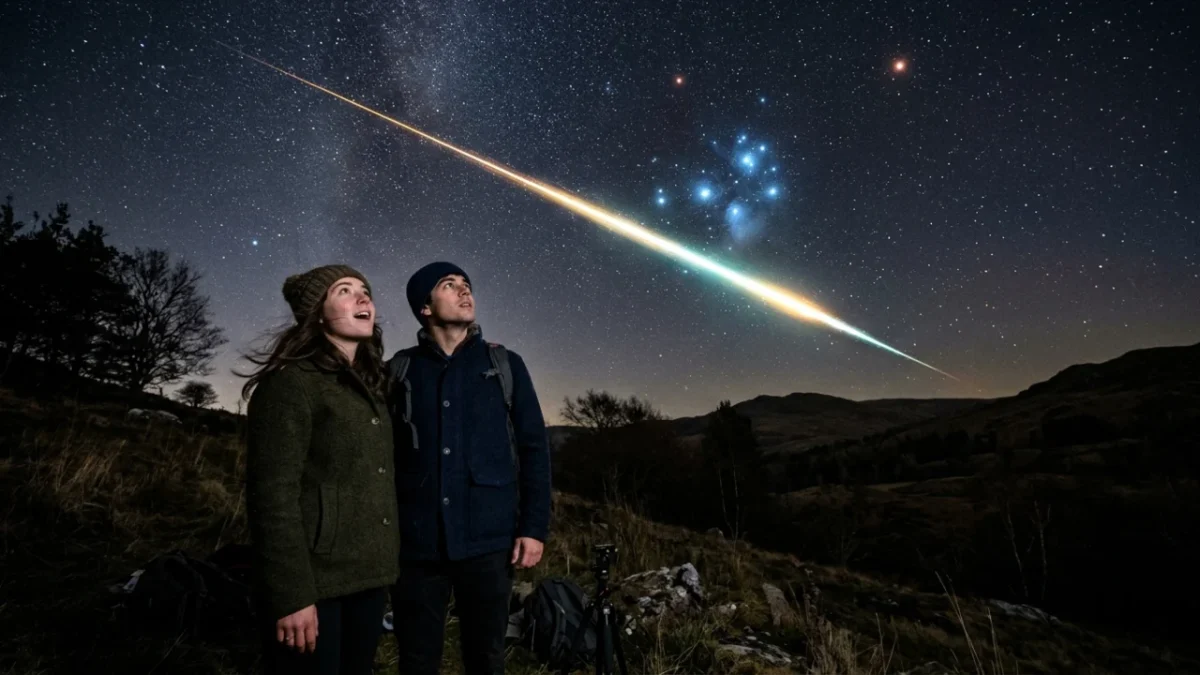
A sparse stream of ancient debris from Comet Encke is colliding with Earth’s atmosphere at over 65,000 miles per hour, initiating the opening phase of the annual Taurid meteor shower. While the display begins quietly in the late hours of late October, it marks the arrival of high-velocity cosmic pebble strikes that build directly toward a November peak.
For skywatchers gazing upward after midnight, the celestial show is framed by an eerie backdrop: the rising “Halloween cluster” and a notorious, blinking three-star system long feared as an omen of doom.
The Mechanics of a 65,000 MPH Cosmic Collision
Unlike intense showers that discharge dozens of shooting stars every hour, the Taurids are renowned for precision and velocity rather than pure volume.
Earth’s orbital journey routinely carries the planet through the trail of dust and rock left in the wake of Comet Encke. Although the vast majority of these particles measure no larger than a standard pebble, their extraordinary entry speed creates enough kinetic friction to superheat the surrounding atmospheric gases into brilliant streaks of light.
The meteors appear to originate from the constellation Taurus the Bull, which climbs steadily into view during the late evening hours.
Because the debris field is relatively dispersed, spotting these cosmic fragments requires patience and optimal timing, with peak visual opportunities occurring strictly after midnight once the radiant point ascends high above the horizon.
The Sinister Rise of the ‘Halloween Cluster’
Tracking the Taurids also brings observers face-to-face with one of the most historically ominous formations in the northern hemisphere: the Pleiades star cluster.
Often referred to as the “Seven Little Sisters”, this group of more than 100 young stars sits over 410 light-years away, having formed from a dense cloud of hydrogen gas roughly 100 million years ago. Resembling a miniature dipper, the cluster earns its seasonal moniker—the “Halloween cluster”—by rising early in the north-east and reaching its zenith around the midnight hour.
Throughout antiquity, the midnight culmination of the Pleiades carried severe cultural weight, frequently tied to rituals honouring the deceased.
Early civilisations, including ancient Egyptian observers, maintained that when the cluster attained its highest point in the autumn sky, the threshold between the living and the fallen grew dangerously thin, leaving populations vulnerable to natural upheavals and wartime conflict.
The Hero and the Blinking Eye of Medusa
Directly above and to the left of the Pleiades looms the constellation Perseus the Hero, immortalised in classical mythology for slaying the gorgon Medusa.
While Perseus was celebrated for wielding Athena’s reflective shield and Mercury’s winged sandals, the celestial stickman carries a terrifying trophy across the northern sky: Medusa’s severed head, marked by the distinctive variable star Algol.
The Astronomical Reality of the ‘Demon Star’
Algol earned the historical title of the “Demon Star” because ancient astronomers noticed something deeply unnatural about its behaviour: the star visibly blinks.
- The Eclipse Cycle: Rather than emitting a steady glow, Algol undergoes a dramatic dimming sequence roughly every three days.
- Nine Hours of Darkness: The system remains noticeably subdued for approximately nine hours before restoring itself to full brightness.
- A Three-Star Dance: Modern astrophysics confirms Algol is actually an eclipsing binary variable system containing three stars, where two massive bodies eclipse one another along Earth’s line of sight.
This periodic celestial eclipse created centuries of superstition, cementing Algol’s reputation as a baleful, watchful eye staring down from the heavens.
Maximising Your Midnight Vantage Point
Catching swift fragments of Comet Encke while navigating the surrounding mythological constellations requires deliberate preparation.
- Target the Post-Midnight Window: Activity ramps up significantly after 12:00 AM local time, when Taurus climbs away from ground-level obstructions.
- Allow for Dark Adaptation: Step away from domestic artificial lights and mobile phone screens for at least 20 minutes to allow peripheral night vision to develop.
- Ditch Optical Equipment: Telescopes and binoculars restrict visual range; scanning the open expanse between Taurus, Perseus, and the Pleiades with the naked eye yields the highest probability of catching sudden fireballs.
As the late autumn sky darkens and temperatures drop, this atmospheric collision will only intensify toward early November.
💡 Have you spotted the early Taurid meteors or tracked the dimming cycle of the Demon Star from your area? Share your skywatching observations below.
🔍 Keep looking toward the north-eastern horizon as midnight approaches, and verify your local viewing conditions before stepping out into the cold.
👇 Join the discussion and let us know what celestial spectacles you have managed to photograph this season.
 1
 2
 3
 4