
The October Supermoon Just Reached Peak Illumination Over the Skies: Why Tonight’s Haunting Orange Glow Will Not Return on Halloween

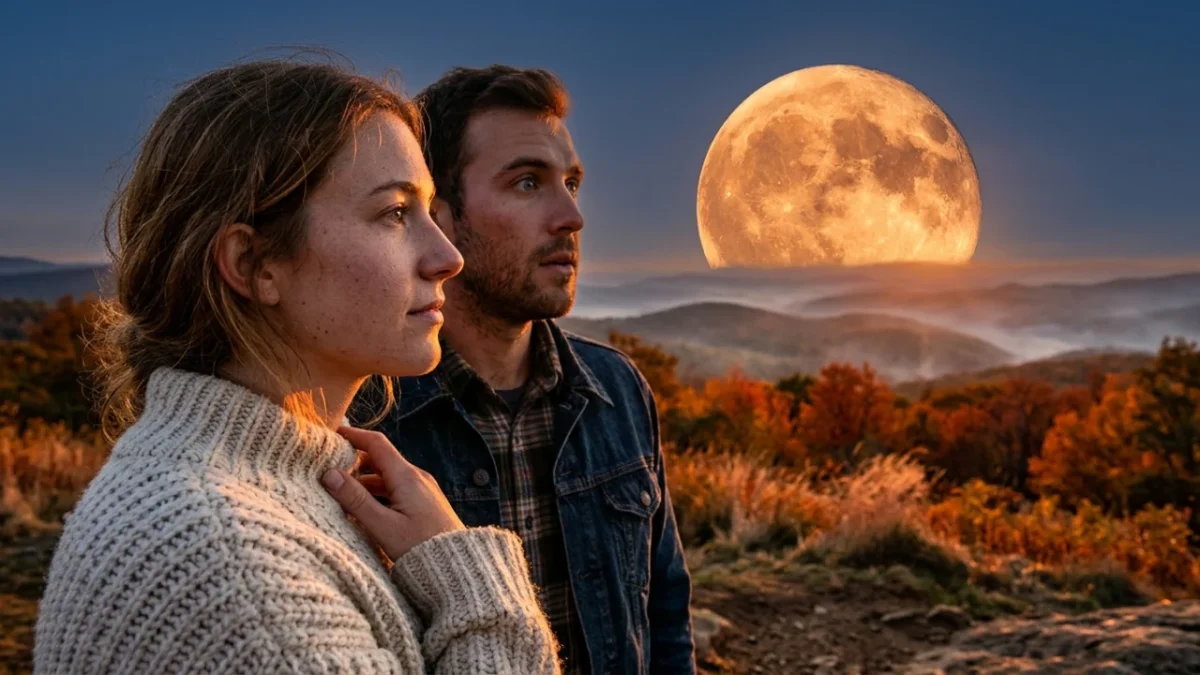
The luminous supermoon known as the Hunter’s Moon has officially crossed its exact moment of astronomical peak, treating skywatchers across the country to a colossal, amber-tinted spectacle in the night sky. While the orb appeared at its absolute fullest at precisely 12:12 a.m. Eastern Daylight Time, spectators stepping outside tonight will still witness a visual masterclass as the moon hovers low on the horizon, radiating an unmistakable pumpkin glow just days before Halloween.
Anyone expecting an authentic full moon on Halloween night itself will face disappointment, as NASA calculations confirm the lunar face will diminish to a 68 percent waning gibbous by October 31. The atmospheric physics driving the eerie copper colouration alongside the strict nineteen-year orbital cycle explain why this display remains your sharpest view of the season.
The Physics Behind the Haunting Amber Silhouette
The breathtaking orange hue that defines the October horizon does not stem from changes on the lunar surface, but rather from the thick blanket of the Earth’s atmosphere. When the moon sits low along the skyline during dusk, its reflected light must travel through an extensive volume of atmospheric particles, scattering shorter blue wavelengths and permitting deeper reds and oranges to reach human eyes.
Historical folklore mirrors these visual mechanics, endowing the seasonal phenomenon with enduring cultural significance. According to archival records preserved by NASA, agricultural communities depended upon this vivid glow to gather winter supplies once autumn fields were cleared of harvest debris.
Across various cultural traditions, observers have attributed multiple titles to this display, often documented by AccuWeather as:
- The Sanguine Moon: Representing the seasonal preparation and game tracking vital for colder months.
- The Dying Grass Moon: Signalling the frostbitten transition of autumn foliage before deep winter sets in.
- The Travel Moon: Honed by nomadic traditions monitoring clear nocturnal conditions for movement.
- The Waking Moon: Derived from historic seasonal patterns tracking shifting animal activity.
The 19-Year Rarity: Why Halloween Night Stays Dark
Popular folklore persistently links Halloween with towering, brilliant full moons, yet astronomical reality paints a vastly different timeline. The last instance of an illuminated lunar disk aligning with trick-or-treating occurred during 2020, and the celestial geometry required for that alignment happens only once every 19 years.
A lunar cycle spans roughly 29.5 days, ensuring the date of maximal illumination shifts backward against our calendar every autumn. Consequently, the next legitimate Halloween full moon will not arrive until 31 October 2039, an occasion that will concurrently rank as a rare blue moon because it represents the second full moon within that singular calendar month.
Future Halloween Full Moon Occurrences
Between our current era and the year 2100, astronomical records confirm only four calendar cycles will witness a genuine Halloween full moon:
- October 31, 2039: Ending a nineteen-year drought with an elusive double-moon occurrence.
- October 31, 2058: The subsequent scheduled alignment across western night skies.
- October 31, 2077: The penultimate alignment of the present century.
- October 31, 2096: The final nineteenth-century cycle repetition before the twenty-second century.
Observers will experience an approximate preview in 2031, when a full moon arrives on October 30, casting substantial ambient light during festive celebrations the subsequent evening despite technically waning.
How to Optimise Tonight’s Skywatching Conditions
Viewing this celestial giant does not demand high-end optical machinery, though basic preparations dramatically elevate the experience. Because the moon remains visually full to the naked eye for hours around its technical zenith, step outdoors during twilight hours as the disk rises over eastern landmarks to maximise the famous “moon illusion,” where foreground structures make the orb appear unnaturally massive.
To capture optimum surface texture and contrast, observers should minimise artificial light interference. Stepping into open parks, rooftop decks, or rural outskirts permits natural night adaptation, allowing craters, dark basalt plains, and ray patterns to emerge in crisp relief.
- Allow Visual Dark Adaptation: Stash mobile phones away for at least twenty minutes so ocular rods adapt fully to ambient darkness.
- Deploy Compact Optics: Binoculars sporting modest magnification or beginner spotting scopes with 70mm apertures easily resolve lunar craters along the terminator line.
- Time the Eastern Horizon: The rich copper hue is most pronounced within the first forty minutes following sunset.
The Winter Horizon: What Awaits Skywatchers
If cloud cover disrupts viewing conditions in your area tonight, the astronomical calendar provides further opportunities before the year closes out. Two consecutive supermoon events remain on the horizon, each scheduled to pull the lunar orbit toward exceptionally close perigee approaches.
The upcoming Beaver Moon will attain technical peak on 24 November at 9:53 a.m. Eastern Time, providing dramatic early evening vistas as dusk falls. Closing the calendar year, the winter Cold Moon is projected to peak on 23 December at 8:28 p.m. Eastern Time, crowning the winter solstice period with brilliant, high-altitude illumination.
💡 For tonight, bundle up warmly and step away from illuminated screens to catch the autumn sky’s most striking atmospheric display.
🔍 Finding a clear viewpoint unobstructed by urban skylines offers the richest reward as the amber disc climbs into the darkness.
👇 Did you catch a glimpse of the glowing orange horizon this evening? Share your local viewing conditions and sightings below.
 1
 2
 3
 4