
After a 10-Year Scientific Hunt in Congo’s Canopies, Researchers Confirm the Discovery of a Brand-New Primate: Meet the Likweli

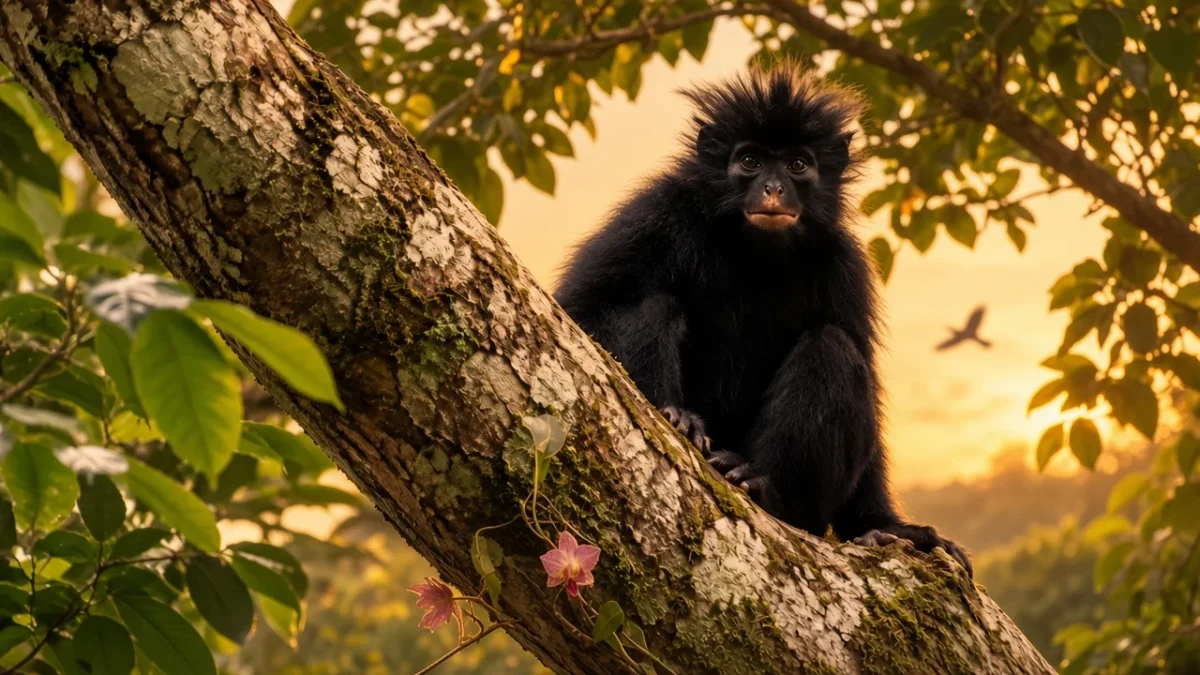
After a decade of rigorous field tracking in the Democratic Republic of Congo, an international team of researchers has officially confirmed the discovery of a new monkey species. Scientifically named Colobus congoensis and known locally as the Likweli, the elusive canopy-dweller was formally unveiled in the scientific journal PLOS One.
Discoveries of this caliber are extraordinarily uncommon in modern primatology. Finding an entirely unrecognized primate population rewrites the biodiversity maps of Central Africa.
“Discovering a primate species is exceptionally rare, especially in populations previously unknown to science,” stated Julia Arenson, a study co-author and postdoctoral researcher in Yale University’s Department of Anthropology.
Why Field Experts Spent 10 Years Verifying the Primate
Confirming that an animal represents an entirely distinct branch on the evolutionary tree takes far more than a single sighting. The Likweli spends its life high in the dense treetops of Lomami National Park, keeping it well out of easy reach.
Between 2018 and 2022, field teams recorded 114 direct observations of the animal. Over those years, scientists painstakingly compiled photographic evidence, cataloged vocalization recordings, and extracted DNA samples to cross-reference against known primate databases.
The turning point for definitive anatomical confirmation arrived in 2021. With official authorization, wildlife authorities confiscated three deceased specimens from local hunters, providing the scientific team with the physical tissue and bone structures required for conclusive laboratory analysis.
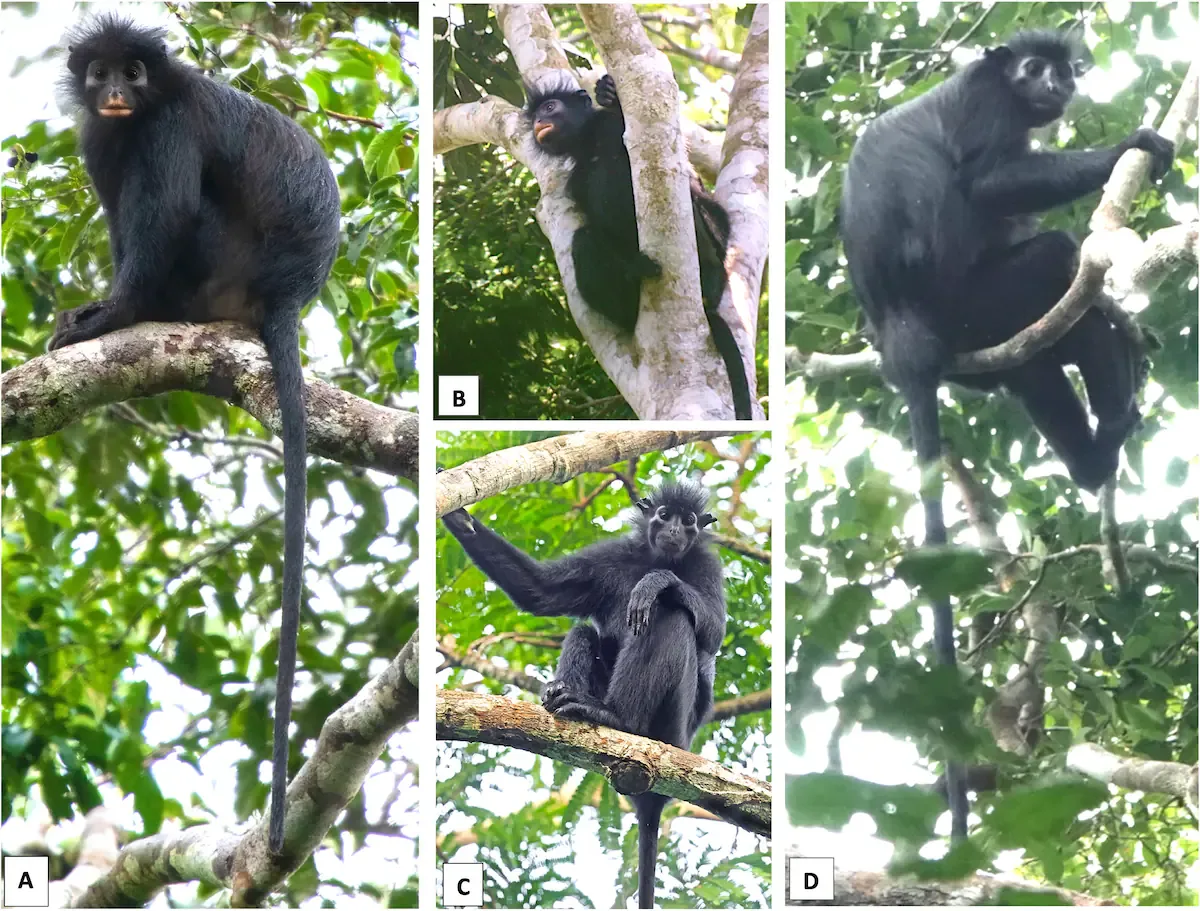
Images A and B show the Likweli monkey, while images C and D show its similar relative Colobus satanas.
What Sets the Likweli Apart From Known Primates?
The Likweli belongs to the colobus family, sporting dense black fur and a long tail. However, several distinct physical markers separate it from related species:
- Compact stature: It displays a noticeably smaller overall body size compared to similar colobus primates.
- Facial coloring: Distinctive orange and cream-colored patterns frame its mouth and nose.
- Under-tail markings: Patches of stark white fur sit visibly beneath the base of its tail.
At first glance, researchers frequently confused the animal with Colobus satanas, another dark-coated relative. Yet genomic analysis shattered the assumption that they were the same animal.
DNA comparisons revealed that the ancestors of both species diverged between 4.7 and 5.8 million years ago. They have been evolving entirely independently for millions of years.
The Village Survey That Exposed Its Extreme Rarity
A widespread assumption in field biology is that indigenous communities always recognize the wildlife sharing their forests. With the Likweli, that was far from the case.
Researchers conducted field interviews across 52 local villages surrounding the park. Only eight communities were able to recognize and identify the primate, confirming just how cryptic and sparsely distributed the animal is in the wild.
| Metric or Trait | Documented Finding |
|---|---|
| Scientific Classification | Colobus congoensis |
| Common Local Name | Likweli |
| Geographic Stronghold | Lomami National Park, DR Congo |
| Systematic Observations | 114 sightings (2018–2022) |
| Evolutionary Divergence | 4.7 to 5.8 million years ago |
| Community Recognition | Identified in only 8 of 52 surveyed villages |
| Proposed Conservation Status | Endangered |
Why Researchers Are Calling for Immediate Protection
Documenting a species for the first time often coincides with a race against extinction. Because the Likweli occupies a restricted range and maintains a low population density, active hunting represents an immediate threat to its survival.
“Our analyses provide strong evidence that this is a new and distinct species, endangered,” stated Eric Sargis, a Yale professor of anthropology and study co-author.
Due to these combined pressures, the research team is urging international conservation authorities to officially list the new monkey species as endangered to safeguard Lomami National Park’s vulnerable canopy ecosystem.
✨ Discoveries like the Likweli prove that Earth’s wildest habitats still hold ancient, undiscovered secrets.
📱 Protecting these isolated pockets of biodiversity remains one of the most pressing challenges facing global wildlife biologists.
💬 Drop your thoughts in the comments below: Did you realize modern science was still finding brand-new primate species?
👇 Share this story with fellow wildlife enthusiasts to spread the word about Central Africa’s newest protected resident.
 1
 2
 3
 4
