
Lab Tests on a 3,000-Year-Old Spanish Gold Hoard Reveal Two Artifacts Were Forged From Extraterrestrial Metal

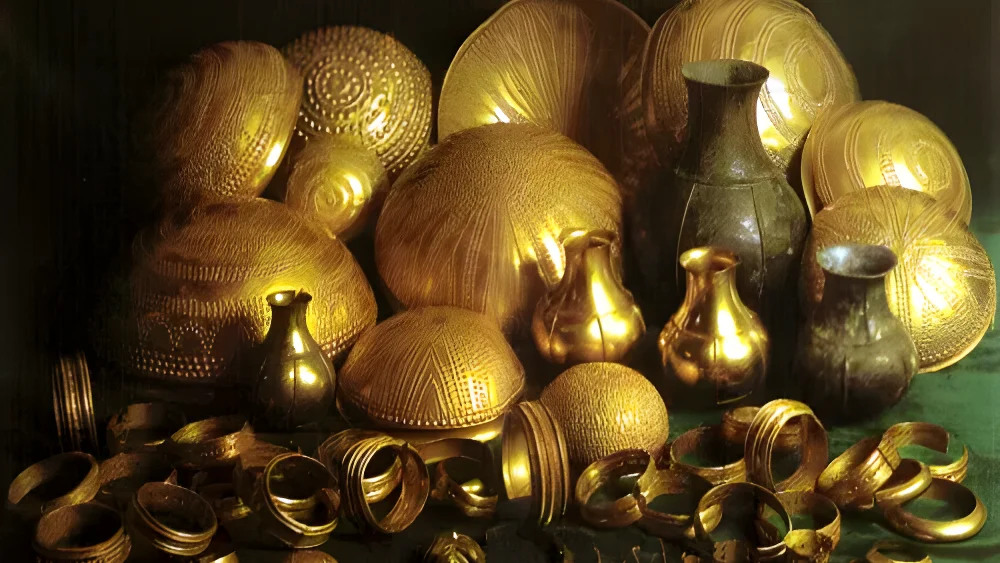
When archaeologists unearthed a 3,000-year-old gold hoard in a Spanish gravel pit in 1963, two corroded metal pieces completely baffled them. Six decades later, high-precision laboratory testing delivered a startling answer: both artifacts were crafted from meteoritic iron that plunged to Earth from deep space.
The discovery reshapes our understanding of ancient European craftsmanship during the Late Bronze Age. Metalworkers shaped this extraterrestrial iron centuries before local populations mastered the art of smelting terrestrial ore.
What Is the Treasure of Villena?
Local archaeologist José María Soler first discovered the collection near the town of Villena in southeastern Spain. Today, the Villena Archaeological Museum protects the assembly, widely celebrated as one of the most significant prehistoric gold hoards across all of Europe.
Official museum records catalog 66 distinct objects within the hoard, while select inventories count 59 items. Delicate sheet gold constitutes the bulk of the finding, accompanied by prized pieces of silver, amber, and iron.
Dating places the creation of these relics between 1400 and 1200 BCE. Among radiant golden bowls and vessels, two dull items stood apart from the moment excavators lifted them from the earth.
The Two Enigmatic Relics
Original excavation logs from 1963 describe the objects as a heavy, leaden metal concealed beneath a cracked oxide shell. Artisans fashioned the pieces into two distinct functional shapes:
- A thick open wrist bracelet designed for personal adornment.
- A hollow hemisphere, originally encased in thin sheet gold, likely designed to cap the pommel of a sword or a ceremonial scepter.
For decades, researchers could not reconcile how iron objects existed inside a Bronze Age hoard without showing standard terrestrial characteristics.
How Chemical Analysis Proved the Metal Came From Space
Salvador Rovira-Llorens, a retired museum conservator, spearheaded a scientific initiative alongside researchers Ignacio Montero Ruiz and Martina Renzi. The analytical team extracted tiny metallurgical samples from both artifacts to undergo rigorous mass spectrometry testing.
Their findings, published in the scientific journal Trabajos de Prehistoria, focused on key chemical markers that differentiate earthly iron ore from meteorites. Terrestrial deposits contain negligible nickel levels, while space rocks feature an unmistakable iron-nickel signature.
“Because meteorites carry far higher nickel concentrations than iron mined on Earth, the presence of a distinct iron-nickel alloy pointed straight to a meteoritic source.”
Spectrometric results confirmed high nickel proportions in both items, identifying them firmly as meteoritic iron artifacts. Because millennia of corrosion altered the exterior metal, scientists plan further non-invasive portable X-ray scans to expand their dataset.
Myth vs. Reality: Iron Value in Prehistoric Europe
A widespread misconception assumes that iron was always regarded as an ordinary, utilitarian metal meant for tools and weapons. During the Late Bronze Age, the reality was entirely the reverse.
| Historical Assumption | Archaeological Reality |
|---|---|
| Iron was a cheap, everyday base metal. | Sky-fallen iron was rarer than gold and treated as an elite luxury material. |
| European smelters extracted the ore locally. | Terrestrial smelting did not yet exist in Western Europe; metal came from space. |
Because terrestrial smelting technology had not yet arrived in Western Europe, native communities worked strictly with bronze, gold, and silver. When workable metallic iron descended from the heavens, ancients viewed it as a divine gift of supreme prestige.
Connections to Ancient Trade Networks
Meteoritic iron artifacts from this exact era remain exceptionally rare across the archaeological record. The most famous comparison sits thousands of miles away: the renowned celestial iron dagger buried with Egyptian Pharaoh King Tutankhamun.
Archaeologists see no evidence that indigenous Iberian metalworkers possessed the complex techniques needed to cold-work meteoritic iron. Instead, evidence indicates these treasures journeyed into Spain across vast maritime and Mediterranean trade routes connecting eastern cultural centers to the West.
✨ The confirmed identification of these objects makes them the oldest known meteoritic iron artifacts ever documented on the Iberian Peninsula.
📱 Advanced spectrometry continues to reveal that ancient civilizations were far more globally connected—and resourceful—than previously understood.
👇 How do you view prehistoric artisans crafting tools from falling meteors? Drop your thoughts in the comments below!
 1
 2
 3
 4
