
The 4.5-Billion-Year-Old Cosmic Jewel Unearthed in the Gobi Desert: How a Massive Stash of Gemstone Meteorite Redefined Solar History

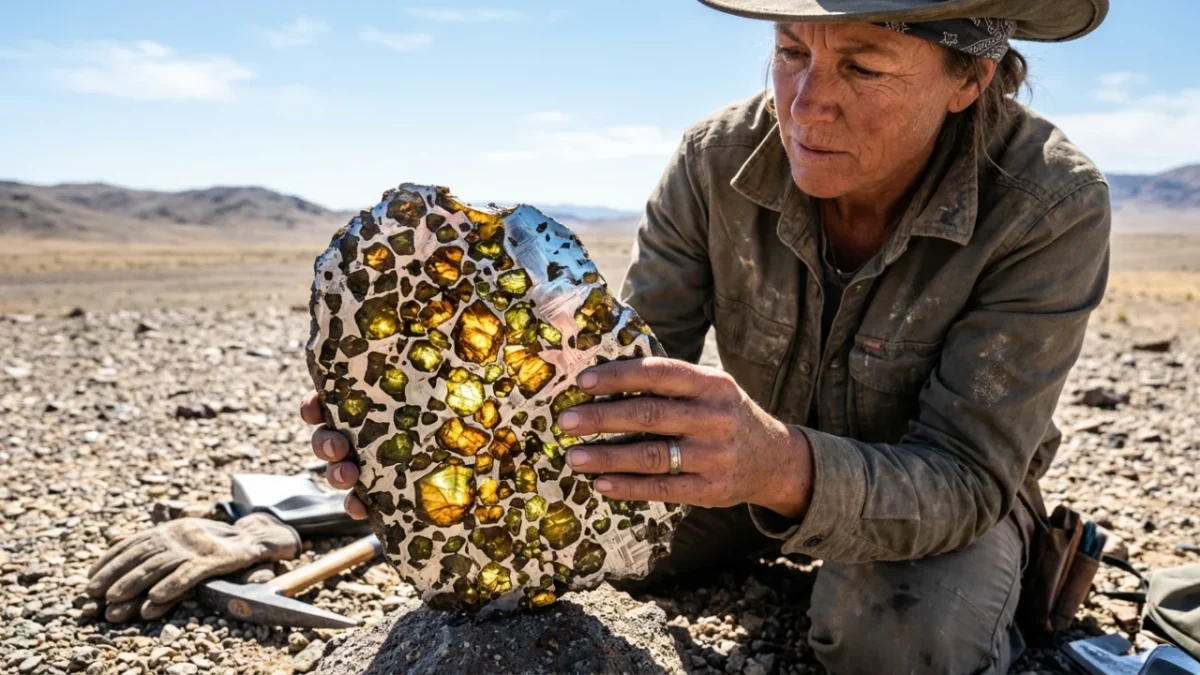
A solitary hiker resting on a colossal boulder in the arid hills of Xinjiang, China, unknowingly stumbled upon one of the rarest geological relics in the known universe: the Fukang pallasite meteorite. When cracked open, the unassuming grey stone revealed an astonishing interior of glowing, honey-coloured olivine crystals suspended in a silvery honeycomb of ancient nickel-iron metal.
Weighing over a tonne, the colossal celestial body originated during the birth of our solar system roughly 4.5 billion years ago. Rather than being ordinary space debris, the specimen represents a preserved sliver of the boundary layer between the molten core and rocky mantle of an ancient proto-planet destroyed in violent deep-space collisions.
The sheer scale and preservation of the find stunned planetary researchers worldwide.
The Chance Encounter Near the Foot of the Bogda Mountains
In 2000, a local explorer happened upon a two-thousand-pound mass protruding from the scrubland near Fukang, a city situated along the northern foothills of the Bogda Range. The rock had served as a convenient resting post for decades before anyone questioned its unusual density and metallic heft.
Curiosity eventually prompted the extraction of a small sample, which was sent across international borders for rigorous geochemical screening. Laboratory assays quickly authenticated the material as an exceptionally pristine pallasite, a classification shared by less than one percent of all recorded meteorites on Earth.
The main mass was subsequently extracted, revealing an extraterrestrial treasure that would permanently alter modern meteoritics.
Anatomy of a Celestial Masterpiece
Pallasites represent a transitional frontier between solid planetary iron and crystalline mantle stone. Under standard earthly circumstances, materials with such drastically different densities separate completely, but the Fukang pallasite meteorite captured that delicate boundary in perpetual suspension.
- Olivine Crystals: Translucent, gem-grade magnesium-iron silicate crystals (often celebrated as peridot) range from pale amber to deep golden olive.
- Nickel-Iron Matrix: An interlaced metallic blend composed of kamacite and taenite that creates structural stability across the entire formation.
- Widmanstätten Patterns: Microscopic structural lines visible upon acid-etching that prove cooling occurred over millions of years inside an insulated protoplanetary core.
When expert preparators slice the Fukang material into thin sections, backlight passes straight through the translucent crystals, creating an appearance reminiscent of cosmic stained glass.
The Violent Origins of Pallasite Formation
Planetary scientists trace the formation of pallasites back to the dawn of our solar nebula. As protoplanets accreted dust and debris, dense metals settled inward toward the gravitational core, while lighter silicates floated toward the exterior mantle.
Cataclysmic impacts between these infant worlds shattered their crusts, allowing liquid iron to inject directly into fractured reservoirs of gemstone crystals before cooling slowly in the vacuum of space.
Each polished cross-section provides direct physical access to an internal planetary zone that human technology cannot reach on Earth.
Global Dispersion and Modern Scientific Value
Due to its breathtaking visual appeal and monumental mass, portions of the Fukang pallasite meteorite have found homes in premier natural history collections and prestigious private research institutions around the globe. Specialists meticulously mapped, catalogued, and divided major sections to safeguard portions for peer-reviewed study while commercial collectors acquired specimen slices.
Specimens of this calibre routinely undergo non-destructive isotopic analysis to establish solar chronology, offering irreplaceable benchmarks for astrophysicists studying stellar formation.
Beyond academic study, the stone remains a benchmark of natural wonder, proving that the vacuum of space harbours structures as visually mesmerising as any terrestrial gemstone.
🔍 The sheer survival of the Fukang specimen across billions of years reminds us how much cosmic history remains buried just beneath the desert soil.
💡 As remote sensing technology advances, researchers anticipate identifying further deep-space impact deposits hidden in plain sight across remote badlands.
👇 Have you ever seen an authentic pallasite slice in person? Share your thoughts and questions in the comments below.
 1
 2
 3
 4