
A 4-Billion-Year-Old Rock Found in the Sahara Just Proved Early Mars Had an Active Water Cycle: Meet Meteorite Teghaza 001

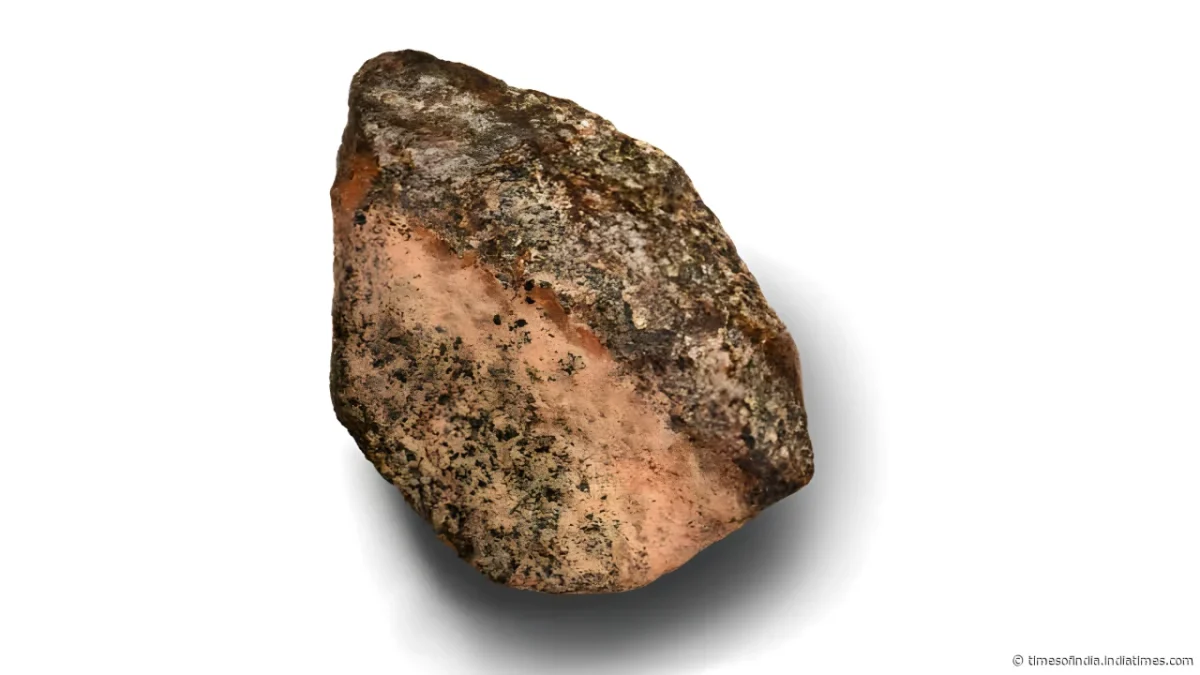
A primitive stone discovered in the vast sands of the Sahara Desert, officially designated as Teghaza 001, is an authentic piece of Mars that dates back more than four billion years. Precise isotopic studies confirm that this ancient space rock originated on the Red Planet, carrying physical proof of an active, intertwined volcanic and water history during the planet’s earliest days.
Rather than describing a planet that was immediately barren and lifeless, the geological fingerprints inside Teghaza 001 reveal that liquid water actively interacted with volcanic rock on early Mars. This discovery delivers critical ground-truth data about the Martian climate system when the solar system was still forming.
The find directly reshapes what scientists understand about the planet’s ancient environment, establishing that liquid water was not an isolated anomaly, but part of a dynamic, interconnected cycle.
Unlocking Mars’ Primordial Climate Through Isotope Science
Researchers verified the extraterrestrial origin of Teghaza 001 through rigorous isotopic analysis. By measuring distinct elemental ratios trapped inside the stone, laboratories matched its chemical signature directly to the Martian crust.
The sheer age of the sample places its formation more than four billion years ago, making it a surviving relic from Mars’ foundational era. While geological activity on Earth consistently recycles ancient crust through plate tectonics, this meteorite preserved the original environmental conditions present during its formation.
Key scientific takeaway: Meteorite samples like Teghaza 001 provide direct, laboratory-grade evidence of Martian surface conditions that orbital instruments can only observe from afar.
The critical revelation lies in the rock’s dual signature: evidence of intense volcanic heat combined with undeniable signs of prolonged water exposure.
A Misconception About the Red Planet’s Ancient History
A persistent public myth suggests that Mars has always been a frozen, bone-dry wasteland devoid of dynamic surface hydrology. The physical record inside Martian meteorite samples tells an entirely different story.
Instead of a static desert world, the internal composition of Teghaza 001 proves that Mars once supported a complex water cycle. Volcanic materials and hydrothermal or surface water systems were actively engaging with each other, altering minerals and leaving permanent chemical markers inside the stone.
| Rock Characteristic | Planetary Insight |
|---|---|
| Origin & Age | Confirmed Martian crust older than 4 billion years |
| Isotopic Signature | Definitive proof of Mars origin verified in laboratory tests |
| Volcanic Composition | Evidence of early planetary magmatic and volcanic activity |
| Aqueous Alteration | Direct evidence of an active, complex Martian water cycle |
Why Teghaza 001 Matters for Planetary Exploration
Understanding early Martian environmental conditions provides the baseline for answering whether the planet ever supported habitable niches. Because Teghaza 001 originated during the planet’s first several hundred million years, it documents the exact window when surface conditions were at their wettest.
Every structural layer identified in this Saharan discovery helps researchers map out how long surface water persisted before the Martian atmosphere thinned and dried out completely.
✨ Discoveries like this prove that the most profound secrets of our solar system are sometimes waiting right on the surface of our own deserts.
📱 As planetary scientists continue analyzing ancient rocks like Teghaza 001, our picture of early Mars keeps shifting toward a dynamic, water-rich world.
💬 What do you think about the evidence of an ancient Martian water cycle? Drop your thoughts in the comments below!
 1
 2
 3
 4
